



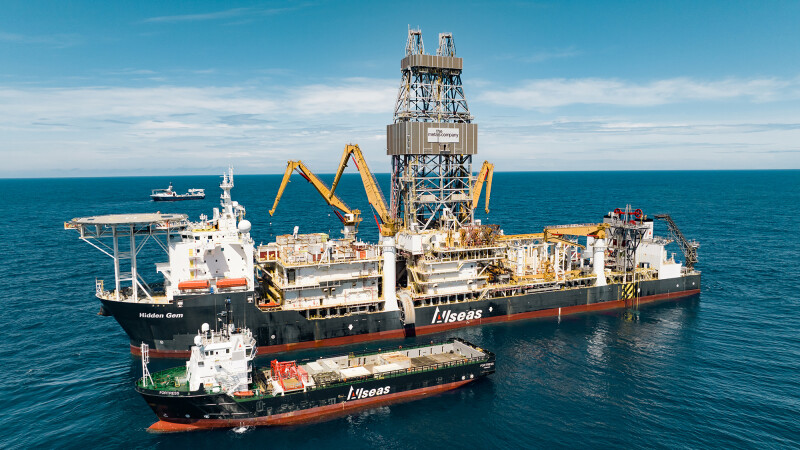
The Metals Company Inc. (TMC), Vancouver, British Columbia, on Monday annoucnced it has signed a commercial agreement with offshore contractor Allseas, Châtel-Saint-Denis, Switzerland, to develop and operate the first commercial polymetallic nodule collection system in the Clarion Clipperton Zone, located between Hawaii and Mexico in the Pacific Ocean.
Under the contract for development work and commercial production, Allseas will complete the procurement, integration, and operation of the collection system, which will carry a nameplate production capacity of 3 million wet tonnes per annum. The system will deploy two tracked collector vehicles operating at depths exceeding four kilometers on the seafloor. Nodules gathered by the vehicles will travel via a riser system to allseas' surface production vessel Hidden Gem, then be transferred to bulk carriers at sea for transport to shore-based processing facilities.
TMC said Allseas will fund a significant portion of development costs, which will be recoverable through production revenues, further aligning both companies around the commercial outcome.
Concept and basic engineering for several critical long-lead components are already complete, including the 4-km riser pipe, launch and recovery systems, and the umbilical connecting the collector vehicles to Hidden Gem. Tender and vendor engagement is set to begin soon, with subcontract awards expected by the end of Q3 2026. TMC anticipates system commissioning will begin in Q4 2027, subject to receipt of required permits and regulatory approvals.
The agreement builds on a strategic alliance agreement the two companies first signed in 2019 and a successful 2022 pilot test in which Allseas lifted 3,000 metric tons of nodules to the surface.
"This agreement with Allseas is now the contractual cornerstone of our strategic alliance with Allseas: it establishes a clear commercial framework for how we complete the development and commissioning of our first commercial-scale nodule recovery system and start offshore nodule recovery operations," said Gerard Barron, chairman and CEO of The Metals Company. "In addition to being our largest strategic shareholder, Allseas has been an outstanding, mission-aligned technical partner. They didn't just prove their system works; they worked closely with us to take every opportunity to further refine the design to minimize the environmental footprint based on the extensive baselining and monitoring of the field test and are willing to help us finance system development costs. Together, we are moving from firsts in deep-sea science and engineering towards first commercial recovery operations."
The system design and production capacity align with the initial phase of TMC's SEC-compliant S-K 1300 Preliminary Feasibility Study for NORI Area D, published in August 2025. TMC, which has been developing the project since its founding in 2011, holds what it describes as the world's largest resource of seafloor polymetallic nodules, which contain nickel, copper, cobalt, and manganese used in energy, defense, manufacturing, and infrastructure applications.
The agreement comes amid an aggressive push by the Trump administration to unlock deep-sea mining as a strategy for securing critical mineral supply chains independent of foreign adversaries, particularly China. In April 2025, President Trump signed the "Unleashing America's Offshore Critical Minerals and Resources" executive order, directing federal agencies to expedite permitting for seabed mining in both U.S. and international waters. In January 2026, NOAA finalized a rule allowing companies to apply simultaneously for exploration licenses and commercial recovery permits, compressing what had been a sequential, multi-step process.
TMC moved quickly under the new framework, with its U.S. subsidiary filing the first-ever consolidated application under the new rules in January 2026, covering roughly 65,000 sq. km in the CCZ. NOAA determined that application to be in full compliance with applicable law on May 1.
Critics, including more than 40 countries and environmental groups, have opposed the U.S. approach as bypassing the United Nations' International Seabed Authority, which has thus far been unable to finalize a global mining code for international waters.
