



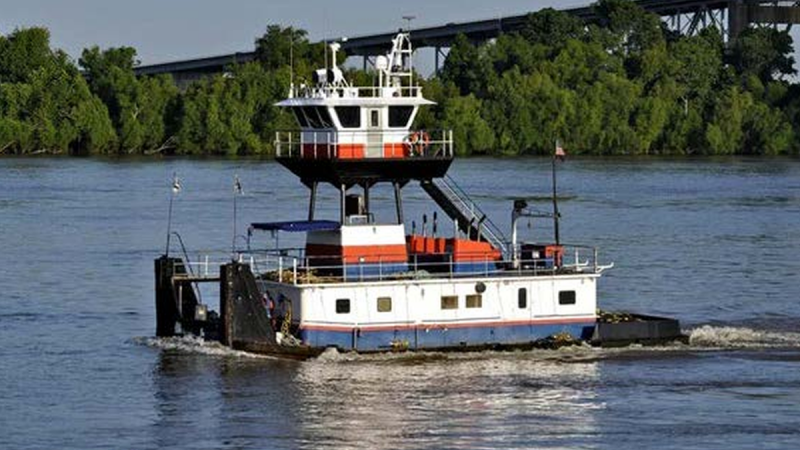
The National Transportation Safety Board (NTSB) has determined that a compromised access hatch and unsealed watertight bulkhead penetrations led to the flooding and sinking of the towing vessel Cajole on the Lower Mississippi River.
On June 12, 2024, at about 3:30 p.m. local time, the Cajole was transiting upriver near Waggaman, La., when the vessel began taking on water. The two crewmembers aboard attempted to dewater the vessel but were unable to control the flooding. They secured the tug to a nearby barge and evacuated with the assistance of a Good Samaritan vessel. No injuries were reported.
The Cajole later sank. NTSB noted a light sheen was observed on the water following the incident. Damage to the vessel was estimated at $2 million.
In its investigation, the NTSB concluded that the probable cause of the casualty was “likely a compromised flush-mounted access hatch, which allowed water to flood into a forward void space, and unsealed penetrations in a transverse bulkhead, which allowed for progressive flooding aft into the engine room.”
The agency said the initial flooding in the forward space was able to spread because penetrations through a watertight bulkhead were not properly sealed, allowing water to migrate into the engine room and overwhelm the vessel’s pumping capabilities.
As part of its findings, the NTSB emphasized the importance of maintaining watertight integrity throughout a vessel. The report highlighted that deficiencies involving bulkheads, decks, and hull plating should be corrected using permanent repairs.
Citing Coast Guard guidance, the report noted that operators should ensure that electrical cables, piping, remote valve actuators, and other components passing through watertight bulkheads and decks are frequently inspected and properly maintained. These penetrations typically rely on specialized sealing systems, such as packing glands or penetration seals, and their condition is critical to preventing progressive flooding, NTSB said.
The NTSB said regular inspection and maintenance of these fittings can help reduce the risk of flooding casualties similar to the loss of the Cajole.
