



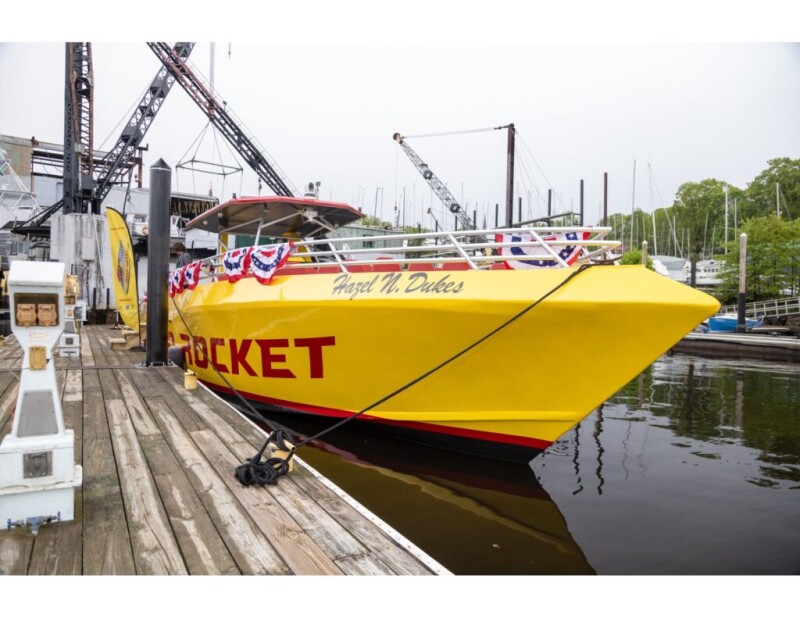
Two New York entrepreneurs are taking a unique approach to helping locals and visitors discover Harlem’s hidden cultural and gastronomic gems by water. Their company purchased a 100-person tour boat and had it retrofitted at Derecktor Shipyards’ facility in Mamaroneck, N.Y. The boat is named the Hazel N. Dukes, and the company operating it is called Harlem Rocket LLC, a subsidiary of Paradise Express Ferry.
Co-founder and CEO Garry Johnson, an architect, has a background in real estate and construction, with more than 30 years’ experience creating affordable housing in urban communities. Johnson attributes his interest in the maritime domain to his stepfather, who served in the Navy.
Johnson’s business partner, Michael Preston, is co-founder and vice president of government affairs and customer experience. He brings a background in entertainment, theater management, and organizing large-scale festivals.
“We saw a natural fit with what we’re looking to do with tourism development on the waterfront and bringing large numbers of people onto the vessel,” said Preston. “Once you bring a waterfront operation to a waterfront area, it improves the value of that waterfront.”
PREPARING THE BOAT
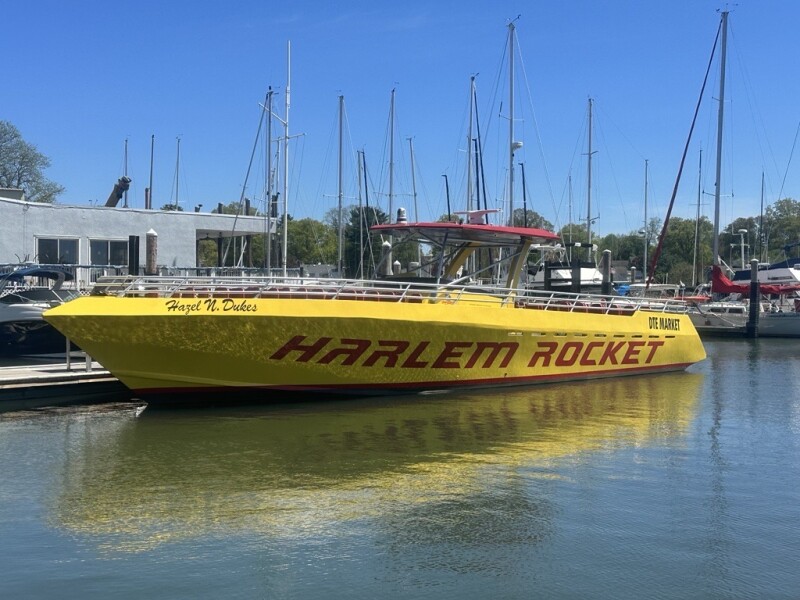
Johnson and Preston found the vessel that would become the Hazel N. Dukes on the hard in Panama City Beach, Fla., where it had worked as a dolphin tour boat. It’s a 57'x16' V-bottom that was designed and built by Yank Marine Inc., Tuckahoe, N.J., constructed as part of a series of large, open tour boats that continue to operate in the U.S. and internationally.
Harlem Rocket commissioned Micah Tucker and his company, Tucker Marine, Bayville, N.Y., to manage the refit. Tucker, a naval architect, had previously spent 10 years running Derecktor’s Bridgeport, Conn., yard.
“She was well-built,” said Tucker. “Cosmetically, the boat was in rough shape, but overall, it was in good shape and a candidate for a refit.”
The boat was built with cold-molded construction that features epoxy resin and fiberglass over wood. While some boats in the Yank series were built with a raised helm, the Hazel N. Dukes’ centrally positioned operating station is basically on the same level as the deck. A new aluminum helm station was added during the refit.
Hazel N. Dukes was designed with a variable deadrise bottom and is propelled by straight-shaft inboards. A pair of rebuilt, naturally aspirated Detroit Diesel 8V92s power the boat to a top speed of about 30 knots, though most tours will be run at slower speeds.
Electronics supplier Raymarine sponsored the refit with a modern electronics suite including a virtual-reality-based navigation system that gives a full heads-up display of the charted course and the vessel’s position on it.
The primary components in the Raymarine suite included Axiom Pro 12 RVX and Axiom Pro 16-S multifunction displays, a Cyclone 4' 55-watt radar, the Evolution EV400 Power Pilot Pack autopilot with a hydraulic drive. Cameras included a Teledyne FLIR M300C marine unit, and the radio is a Ray73 marine VHF with a hailer, spare handset, and loudspeaker/foghorn. All required cabling and hardware were included.
The boat’s rated capacity is 100 passengers, and it’s expected to go into service in early July, operating on the Hudson River out of New York’s West Harlem Piers at W. 125th St.
EXPANDING OPPORTUNITIES
During the refit, Johnson and Preston took neighborhood kids to see the work at various stages. “We put them on the vessel as it was being overhauled, and they couldn’t fathom the size of it,” said Preston. “Then getting up on the boat and seeing the deconstruction and construction, they saw this boat, and now they’re going to see it put back together. They’re excited. The community and the industry are excited in New York because a lot of people have heard about the Harlem Rocket coming to fruition.”
Once Harlem Rocket is open for business, the Hazel N. Dukes will offer two tours that run at multiple times per day. Ticket prices are $40 for adults and $30 for children. An evening cruise will start with complimentary champagne for adults over the age of 21, and tour guides will point out culturally important sites in Harlem’s history.
When the tours end, visitors will be encouraged to patronize local restaurants and retail stores. “This is marketing, hospitality, customer service engagement,” said Preston. “We are looking to have these young people involved in the historic presentation and development of this business.”
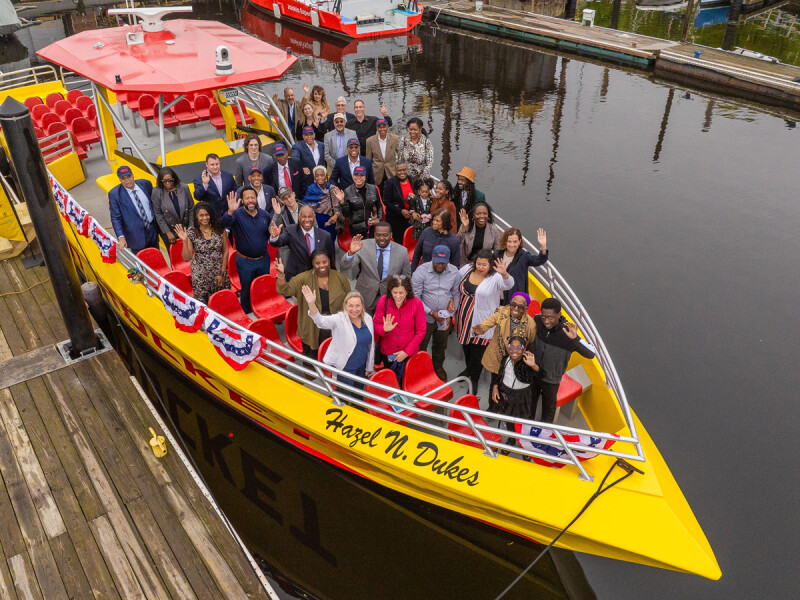
Three years ago, Paradise Express Ferry was designated by New York’s Department of Small Business Services as the city’s first Minority Business Enterprise in the maritime operations field.
Harlem Rocket aims to expose local youth to opportunities in the maritime industry. “People see boats, ships, tugs, and barges go by every day,” said Johnson. “They have no clue that those are viable careers and opportunities.”
Added Preston, “We have a motto: ‘A kid can’t be what a kid can’t see.’”
Harlen Rocket received more than 500 applications for seasonal positions, including both onboard and shore-based jobs. Johnson and Preston hosted four group sessions for 315 candidates, with up to 50 people per session attending presentations about the company and their future plans. After narrowing down the pool, follow-up interviews were conducted via Zoom.
“No [previous] employer had ever given them a presentation about their business and why [it] was important,” said Johnson. “No one had explained to them that we can’t do it without them.”
Some of the deckhands for the summer 2025 season are experienced hands who have other on-deck gigs, but many on the shoreside staff come from myriad educational and professional backgrounds, ranging from medicine to academia to entertainment.
“We had one kid from SUNY Maritime who wanted to go into pier operations as a supervisor,” said Johnson, noting other shoreside operations employees are from the local maritime high school.
“Many of them have good clarity about why this is important,” said Preston.
LOOKING AHEAD
Johnson and Preston have interests in expanding to other locations, potentially placing additional boats in those areas or operating Harlem Rocket year-round by moving the Hazel N. Dukes to a warmer location in the off-season.
“I think a lot of our people would ask, ‘Can I go?’” said Preston.
Johnson said that as the company looks to grow its fleet, he wants to look at diesel-electric hybrid and other reduced-emissions propulsion systems. “As we expand our fleet and we add a vessel in Harlem or another city, you want to be able to move off the dock using electric and move down river on efficient diesel,” he said. “We’re going to continue down the pathway to create more environmentally friendly vessels for the communities we want to work in because it makes sense to do so.”
For future newbuilds, Harlem Rocket plans to work with Tucker, who has experience designing and building multihull hybrid and electric vessels. Johnson understands that the shoreside infrastructure is not in place to support all-electric propulsion, but that it could be an option when the proper charging capacity is in place.
