



More than 60 years after Sir William “Bill” Hamilton’s jetboats clawed their way up the Colorado River, the company that built them faces a new challenge: scaling to meet rising demand for commercial and military waterjets.
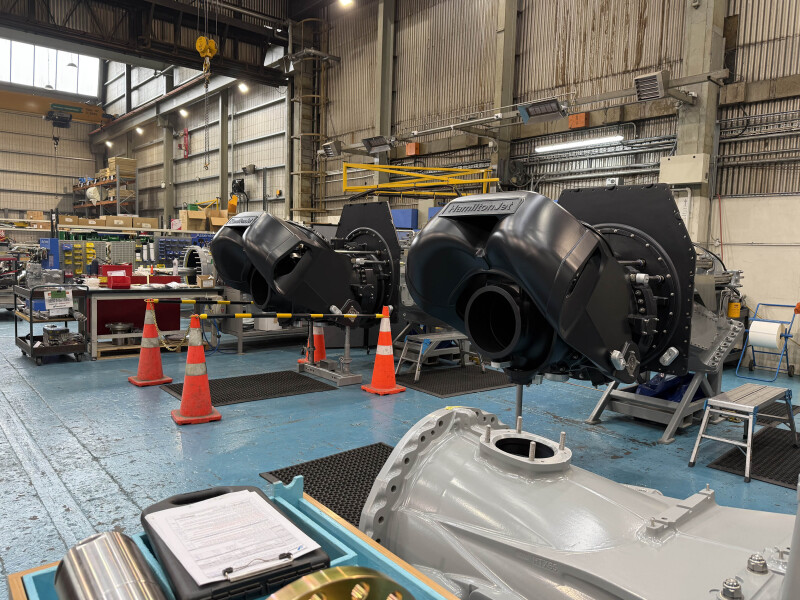
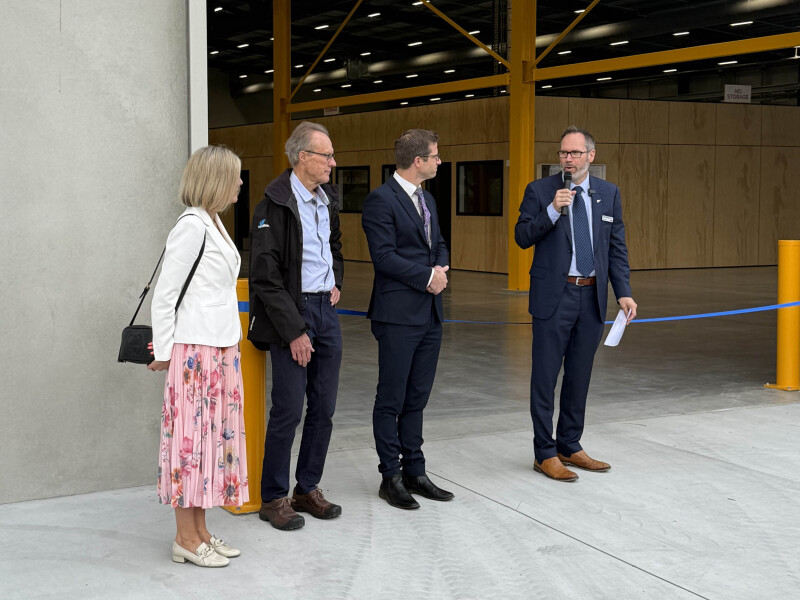
In October, HamiltonJet welcomed hundreds of its employees and its network of global distributors to its Christchurch, New Zealand, headquarters for the official opening of its new factory, a facility designed to give the storied waterjets manufacturer room to grow.
Managing Director Ben Reed said the state-of-the-art facility positions HamiltonJet to increase production in line with rising demand. “We’re at an output level today that is about our maximum on the large jet line,” he said. “And I can see more business coming… anywhere between 30% more and double in the next four or five years.”
The new 80,000-sq.-ft. facility is still ramping toward full operation. Today it offers a 40% increase in capacity over HamiltonJet’s existing production levels, with room to expand to nearly double that if the company one day adopts around-the-clock shifts.
The expansion marks what Reed described as “a turning point.” But getting to that moment took more than a decade of strategic planning, several pivots, and a steady commitment to quality, innovation, and a particular kind of corporate independence.
BUILDING UP
Reed joined HamiltonJet in 2013 to lead new product development. He took over as general manager in 2016 and became managing director in 2020. When he took the helm, the company was exploring a full relocation to a new site. Land had been purchased under Reed’s predecessor, but the company had not yet hit go on the expansion.
After a year and a half of analysis, the answer became clear, Reed said: a total move didn’t make financial sense. The company already had room to grow on its existing property — more than enough, it turned out.
“Why are we moving and losing all the factory space we’ve already got?” he recalled asking. The company reversed course, sold the new parcel for a profit, and reinvested in its original footprint, constructing a new factory next to its existing one.
The final push to build came when a surge in post-Covid government spending temporarily jammed the production schedule, pushing lead times to as long as 18 months. “It taught us the lesson that we needed to do it,” Reed said.
Staffing the new plant will require HamiltonJet to increase its factory workforce by about 30 people from the current 200, and that number is expected to continue rising in the years ahead if all goes according to plan.
The company will also construct new offices for its corporate and engineering staff, which account for another 200 employees in Christchurch. In total, HamiltonJet employs 465, including 65 outside of New Zealand.
LEAN PRODUCTION
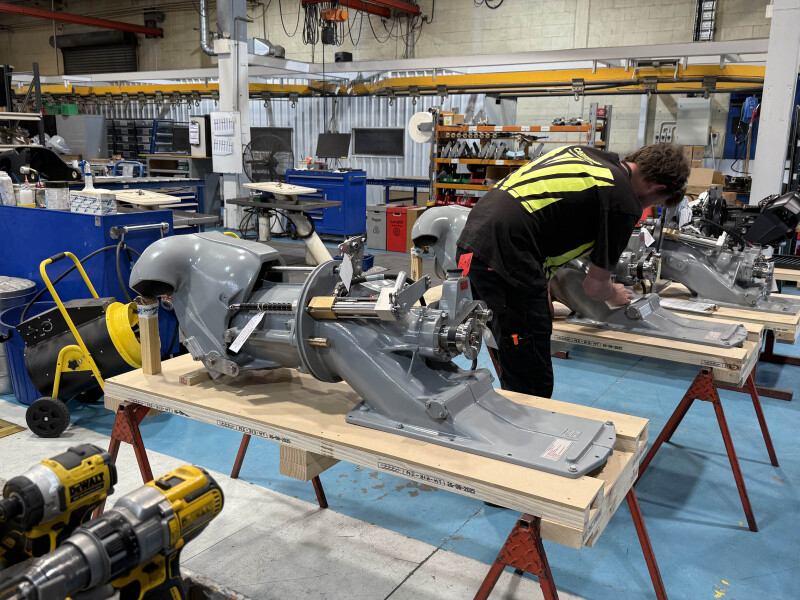
HamiltonJet has long operated on what Reed described as a highly refined, “batch-of-one,” “made-to-order” manufacturing system.
Reed, a mechanical engineer, is an expert in lean production, having implemented it at Ford Motor Co. and Caterpillar before joining HamiltonJet. “I’ve got this thing running through me that I love the concepts and processes of lean,” he said.
The approach, which is rare for a manufacturer handling such a variety, allows the company to produce almost any model in any sequence without stockpiling parts. HamiltonJet produces several series of waterjets, including the HJ, HM, HT, HTX, HJX, and LTX series, offering more than 20 different models across these ranges, from smaller units up to powerful jets for large vessels, covering a power spectrum from 150 kW to 5,500 kW.
“I came to HamiltonJet, and I looked at [its lean production model], and I went, ‘Oh my God, this is so clever,’” Reed said. “It could be a case study for somebody in the manufacturing industry.”
The new facility, which will help the company boost its large-jet output in particular, extends that system by “straightening the flow,” aligning casting, machining, painting, and assembly into a single, coherent line that is expected to unlock new levels of efficiency, Reed said.
HERITAGE
HamiltonJet’s origins are well known in New Zealand, and in the world of marine jet propulsion, the Hamilton name is ubiquitous. But the company didn’t get its start in the waterjet business.
Kiwi engineer and inventor Bill Hamilton founded CWF Hamilton & Co. Ltd. in 1939 to build earthmoving equipment and heavy machinery. He brought an engineer’s pragmatism and an explorer’s drive, constantly pushing both his innovations and himself into uncharted territory.
In the 1950s, Hamilton set out to build a boat that could navigate the fast-flowing Waitaki River, waters too shallow for propeller-driven craft, whose props struck the riverbed. The concept was proven in dramatic fashion in 1960, when three Hamilton jetboats became the first — and still the only — to travel up the Colorado River through the Grand Canyon.
Hamilton went on to pioneer the modern waterjet, setting the company on a trajectory to become the world’s leading producer of the technology. Today, HamiltonJet officials estimate that the company holds approximately 40% of the world’s waterjet market share, delivering jets to a wide range of commercial and military vessels, from whale-watch boats and ferries to workboats, crewboats, and advanced military patrol ships.
All HamiltonJet waterjets are manufactured in Christchurch, with more than 97% bound for export. The United States is the company’s largest market, accounting for about 20% of revenue. Notable recent examples of U.S. vessels equipped with Hamilton jets include the Breaux’s Bay Craft-built pilot boats San Jacinto and Juan Seguin — 2025 winners of WorkBoat’s Significant Boat award — as well as the latest ferries built by Mavrik Marine for San Francisco Bay Ferry and Golden Gate Ferry, a new diesel-electric patrol boat being built by Moose Boats for Seattle’s King County, and the Mark VI patrol boats built by SAFE Boats International for the U.S. Navy.
Over the past 10 years, the company has invested heavily in technology development, introducing more robust waterjets that deliver efficiency gains up to 7%. It has also focused on electrification, autonomy, and digitization, including the AVX and AVXexpress electronic controls; autonomy products such as the JETanchor positioning system, JETlink autonomous and remote-control solution, and the JETfighter firefighting control interface; as well as the Overwatch remote monitoring tool.
Internally, despite decades of international growth, the company’s culture still reflects the values of its founder and the family that continues to own it: innovation, quality, and self-reliance. Bill’s grandson, Mike Hamilton, serves as chairman of the board, and Mike’s son, Sam Hamilton, is both a board member and part of the engineering team.
Reed said the new factory was built entirely from retained earnings. “We have not borrowed a cent on it,” he said.
The quality-first philosophy extends to customer support. Reed recalled a Hinckley yacht with recurring jet bearing failures. When engineers discovered a machining error in the original housing, HamiltonJet replaced the entire unit. “We replaced the jet. It’s 19 years old,” Reed said. “If we’ve done something wrong, we’ll fix it.”
This approach is now formalized in HamiltonJet’s newly expanded three-year warranty, which he contrasted with competitors’ more restrictive terms: “Ours is just anything that goes wrong — we’re going to fix it, if we think it’s our problem.”
STAYING CONNECTED
As HamiltonJet prepares to scale further, Reed said preserving a people-centric culture is a priority, emphasizing visibility, communication, and employee empowerment. “I’m a stand-at-the-front, at-the-right-moment leader,” he said. “You’ve got to let people do their job. It might be trite to say, ‘You need to hire good people and then get out of their way,’ but that’s absolutely true.”
The mindset carries over to how Reed approaches building the HamiltonJet workforce. “I have a philosophy that you only hire crackerjacks,” he said. “You don’t always know when you hire somebody… But every individual you’re going to bring into the company needs to be fantastic. I definitely push that with my team.”
Even as managing director, Reed said he meets with every new hire. He also writes a weekly internal newsletter, a practice that began during New Zealand’s Covid lockdowns. “I missed one in five years,” he said.
Reed, who spends roughly a quarter of each year on the road, said it’s just as important to stay connected with customers. “Our customer base buys off relationship as much as product,” he said. “They need to trust the people they’re doing business with.”
HamiltonJet leans on its regional offices in Seattle, London, and Singapore, along with a network of 53 distributors, to stay close to customers and remain ready for market shifts, according to Andy Wyatt, global sales support manager. “It’s a push-pull feedback, constant communication with the network,” he said.
Wyatt said that some markets around the world, such as the passenger vessel market in the U.S. Pacific Northwest, are generally steady, providing a predictable baseline for production. Beyond that, maintaining constant dialogue is essential for adjusting factory workflows as needed.
“Fifteen years ago, our single biggest market was offshore oil and gas. Now it’s one of the smallest,” Wyatt said. “A few years ago, we were really hot on offshore wind. That is a certain size of vessel, so it tends to drive [demand for] a certain size of jet. There’s a big focus at the moment on patrol and military, and again, that’s tending to equate to a certain size of jet. So, we’re able to prepare and adjust for what’s going to be going through the factory.”
FOLLOWING THE SIGNALS
Asked where the biggest market opportunities lie, Reed didn’t hesitate: defense.
He added that HamiltonJet has been growing at about 11% annually over the past seven years, a trend that is expected to continue as governments spend further to bolster their defense capabilities. Demand for large fleets of uncrewed surface vessels in the U.S., for example, appears especially promising.
“It is downright obvious at the moment that defense spending across the globe is going up by about double,” he said, pointing to U.S. procurement changes and major increases in the U.K., Australia, New Zealand, and NATO countries.
Defense work already accounts for roughly half of HamiltonJet’s business — including police and quasi-military applications. If overall defense volume rises significantly as anticipated, Reed said, the company “will need every bit of the additional capacity now coming online” in its new factory.
HamiltonJet is particularly well-positioned for the U.S. Navy’s Modular Attack Surface Craft program, having supplied jets for all three prototype Medium Unmanned Surface Vessel boats that recently completed autonomous transits between the U.S. and Australia.
Reed believes autonomy is changing defense procurement timelines. “Military has two speeds: glacially slow and canceled,” he said. “But if you take people off the boat, you don’t have to meet a thousand-page specification. You can build much quicker.”
