



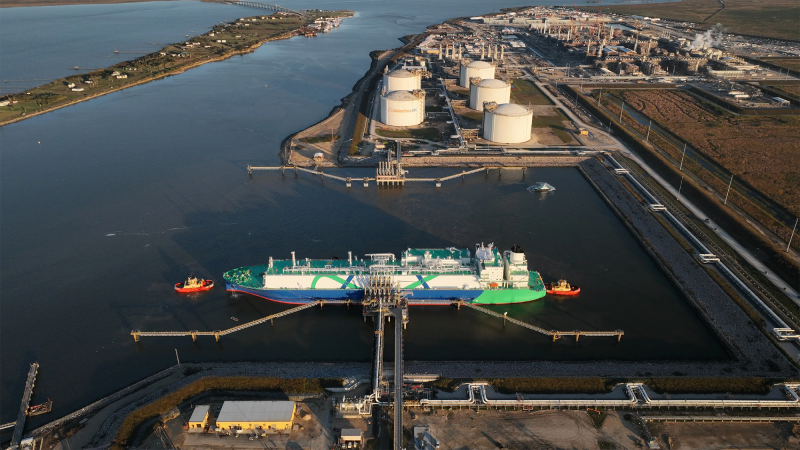
Golden Pass LNG, a joint venture between QatarEnergy and ExxonMobil, has begun producing liquefied natural gas (LNG) from Train 1 at its Sabine Pass Terminal, marking a key milestone as the project moves toward full operations.
“Today, we began producing LNG at our terminal in Sabine Pass, marking the completion of a significant effort to construct, commission, and start up the first LNG Train and the beginning of operating a world-class facility with an exceptional team,” said Alex Savva, President and CEO of Golden Pass. “This remarkable step was achieved through the unwavering dedication of our employees, commitment of our shareholders, and the strength of our partnerships.”
With first production now achieved, Golden Pass LNG moves toward delivering its first cargo and reaching sustained liquefaction operations. The start of production positions Golden Pass LNG to deliver its first cargo and begin international exports in the second quarter, it said in a statement.
“I’m proud of our team and their tireless work to ensure we safely reached this milestone,” said Jeremy Horn, Vice President of Operations for Golden Pass. "We’re excited to go to work delivering Texas LNG to power the world.”
When fully operational, the Sabine Pass terminal will comprise three liquefaction trains with a combined capacity of 18.1 million tons per year. Trains 2 and 3 are expected to come online in the fall of 2026 and early 2027, respectively, according to industry analysts. The facility also includes five 155,000-cu.-meter LNG storage tanks and two marine berths capable of accommodating Q-Flex and Q-Max class LNG carriers — among the largest vessels afloat, with cargo capacities up to 266,000 cu. meters.
The terminal's location on the Sabine-Neches Waterway, about 10 miles south of Port Arthur, Texas, places it among a small number of deepwater Gulf Coast ports capable of handling vessels of that size.
Golden Pass is one of several major U.S. LNG export facilities on the Gulf Coast, joining Cheniere Energy's Sabine Pass and Corpus Christi terminals, Venture Global's Plaquemines LNG in Louisiana, and Freeport LNG in Texas. Its entry into service adds to a wave of U.S. export capacity expansion at a time of strong global demand, particularly from European buyers seeking alternatives to Russian pipeline gas.
