



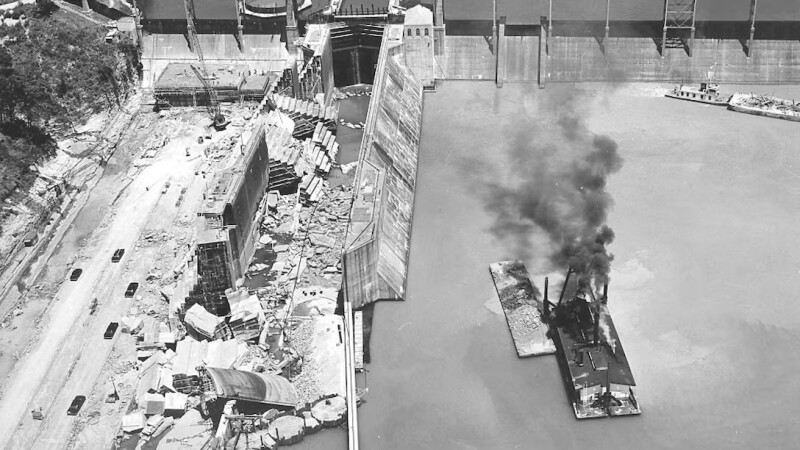
The U.S. Army Corps of Engineers (USACE) Nashville district announced on Sept. 15 that a long-lost film roll has surfaced offering rare footage of one of the most significant structural failures in the history of the Tennessee River navigation system.
Jim Davis, a retired USACE operations manager who served in the Nashville district from 1968 to 2014, recently discovered an 8-millimeter Kodachrome movie in his family’s possession. The film contains scenes from the 1961 wall collapse at Wheeler Lock, a failure that claimed three lives, halted cargo traffic, and reshaped how engineers approached future lock construction, the USACE article said.
The footage captured scenes of the aftermath likely on June 3, 1961, the day after the collapse. Labeled “Wheeler Dam,” the reel eventually came into Davis’ hands and was later given to his grandson, Justin Gray, now the lockmaster at Wheeler Lock. Gray shared it with the Nashville District Public Affairs Office, which arranged for digitization. The publicly available film now provides a vivid record of the incident.
According to Wheeler Lock’s logbook entry, the land wall and lower miter gates failed at approximately 9:20 p.m. on June 2, 1961. Lock operators Horris Hamner and Harvey Crymes were completing a lockage with the motor vessel Andrew B. when the north wall shifted and broke apart. At the time, the lock chamber was full and the upper gates open.
The Andrew B., pushing 16 loaded barges at the time, fought the surge of water that threatened to drag it back into the chamber. Upstream, a fleet assisted in setting an emergency needle dam closure under extreme flow conditions.
A Tennessee Valley Authority memo noted it took four days to fully install the needle dam, with the reservoir lowered seven feet to relieve pressure. TVA’s investigation later concluded that a seam of clay hidden in shale bedrock caused the collapse. The seam had gone undetected during both the original 1930s construction and subsequent geologic surveys.
