



EcoNavis Solutions, Glasgow, Scotland, has been selected by a U.S. federal agency to lead a $500,000 study aimed at improving propulsion efficiency and reducing underwater radiated noise on offshore vessels and workboats operating in the Gulf.
The federally backed project will center on a full-scale retrofit and validation program aboard a designated workboat, not yet announced. The goal is to demonstrate how an integrated hydrodynamic optimization approach, rather than isolated technology upgrades, can deliver measurable gains in fuel efficiency while addressing growing regulatory attention on underwater noise.
The study reflects a broader shift toward evaluating whole-vessel performance as operators face rising fuel costs and stricter emissions and environmental requirements.
“This project allows us to validate, at full scale, how an integrated set of hydrodynamic technologies can improve propulsion efficiency and reduce underwater noise in real operating conditions,” said Dr. Batuhan Aktas, founder and CEO of EcoNavis Solutions. “The focus is not on a single device, but on how the entire propulsion train can be optimised and verified through data.”
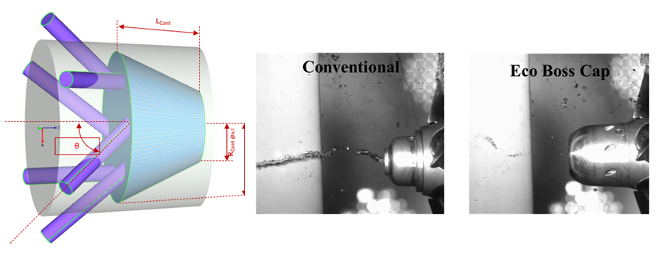
The technical scope includes the integration of several propulsion efficiency components: a flow-aligned twisted rudder known as EcoVane, the company’s Eco Boss Cap propeller hub, and pressure-relieving modifications to propeller blades. Each component is designed to address different sources of hydrodynamic loss, including wake misalignment, rudder drag, and cavitation at the propeller hub and blades.
According to EcoNavis, the combined system is expected to improve propulsion efficiency by about 5% and reduce underwater radiated noise by more than three decibels. These figures will be validated through controlled before-and-after sea trials, including direct measurement of shaft power and acoustic output.
The project will begin with computational modeling to establish a performance baseline for the selected vessel, followed by vessel-specific design optimization using flow analysis. Manufacturing, installation, and full-scale trials will follow.
Performance data will be collected and verified using established international standards, including ISO 15016 for fuel efficiency and ISO 17208-1 for underwater noise measurement.
EcoNavis will lead hydrodynamic design and simulation work, supported by propulsion specialists including King Propulsion, CJR Propulsion, and Oscar Propulsion.
Duncan Troy, CEO of Oscar Propulsion, said the Gulf of Mexico was selected due to its concentration of offshore support, harbor, and crew transfer vessels, along with increasing regulatory scrutiny on emissions and underwater noise.
“The industry is under pressure from both fuel costs and regulation,” Troy said. “What owners need are solutions that are not only technically effective, but commercially realistic. This project is about proving both.”
The program will also incorporate class approval and manufacturing processes to support scalability and broader fleet adoption. In addition to the demonstration vessel, the project is intended to generate a validated dataset that can inform similar retrofits across other vessel classes.
EcoNavis said additional details, including the selected vessel and trial results, will be released as the project progresses.
