



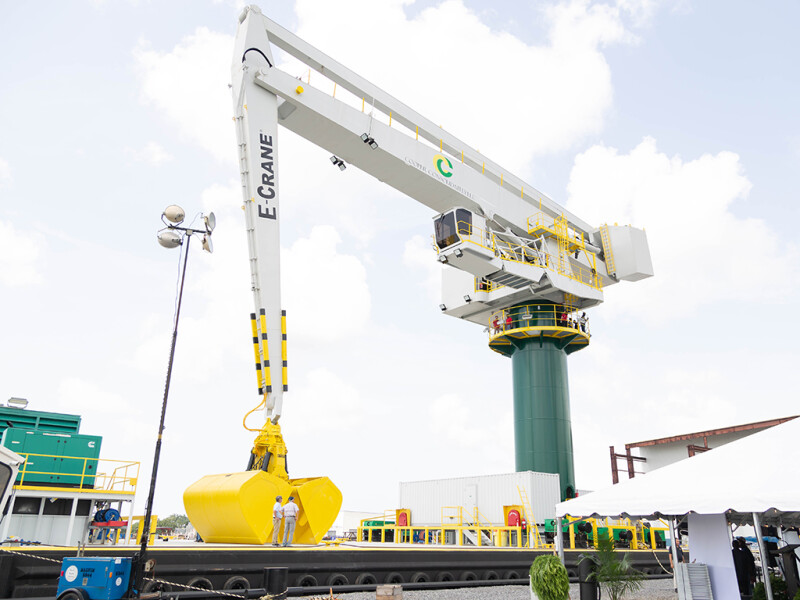
At first brush, Adegem, Belgium, and New Iberia, La., would seem to have little in common. Until one looks closer. Both have people there who speak French, and both are home to E-Crane Worldwide facilities. The company’s headquarters is in Adegem, and subsidiary E-Crane International USA’s Gulf Coast service center is in New Iberia.
E-Crane’s owner, CEO, and chairman of the board Lieven Bauwens still runs E-Crane as a family-owned concern even as it’s grown into a global company.
“At E-Crane we value all our customers equally,” he told the crowd in New Iberia in July during the christening of the new rig Creole King, whose main component is a new E-Crane EC30382 PD-E series, 4000C model stevedoring crane.
E-Cranes are purpose-built for bulk materials and scrap handling, designed and constructed in the European headquarters and factory. Since E-Crane entered the U.S. market in the mid-1990s, the buyers have mostly been inland waterway operators, and more specifically, they’ve mostly purchased barge-mounted cranes, like that of the Creole King.
The company’s U.S. headquarters is in Galion, Ohio, a landlocked, small farming community in central Ohio. But most of its installed E-Crane customer base is in the South.
“I think of it this way, if you are building an investment bank, for sure you need an office in Manhattan,” said E-Crane International USA’s CEO, Steve Osborne. “The same goes for floating bulk material handling cranes. New Orleans and the Lower Mississippi are the epicenter for inland waterway bulk cargo movement.”
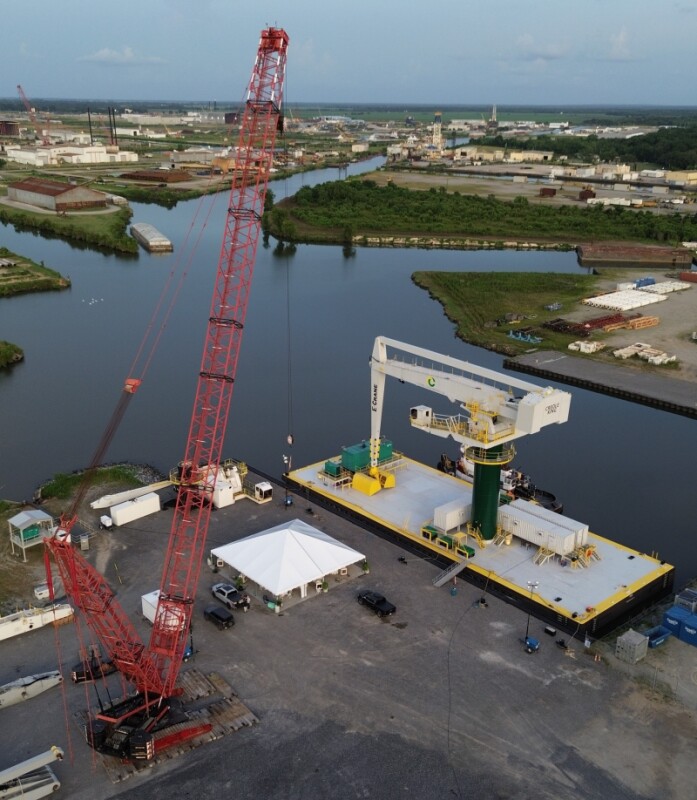
As E-Crane began looking to open a second service center, it sought a location with water access. Eventually, the company found the Port of Iberia, and Craig Romero, the port’s executive director, secured nearly $6 million in funds to build out the infrastructure needed to have E-Crane’s own waterside service facility for a floating crane. The 13-acre facility opened on Jan. 1, 2024, and consists of seven acres of compacted yard storage, 1,500 linear feet of water frontage, 580 linear feet of new construction reinforced bulkhead, a 26,000-sq. ft. assembly shop, a 1,100-sq. ft. climate-controlled warehouse, 400-ton heavy lift crawler crane, and a 148’x54’x13’ deck barge. The facility is also awaiting approval to become a Foreign Trade Zone.
“Port of Iberia offered the best combination of water access (via the Intracoastal Waterway) and infrastructure upgrades for E-Crane to select them as the location of the new service center,” said Osborne.
From New Iberia, E-Crane can serve clients from Florida across the U.S. Gulf to Texas and up the Mississippi River into Mississippi, Arkansas, and Tennessee.
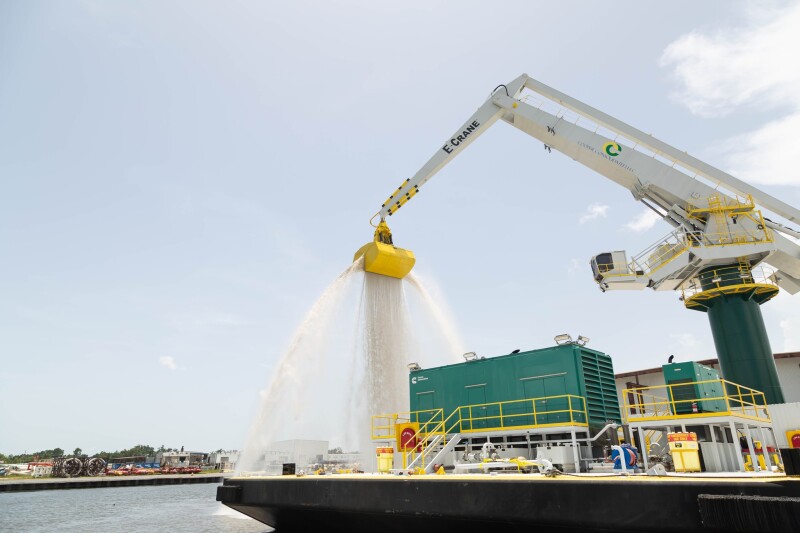
Osborne said that bulk and scrap handling can vary significantly depending on the commodity. One day, a facility might unload distiller’s dried grains at 34 lbs. per cubic foot (pcf), and the next day handle pig iron at 500 pcf. Due to such wide variations, the industry favors hydraulic-operated machines over cable cranes. Hydraulic cranes can push down into materials for more efficient handling, whereas cable cranes cannot, making it harder to grasp large payloads.
“The upside of the cable crane is the duty cycle classification,” said Osborne. “Cranes are built to strict standards for duty cycle operation, ensuring the machine will last millions and millions of full-load cycles, whereas hydraulic machines are typically built in the style of construction excavators, which have a load capacity based on stability. That is to say, the excavator can lift as much as he wants, so long as he does not tip over. But this stability rating says nothing of duty cycles, or how many millions of cycles a machine can last. E-Crane combines the best of both: hydraulic operation for excellent performance and duty cycle design for long life span.”
For mechanical dredging, Osborne said E-Crane aims to offer a technological alternative to what’s currently available. Dredging with a cable crane is challenging because the operator loses control of the bucket once it’s underwater, and control decreases with depth. Hydraulic excavators offer better control, but as their power increases, their boom and stick length decrease, limiting dredging depth.
“With the E-Crane we are offering a combination high precision with hydraulic operation and good depth (up to 50'),” said Osborne. “On top of that, the equilibrium E-Crane is balanced, unlike excavators and cable cranes. This makes the barge much more stable throughout the working cycle.”
E-Crane currently has no dredging cranes on the Mississippi River but has several cranes that do dredging at times in the Northeast, and two purpose-built dredgers on the West Coast. The company has multiple dredging cranes in Europe and Asia, working with large dredging firms.
