



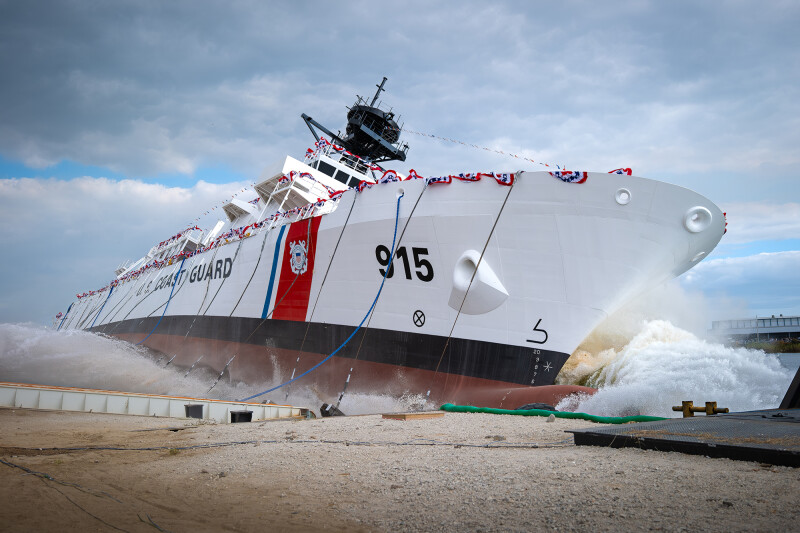
Homeland Security Secretary Kristi Noem announced the partial termination of a Coast Guard shipbuilding contract with Eastern Shipbuilding Group Inc. (ESG), Panama City, Fla., amid delays and rising costs in the production of Heritage-class offshore patrol cutters (OPC).
The move comes amid a Department of Homeland Security (DHS) review of "wasteful" Coast Guard shipbuilding contracts that are failing to meet delivery agreements, the agency said.
"ESG has been slow to deliver four OPCs, harming the U.S.’s defense capabilities and wasting Americans' hard-earned money," the DHS said in a press release on Friday. "In light of that, Secretary Noem partially canceled ESG’s contract for two out of the four OPC … because it was not an effective use of taxpayer money."
Designed to bridge the gap between the larger national security cutters and smaller fast response cutters, the 360'x54'x17' OPCs will support missions such as counter-drug and migrant interdiction operations in coastal waters.
In 2016, ESG was tapped to build up to nine OPCs, but the Coast Guard later modified the contract, reducing the order to just four ships after several program setbacks, including Hurricane Michael's direct hit on Eastern’s shipyard in 2018.
ESG was scheduled to deliver the lead ship, USCGC Argus (WMSM-915), in June 2023, but the timeline has slipped to at least the end of 2026. The company also missed its April 2024 delivery target for the second OPC, USCGC Chase (WMSM-916).
Earlier this year, ESG informed the Coast Guard that it could not fulfill the remaining two ships in the contract — USCGC Ingham (WMSM-917) and USCGC Rush (WMSM-918) — without incurring losses it deemed unsustainable, leading the Coast Guard to halt further work on those ships.
“We share a common goal with the U.S. Coast Guard — to deliver the offshore patrol cutters as quickly and efficiently as possible," Joey D’Isernia, ESG CEO, said in a statement following the stop work order. "We are actively working to reach an agreement that ensures the program is properly funded and can move forward without further delay. System light-offs on hull 1 are currently underway, and despite the unprecedented challenges we’ve faced, we remain confident that our incredible workforce represents the most capable and reliable team to complete these vital national security assets.”
According to a 2023 report from the Government Accountability Office, the OPC program's estimated acquisition cost has risen from $12.5 billion in 2012 to $17.6 billion due to factors such as contract restructuring and recompetition following Hurricane Michael, as well as higher infrastructure costs.
The Coast Guard, meanwhile, maintains its target to procure a fleet of 25 OPCs "as fast as possible," according to the DHS. In 2022, another shipbuilder, Austal USA, Mobile, Ala., was selected to build up to 11 OPCs.
The DHS said that funds saved from the ESG contract termination will be redirected to projects more likely to enhance Coast Guard readiness and value for taxpayers. The newly passed One Big Beautiful Bill Act promises nearly $25 billion for Coast Guard shipbuilding and infrastructure.
“This administration is unwavering in its commitment to the American taxpayer and to a strong, ready Coast Guard,” an unidentified senior Homeland Security official said in the press release announcing the partial contract termination. “We cannot allow critical shipbuilding projects to languish over budget and behind schedule. Our Coast Guard needs modern, capable vessels to safeguard our national and economic security, and we will ensure every dollar is spent wisely to achieve that mission. This action redirects resources to where they are most needed, ensuring the Coast Guard remains the finest, most-capable maritime service in the world.”
In June, the DHS canceled the stalled production of an 11th Legend-class national security cutter for the Coast Guard, citing a year-long delay in shipbuilder Huntington Ingalls Industries’, Newport News, Va., projected completion date and cost overruns.
