


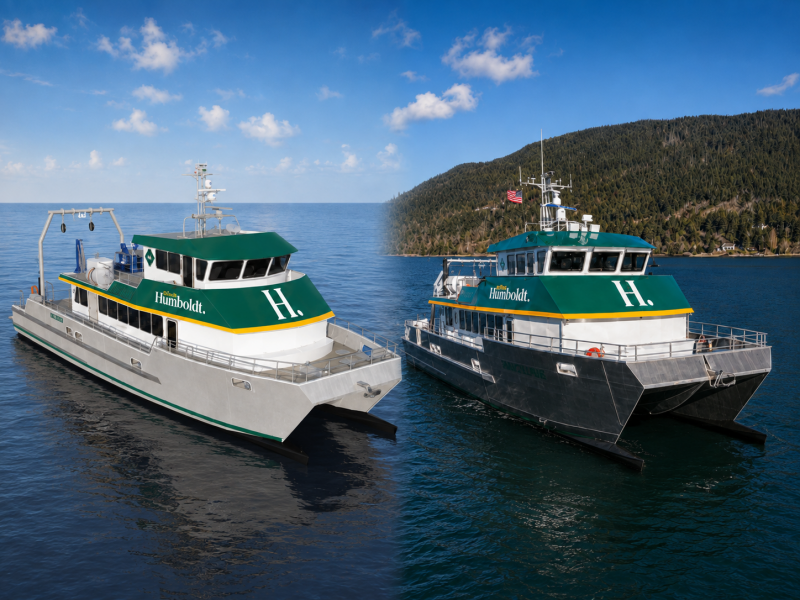
Hull designs from Teknicraft Design Ltd., Auckland, have been proven over many years to be reliable and efficient when used in a variety of commercial applications. In the United States, All American Marine Inc., Bellingham, Wash., has an exclusive agreement to build Teknicraft’s designs. This long-term partnership between the New Zealand-based design house and an established U.S. commercial boatbuilder has been fruitful, with more than 75 vessels completed and placed in service over the past 25 years, and multiple builds currently underway.
ORIGINS
Teknicraft’s hull design is modern, even though the basic concept was developed over 30 years ago. In the mid-1980s, young engineer Nic de Waal and some associates were dabbling in powercat racing when they were tasked to design a catamaran patrol boat that could run at high speeds in severe conditions. That ahead-of-its-time design was the basis of the now well-proven Teknicraft hull form.
South Africa, where de Waal started, was severely isolated by global sanctions at the time, which inhibited international investment. Lacking resources, the company built its own scale hull models and test tank. An engine-driven propeller pumped recirculating water over a flat surface. By adjusting rpm, the team could set the speed of the water and watch the flow as it interacted with the stationary hull.
“You could beautifully observe how everything was working, unlike in a tow test where the model moves,” said de Waal, now Teknicraft’s managing director. “You could just put your finger on and push it down and change the true angle and the center of gravity. So, we built a lot of models and used that as our development tank. We came up with this design, which at that stage was a [65'] catamaran.”
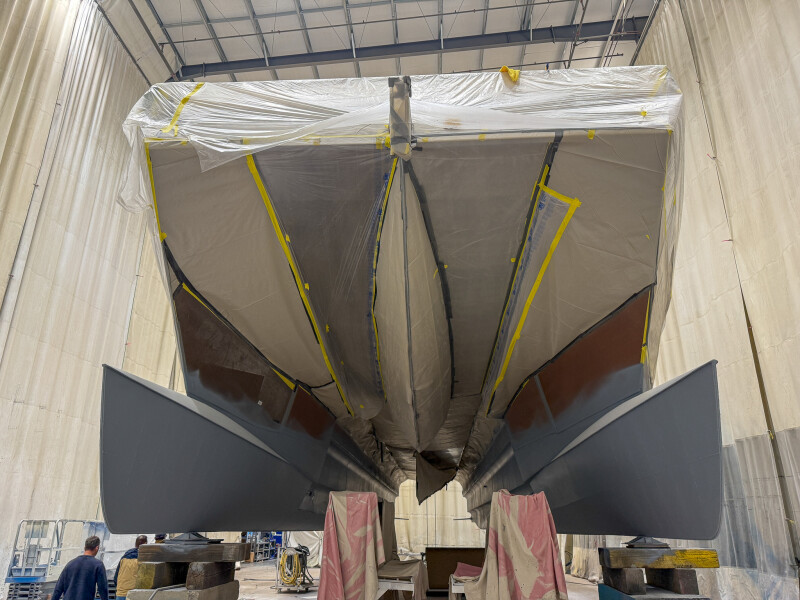
low-wake wash energy signature. All American Marine photo.
COMPLEX HULL FORM
The testing helped minimize drag on the Teknicraft hull while improving overall seakeeping, de Waal said.
“We ended up with half-round semiboards, half-round on the outboard side with vertical insides,” he said. “That formed the basis of what I’m still doing today with a lot of refinements over the years.
“The half-round outboard deadrise gives you the almost perfect shape for low vertical accelerations and improved seakeeping,” de Waal added. “The vertical inside gives us a dry tunnel, which reduces the drag. It also splits the water since it’s an asymmetric hull. It splits the amount of wave that goes between the hulls and what goes on the outward side so that we don’t have tunnel slapping. Nor do we have a hold-up of the waves, which creates drag. Steep curves inside the tunnel increase water deflection, and we’ve incorporated chines and things to further improve waterflow.”
The complex shape of the hull enhances efficiency, speed, and rough-water capability. The original racing hulls were totally asymmetric, but that design didn’t work well on commercial boats, which frequently operate in rough conditions. Asymmetry impedes steering control, especially in following seas.
“We made the bow sections perfectly symmetrical,” de Waal said. “And then some 25% after the stem of the boat, we’ve got a step there, and it changes from symmetrical to asymmetrical at that point.”
KIWI DESIGN IN USA
Teknicraft’s design proved exceptional and continues to serve as the basis for many modern hulls currently in service or under construction. The complexity of hulls that combine contoured exterior surfaces with flatter sections in the tunnel, along with multiple chines, makes them difficult to build. This is one of the reasons why maintaining a strong construction partner is so important.
Two and a half decades ago, Teknicraft signed an agreement that made All American Marine the exclusive builder of its designs in North America.
“They design just for us in this region,” said Ron Wille, All American Marine’s president and COO. “Over many years, we’ve built a lot of boats. It’s been something that’s been really beneficial for both of us. We know how they design boats, and we’re good at building them.”
De Waal agrees, stating All American Marine has the right methods and processes in place.
“I don’t have to keep an eye on them,” he said. “I go there two or three times a year, mostly to attend sea trials of some of the more interesting boats. I’ve got 100% faith and trust in them. They do a fantastic job.”
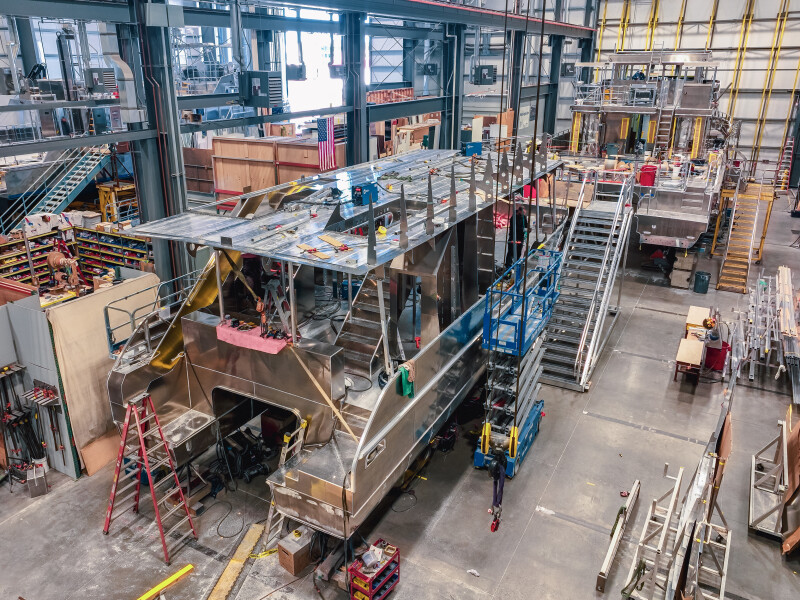
The partnership continues to be prolific with multiple Teknicraft-designed builds underway at All American Marine’s 57,000-sq.-ft. production facility.
The versatility of the fast catamaran design drives production. It works well on a wide variety of commercial vessels, which can be propelled by shafts, pods, or jets. All American Marine has delivered numerous purpose-built passenger excursion vessels, patrol and police boats, research vessels, and fast ferries using the proven hull design. Multiple applications also allow for different power sources, which include diesel, hybrid-electric, full-electric, and even hydrogen fuel cell.
“A lot of the boats that we have built and deployed over the years have been high-speed, high-performance boats, which really helps us when it comes to building all kinds of boats,” Wille said. “Because we focus so much on energy efficiency and efficiency overall, it really equates well for what we’re doing now with the fully electric, battery-powered boat currently under construction.”
FOILING
Teknicraft has been at the forefront of foiling technology in commercial vessels. Always focused on speed and efficiency, the company discovered as early as 1990 that incorporating a fixed foil — the standard at the time — into a modified version of their hull design delivered enhanced performance. When de Waal moved to New Zealand in 1996, he began focusing on foils in earnest.
“We started concentrating on and spent a lot of effort and time to refine the foil system — to make it adjustable, to make them much stronger, more robust, and reliable,” de Waal said. “I worked a lot on different foil profiles — a lot of [computational fluid dynamics] at the time to create the most optimal foil shapes.”
That early work on foils paid off, and many of today’s Teknicraft hulls feature advanced technology, including fixed and dynamic/variable foils, depending on vessel size, speed, and loading.
Wille relates the benefits of foiling to some of the builder’s current and recent projects.
“The hydrofoil provides lift,” he said. “As it picks up speed, the foil raises the boat higher out of the water. This translates to less water resistance, which equates to less fuel burn and higher efficiency.”
ROBUST ORDERBOOK
The international cooperation between Teknicraft and All American Marine continues to drive the production of some sophisticated commercial vessels for North American operators.
A rare monohull designed by Teknicraft, a 108', 350-passenger Subchapter K vessel named El Escudo, recently entered service for Harbor Breeze Cruises, Long Beach, Calif., which operates the parallel-hybrid aluminum tour and excursion boat in Southern California. Zero-emissions harbor operation is achieved using two 300-kW traction motors and a 588-kWh BorgWarner energy storage system backed by twin MAN D2862 EPA Tier 4 diesels.
Delivered to Los Angeles Port Police, a 65'x24' fixed-foil aluminum catamaran dive and patrol vessel is powered by twin Cummins QSM11-715s driving shafts. The vessel cruises at 20 knots with a top speed of 25 knots and is certified to Subchapter T.
“The L.A. port police boat we launched has a fixed foil on it,” Wille said. “They wanted to stick with that because they don’t have a lot of changes in weight on their boat.”
Adjustable foils suit passenger vessels that operate with large weight variances, such as an 84'6"x30'8" quad-waterjet tour/excursion boat being built for Phillips Cruises & Tours LLC, Anchorage, Alaska, Wille said.
“They might go out with 50 people one day and 150 people the next day,” he explained. “Allowing a small adjustment in the angle of attack of that hydrofoil lets them put it at the most efficient setting.”
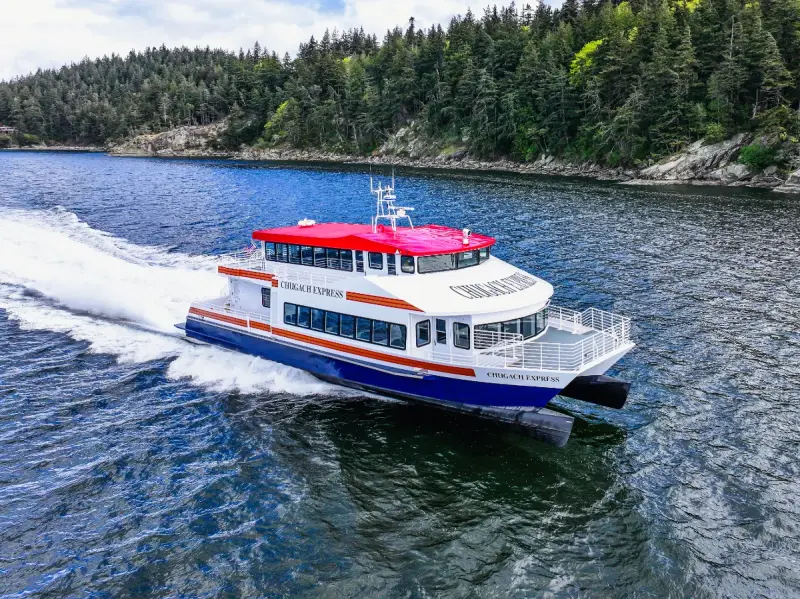
Expanding on the design of the Chugach Express, delivered to Phillips Cruises in 2025, the operator’s new 150-passenger Subchapter T-certified tour boat will be powered by Scania DI 16 082M engines (800-hp each) driving Marine Jet Power 350X waterjets. Cruising speeds are expected to reach 33 knots. The efficient, adjustable-foiling hull and 1,200-gal. fuel tanks will provide an extended range.
A similarly sized vessel with no foils destined for the Orange County (California) Sanitation District will be a series hybrid. Dockside and generator power will charge 588 kWh of battery storage powering electric motors. This will meet the California Air Resources Board’s emissions standards.
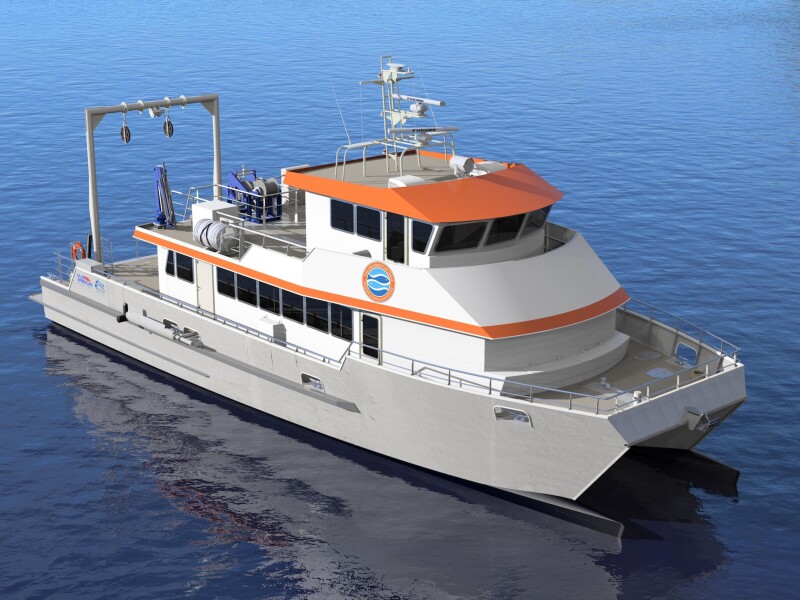
A 73' catamaran research vessel for the University of North Carolina, Wilmington, powered by twin Tier 3, Scania DI 16 diesels (800-hp each) will cruise at 20 to 24 knots fully laden. Two 24-kW Kohler generators are self-paralleling for load sharing. The vessel is configured for both student day trips and overnight voyages. A WASSP multibeam wideband compressed high-intensity radiated pulse echosounder and Kongsberg acoustic doppler current profiler are among sensors on board. A similarly sized research vessel slated for the University of Texas will be powered by a pair of Caterpillar C18 engines. Both vessels feature adjustable foils.
In addition, San Francisco’s Water Emergency Transportation Authority has ordered an all-electric 100'x26' aluminum catamaran for San Francisco Bay Ferry operations. This vessel, slated for completion in early 2027, will run at 24 knots. With shorter distances between stops, no foil is necessary.
The partnership between Teknicraft and All American Marine is thriving as de Waal and his New Zealand-based team continue to produce advanced designs for fast, efficient commercial vessel operations.
“The partnership with All American Marine is so important,” de Waal said. “They have over 25 years’ experience executing this design, so they know how to build them properly.”
“It’s been a really great partnership over the years,” Wille said. “All the different refinements that we’ve worked on with Teknicraft allow us to keep delivering better and better vessels.”
