



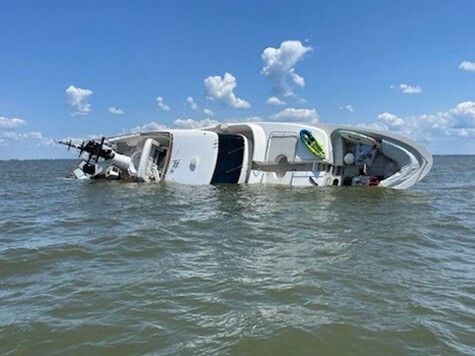
Partially opened doors to an aft watercraft storage space and adjoining engine room introduced flooding and a rapid list to the 122’ Lovebug, partially sinking it in Chesapeake Bay in July 2024 with damages estimated at $8 million, the National Transportation Safety Board reported.
The Lovebug, a San Lorenzo yacht built in 2010, was transiting Chesapeake Bay in the West River north of Shady Side, Md., when the vessel started listing heavily to starboard, according to a narrative by NTSB investigators.
Four crewmembers and one owner on board abandoned the vessel and were rescued by nearby boats before the yacht partially sank in about 12’ feet of water. An oil sheen, around the vessel was contained with a boom, while salvage planning and operations took 16 days.
On July 27, 2024 the Lovebug was near the West River Entrance Light 2, enroute to a frequent destination for the yacht crew and owners, according to the NTSB report. The captain noticed the Lovebug had developed a starboard list, and checked the steering, rudder indicators, and stabilizers on the bridge but found no problems.
The captain told NTSB investigators that, when the vessel first began listing, he did not hear any alarms.
“The list rapidly increased. According to the captain, about a minute after the vessel started listing, the vessel, which had been powered by its starboard generator, lost power. The captain backed off the throttles, and the vessel’s speed dropped to about 4 knots.”
The captain ordered the deckhand to prepare to lower the anchor, but before she could deploy it, “the captain ordered everyone on board to abandon the vessel because the list had become significant, and they were in danger,” according to the report.
The deckhand, chef, steward, and owner jumped into the water. The captain broadcast a distress call on VHF channel 16, verified that all personnel were off the boat. He in turn jumped into the water. “From the time the vessel started listing until the owner andcrew were in the water, less than 4 minutes had elapsed,” investigators noted.
The agency determined that the instability and sinking of the Lovebug was caused by undetected flooding through an open watertight door to the engine room, which allowed water from the yacht’s watercraft storage area to flood in.
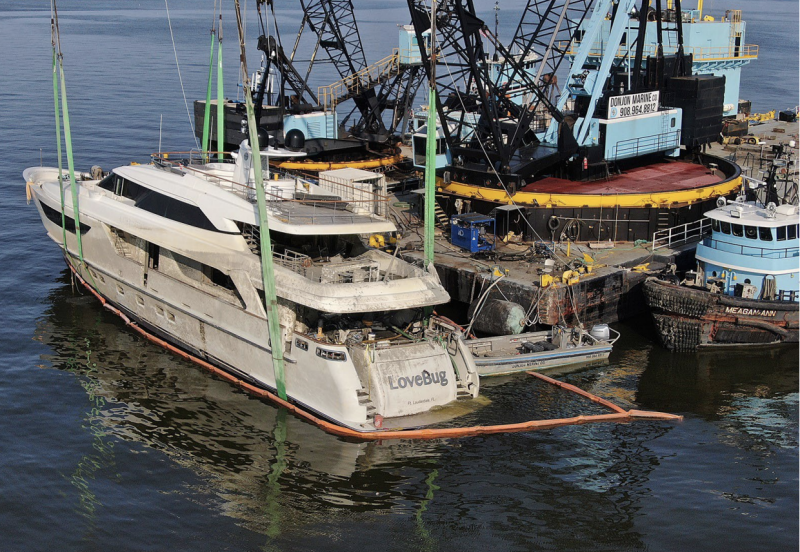
The aftmost spaces on its lower deck were a garage that housed watercraft and a technical area for vessel electrical and mechanical systems on the port side. Forward of the garage and technical area, separated by a watertight bulkhead, was the engine room compartment.
During diving operations, salvors found that this external garage door was partially open, according to the NTSB. Salvors also found the watertight door between the garage and engine room compartment open.
After salvage the Lovebug was towed to Yank Marine in Dorchester, N.J., for survey and overhaul. A marine surveyor and National Transportation Safety Board investigators found no visible hull breach or indication of a potential source of water ingress on the interior or exterior of the vessel.
“Water in the garage would have decreased the yacht’s draft aft, accelerating water ingress through it. If the water level in the garage space reached the lower edge of the open watertight door, seawater would have flooded into the engine room compartment,” the NTSB reported in its analysis.
“The combination of the weight of floodwater, increasing the vessel’s draft, and the free surface effect, created by the flooding of the garage and full-beam-width engine room compartment, likely resulted in a condition of neutral stability, with little righting energy to resist severe heeling or capsize,” the agency concluded. “This resulted in a sudden large list and further flooding until the Lovebug reached equilibrium at a list of 45–50° and then partially sank in the mud.”
