



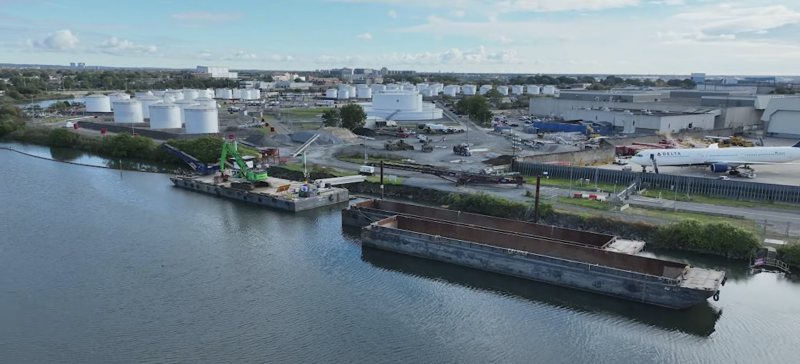
The $19 billion redevelopment of New York’s John F. Kennedy International Airport has used barges to replace trucks moving construction material and debris, an innovative strategy that has eliminated the need for 250,000 truck trips on congested local roads, the Port Authority of New York and New Jersey says.
Barges that can each carry 200 truckloads of material have been docking along Bergen Basin, on the western edge of the airport across from the Hamilton Beach neighborhood in Queens. An adjoining 12-acre site on includes a concrete production plant and a concrete crushing facility, to recycle construction debris and re-use it in building roads and other projects, further reducing needs to truck in materials.
In an announcement timed for “Climate Week NYC” events in the city, Port Authority Chairman Kevin O’Toole said “we are proud to say that we have lived up to that commitment by replacing thousands of trucks with a barging operation that is safer, cleaner and more sustainable while building a new airport that our region and our closet neighbors can be proud of.”
A tally by the agency calculates the strategy has “eliminated more than 7.5 million miles of truck travel on local roads and on the region’s highways.” The barge operation launched in September 2023 “in response to concerns from the surrounding communities about safety, noise, congestion, and the environmental impact of trucks servicing JFK construction,” according to the agency.
Facing deep concerns from surrounding communities about the impact on neighborhoods, the Port Authority looked for alternatives and focused on the region’s waterway connections.
“We went and thought, well, we’ve got waterways here adjacent to what we’re doing,” Jessica Forse, the program executive for JFK redevelopment, said in a video released by the agency.
“We’ve got the ability to produce some materials here on site. Why don’t we create this logistics facility to really reduce the amount of truck trips that we have?”
The Port Authority awarded the contract to build and operate the on-airport construction support facility and its barging program to Modern Efficient Transport and Supply LLC (METS), Mellville, N.Y., an affiliate of Haugland Group LLC.
Barges carry bulk materials such as sand, aggregate, steel and other building materials to the airport and remove non-hazardous debris and soil from the construction sites on the airport. Barges travel to sites from upstate New York to southern New Jersey to retrieve materials and to deliver debris.
“We’ll take a bucket of sand out of the barge…place it into our 24-yard surge hopper,” said Noia. “That surge hopper will then transfer to a conveyor belt that feeds the final conveyor belt to stack approx. 20,000 tons of sand in one place if we needed it.”
Since August 2023, “we’ve unloaded and loaded over a million tons of material already,” said Noia.
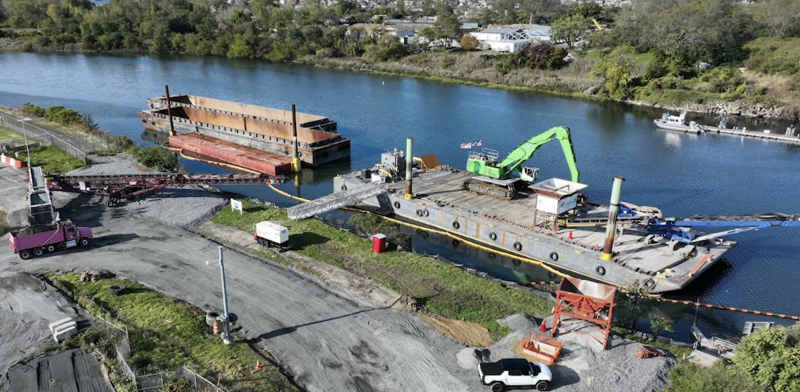
While new material arrives, its feeds a concrete batch plant, said Gina Bigler, director of construction for JFK Airport.
“All concrete that will serve and support the projects that are part of the redevelopment are coming from this onsite batch plant,” said Bigler. As old structures come down to make way, contractors are required to crush and re-use concrete as sub-base for new construction, she said.
“This milestone demonstrates what is possible when the public and private sectors come together, listen to the priorities of the community, and find more efficient ways to deliver critical infrastructure,” said Haugland Group CEO Billy Haugland.
“By moving construction materials and debris by barge rather than truck, we helped reduce congestion, emissions, and disruption in the neighborhoods surrounding JFK, without increasing costs to the project,” said Haugland. “We are proud to partner with the Port Authority on an efficient, modern approach that supports this historic redevelopment while delivering meaningful benefits to the surrounding community.”
In all, Port Authority officials say the environmental benefits of the system include:
- Reduced trucking activity in the surrounding communities;
- Reduced emissions and dispersal of dust and other particulates associated with the transportation of construction materials and construction debris;
- Efficient use of the airport’s water access for transfer of bulk materials to and from the airport;
- Advancement of the Port Authority’s sustainability goals by encouraging responsible recycling of construction debris.
