



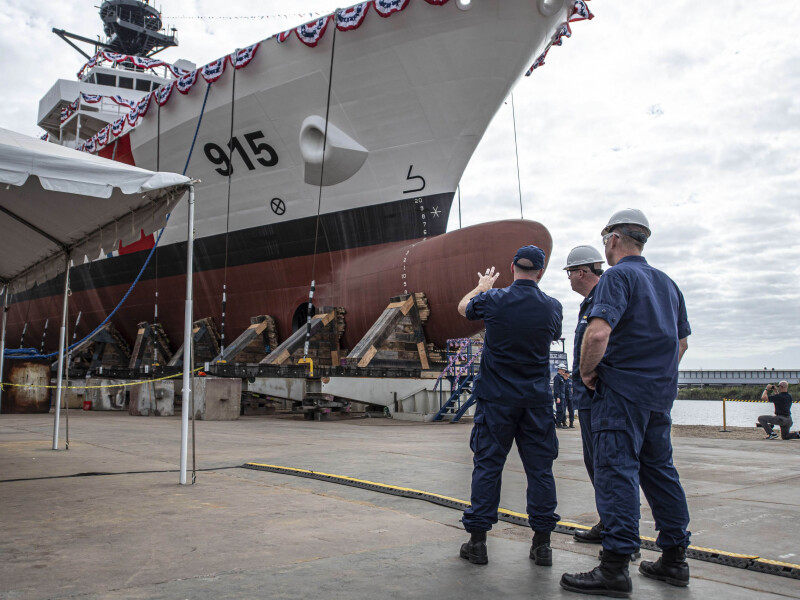
The Coast Guard continues to need better management over its troubled $20 billion Offshore Patrol Cutter (OPC) program, which is years behind schedule, well over budget, has no ships delivered, and recently had two ships canceled, according to a new report by the Government Accountability Office (GAO).
The Coast Guard originally planned to acquire 25 new OPCs to replace its aging Medium Endurance Cutters. The new fleet is considered essential for offshore drug and migrant interdiction, search and rescue, and port and coastal security. It had split the contract between two shipbuilding firms: Eastern Shipbuilding Group (ESG), Panama City, Fla., (which was to build the first four ships), and Austal USA, Mobile, Ala., (which is to build the next 11).
ESG has built and even launched OPC 1, and Austal is currently working on its lead OPC, but both have been plagued by delays. Construction of the ships “began without a stable design, contrary to shipbuilding leading practices,” which in the case of OPC 1 has led to costly rework, the GAO said. “Each shipbuilder’s design remains incomplete, and both have yet to deliver any ships.”
Troubles began early with ESG, when its shipyard in Panama City was devastated by Category 5 Hurricane Michael in 2018 just as work was starting on its first cutter (Argus). That led the Department of Homeland Security (DHS), the Coast Guard’s parent agency, to authorize up to $659 million in extraordinary contractual relief, although that amount was not ultimately awarded.
Technical and financial troubles snowballed, and in July 2025, the Coast Guard terminated construction of OPCs 3 and 4 with Eastern, since delivery of OPC 1 was more than three years late. Then, in November 2025, ESG announced it was suspending work on the program due to a significant financial strain caused by its structure and conditions.
“The Coast Guard is working to determine the next steps for that stage of the program,” the agency told WorkBoat.
This is not the first time GAO has flagged problems with the OPC program. In 2020, it warned that the Coast Guard was using “a high-risk approach of acquiring OPCs that involves significant overlap in technology development, design, and construction activities,” and that its construction process was “contrary to shipbuilding practices.”
The 360' OPCs are designed to have a top speed of 22 knots, a range of 10,200 nautical miles, and a crew of 126. Total acquisition cost for the 25 cutters was $12.5 billion when initially approved in 2012, and had risen to $19.6 billion by 2023, a 57% increase.
GAO FINDINGS & RESPONSE
Among its new recommendations, GAO said the Coast Guard should ensure its designs for the next stage of the Austal ships are stable, and the equipment is tested before new construction begins. It also said the Coast Guard and Navy (which is helping to supervise the program) need to formalize an agreement on how they coordinate their evaluations of Austal’s system for tracking construction progress against its planned schedule and budget. DHS and the Coast Guard should clearly document how testing, procurement processes, and ship design leading practices are incorporated into the construction of future OPCs, GAO added.
While DHS agreed with GAO’s finding that cost and delivery timelines need to be improved, it said the Coast Guard has already updated its design acquisition procedures to align with leading shipbuilding practices. It also disagreed that the Coast Guard and Navy need better coordination of their evaluations.
“Before authorizing the start of construction for the second Stage II Offshore Patrol Cutter in August 2025, the program achieved a design maturity of 94%,” Jeffrey Bobich, DHS director of financial management, said in a reply to the GAO.
He also said that “the Coast Guard maintains that the existing coordination with the [Navy] supervisor of shipbuilding, conversion and repair is sufficient and presents a united front to the contractor.”
However, GAO maintains both recommendations are still valid based on a body of evidence from prior audits of Navy and Coast Guard shipbuilding, as well as leading practices in interagency collaboration identified by GAO.
DESIGN PROBLEMS
The GAO report focused on two major design problems with OPC 1 that made it difficult for ESG to complete the ship.
The first is a new davit system that can launch and retrieve the cutter’s small boats in very heavy weather. Due to ESG subcontractor design and technical problems, “it is unknown when ESG will be able to deliver a contractually compliant davit,” the GAO said. However, Eastern’s davit design and construction was tested and approved by ABS in March 2025.
As a result, the Coast Guard may have to install a legacy davit system that can’t handle the extreme conditions the OPCs are being built for. Adding to the problem, “ESG has struggled to hire and retain qualified workers, resulting in the company needing to hire more inexperienced workers” — a workforce problem affecting the entire shipbuilding industrial base.
Additionally, incomplete drawings for distributive systems such as cabling, electrical, heating, ventilation, and air conditioning that run throughout multiple zones of the ship were found to be causing challenges. Because of this “design instability,” ESG had to undo and redo work that was initially completed out of sequence, such as uninstalling cabling and other systems, and reinstalling them.
“Officials stated this was, in part, because ESG underestimated the complexity of outfitting systems on the OPC due to its inexperience with government shipbuilding,” the GAO said.
While ESG’s major focus is on commercial shipbuilding, Austal is a major supplier of ships for the Navy, has more experience with government contracting, and provides a deeper bench of design and management talent, the GAO noted.
GAO repeatedly stressed “the importance of achieving a stable design before starting construction to reduce cost and schedule risk.” It praised Austal and the Coast Guard for incorporating some key elements of ship design leading practices with the second stage of OPC, but faulted them for starting construction of Austal’s first ship without a stable design.
TIME FOR TESTING?
The report notes that operational testing of initial prototypes is “essential to delivering future ships on time and within budget.” But ongoing delays in the OPC program may make that impossible if the current schedule isn’t pushed back further.
Because the Coast Guard approved several construction variances for Eastern’s OPC 1, the ship will not be representative of the rest of the fleet. Instead, it plans to use Austal’s lead OPC for operational tests, but those won’t be completed until September 2029 at the earliest.
Currently, the Coast Guard and DHS plan to make a full-rate production decision for the other cutters less than one year later, in June 2030. Unless that target is pushed back, any testing delay “increases the risk that the program will buy ships that cannot meet OPC’s performance goals,” the GAO warned.
