



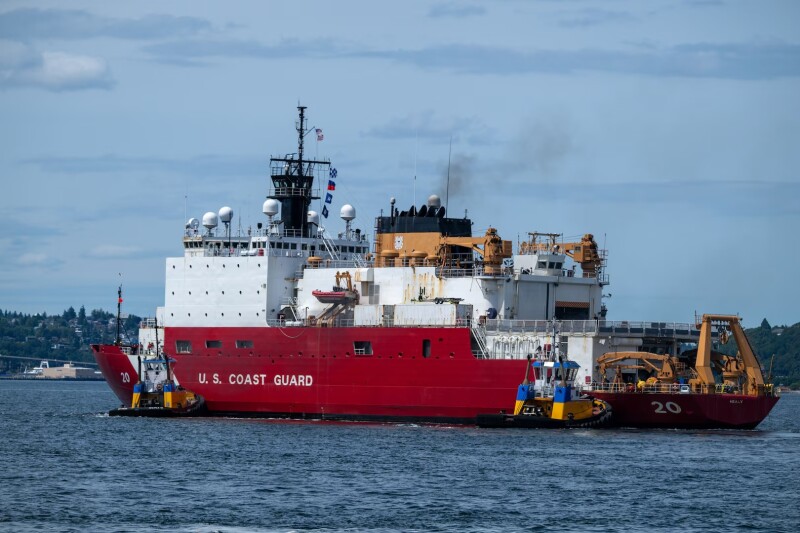
The U.S. Coast Guard has sought an assessment of damaged engine components aboard the icebreaker Healy to determine which parts can be recovered and reused following a major machinery failure in July.
An Oct. 21 procurement notice, detailed in a Nov. 24 gCaptain report, calls for a comprehensive inspection of the cutter's No. 2 main propulsion diesel engine, a Sulzer 12ZAV40S, at Coast Guard Base Seattle. The work includes evaluating component wear, measuring clearances, and identifying parts suitable for reclamation.
The contractor would be required to submit a report documenting its findings, including measurements and high-resolution photographs. An optional work item, capped at $100,000, covers inspection, repair, and requalification of the engine's camshaft.
The Coast Guard announced its intention to award the work on a sole-source basis to Chesapeake, Va.-based Defense Maritime Solutions. The inspection was scheduled for Oct. 26–30.
The work follows a July engineering casualty that forced the 420' cutter to return to Seattle under tow. The vessel was operating northwest of Port Angeles, Wash., when the failure occurred. It was towed to its homeport July 13, disrupting its planned Arctic deployment. No injuries were reported.
Separate Coast Guard procurement documents describe a catastrophic overspeed failure of the No. 2 main propulsion diesel generator. The incident also caused a fire in Generator Room No. 2, damaging fire detection equipment and wiring.
The Coast Guard has also sought maintenance on the vessel's No. 1 and No. 3 diesel generators, including their governors and overspeed protection systems. An October work specification states that both engines had accumulated more than 40,000 operating hours, with no documented service or overhaul of their governors and boosters. The work also includes replacing a damaged cylinder head on engine No. 3.
Commissioned in 1999, Healy supports Arctic research and Coast Guard operations. The cutter has experienced significant machinery casualties before, including a propulsion motor fire in 2020 that forced it to abandon an Arctic deployment.
The available procurement records do not establish the results of the salvage assessment, whether the No. 2 engine can be returned to service, or when Healy might resume operations.
