



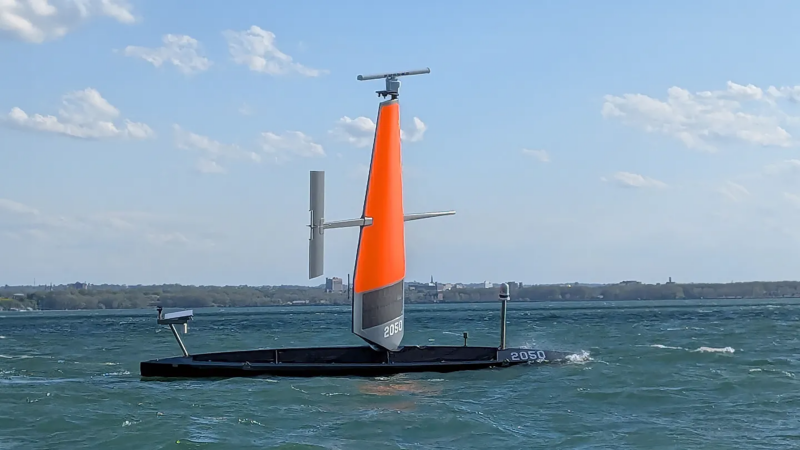
The U.S. Coast Guard is deploying a fleet of 16 Saildrone Voyager uncrewed surface vehicles (USV) across the Great Lakes and Northeast Atlantic under a $15.5 million contract signed in March, as the agency moves to expand its use of autonomous technology for maritime surveillance.
The Great Lakes district will operate its portion of the fleet from May through October. In the Northeast, the vessels will monitor fishing activity in the North Atlantic. The autonomous craft are wind- and solar-powered and equipped with high-resolution cameras, radar, automatic identification system receivers, and collision-avoidance artificial intelligence. Human operators monitor the vessels continuously and can assume manual control if needed.
The deployment represents a geographic expansion of an existing relationship. Saildrone has supported Coast Guard operations since 2023, initially in the Southwest and Southeast districts on counter-drug and migrant interdiction missions, safety-of-life-at-sea operations, and efforts to combat illegal, unreported, and unregulated fishing.
"The expansion of our partnership with the Coast Guard into the Great Lakes and Northeast regions reflects the value Saildrone has delivered in prior missions," said Saildrone President and retired U.S. Navy Vice Adm. John Mustin. "This Voyager fleet will help the Coast Guard maintain persistent, scalable maritime domain awareness across these expansive waters, identifying threats in real time and enabling focused, high-impact interdiction."
In the Great Lakes, the primary mission focus is border security — monitoring cross-border vessel traffic and flagging potential smuggling activity along a stretch of maritime border that is difficult to patrol consistently due to its scale and variable seasonal conditions. In the Northeast, the goal is detecting illegal fishing activity in waters the Coast Guard has described as vast and operationally demanding for crewed patrol vessels.
The Saildrone Voyager measures 33' and is designed for persistent surface and subsurface surveillance. Data is transmitted near-real-time to Coast Guard command centers ashore. The Coast Guard says the drones will also gather weather data to support emergency response planning.
The operational model is built around preserving crewed assets for enforcement. By maintaining continuous autonomous coverage across wide areas, the Coast Guard aims to deploy manned vessels only when a confirmed threat warrants a response.
In addition to surveillance, the Voyager platform is capable of near-shore mapping and seafloor characterization missions.
