


The U.S. Coast Guard has awarded Furuno USA, Camas, Wash., an indefinite-delivery, indefinite-quantity (IDIQ) contract valued at up to $49 million to supply next-generation surface search radar systems for its fleet and shore-based operations. Under the contract, known as NXSSR, Furuno will provide solid-state X-band and S-band radars for cutters, large platforms and shore facilities.
The award was made Sept. 23. A kickoff meeting has been held, and the Coast Guard has issued the first delivery order. It is Furuno’s first Coast Guard IDIQ in almost 10 years, and it builds on the company’s long history supplying navigation technology to U.S. maritime operations.
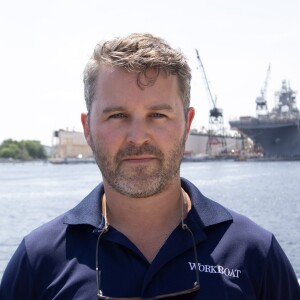
“It’s an interesting evolution from where we’ve been and where the Coast Guard wants to go,” said Matt Wood, Furuno USA’s national sales manager.
The contract covers nearly all cutter classes. Wood said the opportunity includes more than 200 afloat platforms and more than 400 shore sites. Because some vessels will carry one radar and others two or more, he said Furuno expects the contract could support more than 700 radars.
X-band radars, often called 3-centimeter radars, will handle most navigation and on-water target detection. S-band radars will go primarily to shore sites, though some will be installed on larger cutters. The National Security Cutter, Offshore Patrol Cutter and icebreaker classes already use S-band radars.
The Coast Guard is also moving to simplify its equipment. Wood said the service has been running older X-band radars alongside a hybrid S-band system, and now wants a standard commercial off-the-shelf S-band radar. The Coast Guard will handle integration and interfacing downstream of the radar’s signal output.
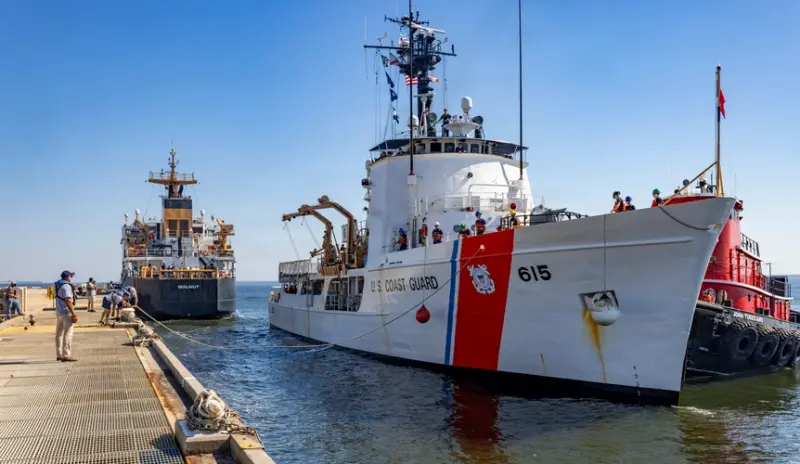
The contract is built around eight core components: antenna arrays, gearbox, processor, keyboard, cable and related items. The Coast Guard can mix and match them to configure everything from an 87' patrol boat to a 210' cutter. Spares, cable, pedestals and monitors are included in the contract, along with a few third-party integrations specific to homeland security missions.
The award also reflects a broader push to consolidate around a single outside vendor for vessel traffic systems, Coast Watch, effectively creating a common supplier for maritime domain awareness afloat and ashore. Wood said the vessel traffic work is new territory for Furuno, as the Coast Guard gradually replaces equipment from several other radar providers.
“Both the Coast Guard and the Navy have a little bit of a hodgepodge of technology,” Wood said. The goal is to standardize installations and reduce the variety of equipment in service, while the Coast Guard continues its own software and hardware development.
The first delivery order covers first-in-class installation work, in which the Coast Guard will determine how to mount and integrate the radars on each vessel class, as well as laboratory and training prototypes. Equipment will go to the Coast Guard’s C5I Integration and Support Center, Portsmouth, Va., which will lead prototyping for both ship and shore systems. Training prototypes will go to the service’s maintainer school in Petaluma, Calif. Wood said the Coast Guard is also working out how to integrate the radars on emerging vessel classes that don’t yet have an established standard, and Furuno expects adoption to follow as new cutter classes are approved.
Nearly all of the Coast Guard’s earlier radars were magnetron-based. Moving to solid state eliminates magnetrons and the microwave integrated circuits that drive them.
“If I take my Furuno hat off and put my taxpayer hat on, there are no magnetrons to replace,” Wood said. “Realistically, they are saving at minimum several thousand dollars per radar per year in maintenance forever.”
Solid-state radars cost somewhat more up front, he said, but with the Coast Guard running them virtually around the clock, Furuno estimates the price difference pays for itself in two to three years. Over a 10- to 12-year life cycle, Wood said, the radar can effectively pay for itself. The new systems also bring improvements in signal processing and target presentation.
Because Furuno is largely replacing its own equipment, much of the physical footprint is unchanged. The gearbox has the same bolt pattern, so crews won’t need hot work on a mast, and only the signal cable has to be changed, Wood said. A common user interface and common components should also make repairs and replacements easier.
The new radars also move the Coast Guard toward type-approved Ethernet under the IEC 61162-450 standard, bridging the gap from NMEA 0183 and NMEA 2000. Cybersecurity is a growing focus, Wood said, and Furuno has only started that work. “It’s fun to be on both the leading edge and the bleeding edge of some of those integrations,” he said.
Federal postings describe the deal as a 10-year contract capped at $49 million. In practice, it is a five-year base period with five option years. Based on similar IDIQs, Wood said, Furuno expects it to run the full 10 years. Actual purchases will depend on Coast Guard budgets and fleet needs.
Furuno must also service the radars for at least five years after the contract ends. “We make the incremental improvements that really matter to the mariner,” Wood said. “We support our product right up front, and we support our product for a really long time.”
Wood said Furuno hopes the award will lead to further work with the Coast Guard as the service integrates more technology over the next several years. “We’re looking forward to improving the way that Coast Guard folks, both on ships and ashore, are able to do their jobs, with more comfort and security.”
