



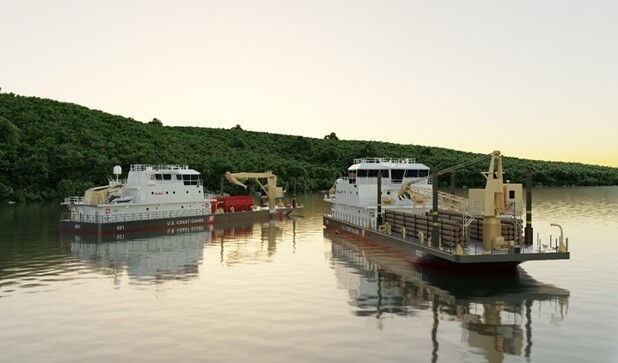
The U.S. Coast Guard has advanced its inland fleet modernization program by ordering the first river buoy tender and long lead time materials for the second inland construction tender under the waterways commerce cutter (WCC) program, the service announced on Tuesday.
The vessels will be built by Birdon America Inc., Denver, at its shipyard in Bayou La Batre, Ala. The Coast Guard said it also placed an order for three additional sets of long lead time materials to support future production, bringing the total value of the combined orders to approximately $110 million.
Funding for the procurement includes $51 million from Public Law 119-21, also known as the One Big Beautiful Bill Act, with the remainder provided through regular appropriations.
The WCC program replaces the Coast Guard’s aging inland tender fleet, which averages nearly 60 years in age, with some vessels still in operation after more than 80 years of service. The inland fleet is responsible for maintaining over 28,200 aids to navigation (ATON) along 12,000 miles of waterways that move approximately 630 million tons of cargo annually.
The 180' river buoy tenders (WLR) service short-range ATON on the Western Rivers, while the 160' inland construction tenders (WLIC) are tasked with building and maintaining fixed navigation aids along the Eastern Seaboard and Gulf Coast.
In 2022, Birdon was awarded a contract worth up to $1.187 billion to design and build 27 new WCC vessels, including 16 WLRs and 11 WLICs. The company began building the first WLIC in June for scheduled delivery in 2027. Construction on the first WLR is now cleared to begin, with completion expected in 2027, according to the Coast Guard.
“Putting new waterways commerce cutters on contract ensures we have the capabilities needed to support the safe and efficient flow of commerce in our inland waterways systems,” said Rear Adm. Mike Campbell, the Coast Guard's Director of Systems Integration and Chief Acquisition Officer.
A third WCC variant, the 120' inland buoy tender (WLI), will be acquired under a separate contract. The Coast Guard said it plans to order three WLIs.
The Coast Guard has said that the new tenders will have greater endurance, speed, and deck load capacity than their predecessors. The three cutter variants — each of which will be self-propelled, monohull vessels — will also feature improved habitability.
In August, the Coast Guard announced that its new fleet of WCCs — the CB-ATON-S class — will be designated the “Chief Petty Officer class.” Each cutter will be named in honor of a Coast Guard chief petty officer.
