



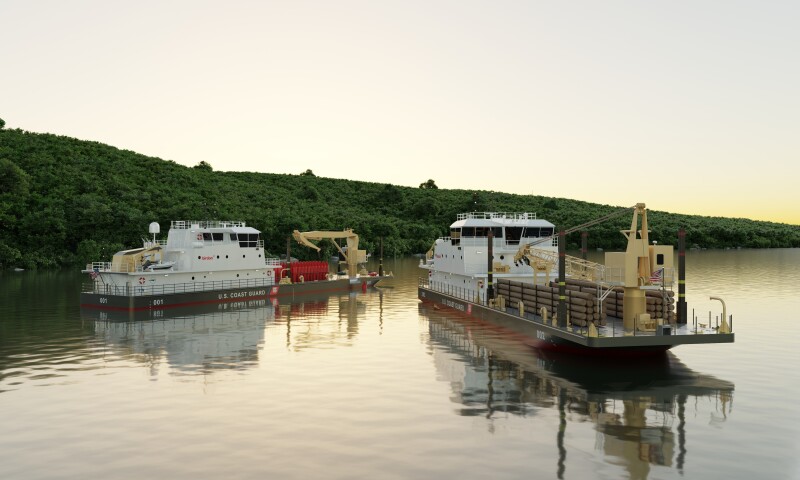
The U.S. Coast Guard announced Thursday that its new fleet of waterways commerce cutters (WCC) will be designated the “Chief Petty Officer class.” Each cutter will be named in honor of a Coast Guard chief petty officer.
The WCCs will replace the Coast Guard’s aging river tender fleet and will support the safe, secure, and reliable flow of commerce on the nation’s marine transportation system. The cutters will maintain aids to navigation, ensuring the safe movement of goods, energy, and materials across U.S. waterways.
In 2022, Birdon America Inc., Denver, was awarded a contract worth up to $1.187 billion to design and build 27 new WCC vessels, including 16 180' river buoy tenders (WLR) and 11 160' inland construction tenders (WLIC). The company began building the first WLIC at its Bayou La Batre, Ala., shipyard in June. Construction on the first WLR is planned to begin by the end of this fiscal year, according to the Coast Guard.
To date, the Coast Guard has received approval to produce the first eight WCCs. Funding is supported by the One Big Beautiful Bill Act, which provides nearly $25 billion, including $162 million to accelerate production and deliver three cutters ahead of schedule.
The class naming announcement was made on National Lighthouse Day. The Coast Guard maintains nearly 45,000 navigational aids nationwide and has been responsible for maritime navigation and commerce safety since 1789.
“Since 1920, chief petty officers and the chiefs mess have driven Coast Guard readiness and operational excellence,” Master Chief Petty Officer of the Coast Guard Phillip Waldron said in a statement. “These new cutters and their crews will build on that legacy, ensuring maritime commerce flows safely and we continue to control, secure, and defend our inland ports and waterways and marine transportation system.”
A third WCC variant, the 120' inland buoy tender (WLI), will be acquired under a separate contract. The Coast Guard said it plans to order three WLIs.
The Coast Guard has said that the new tenders will have greater endurance, speed, and deck load capacity than their predecessors. The three cutter variants — each of which will be self-propelled, monohull vessels — will also feature improved habitability.
