



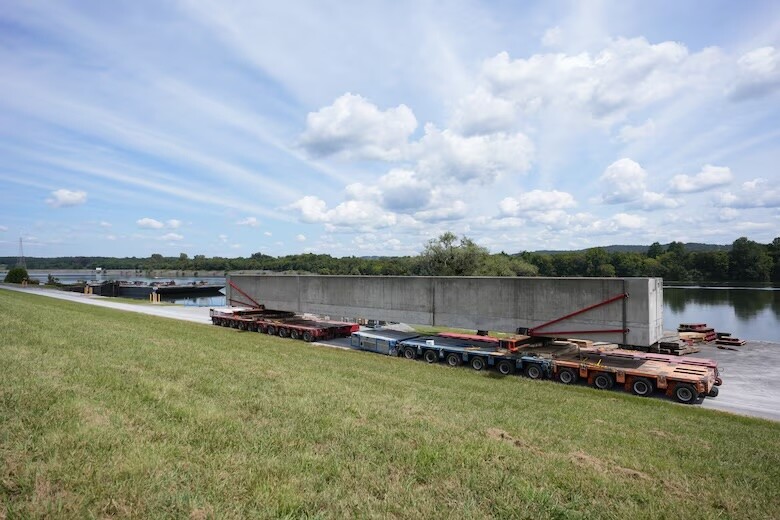
After more than a decade in storage, concrete wall beams are finally on the move for the U.S. Army Corps of Engineers’ (USACE) Chickamauga Lock Replacement Project.
On Aug. 29, the Corps’ Nashville District began transporting the first of 12 upstream approach wall beams from Watts Bar Dam to the Chickamauga site. Each beam measures 120’x10’x10’ and weighs about 463 tons. A USACE press release noted the seven-hour barge trip marks a key step in completing one of the Tennessee River Valley’s most significant inland navigation projects.
“These beams are a critical component of the upstream approach wall contract and getting them to the site is a huge step forward,” said Bob Winters, project manager for the Chickamauga Lock Replacement Project.
The beams, originally fabricated under a 2010 contract and completed in 2013, were stored at TVA’s Watts Bar facility until now. Contractor CJ Mahan, Columbus, Ohio, subcontracted Barnhart, Memphis, Tenn., to move the infrastructure using a hydraulic power system to carefully transfer the beams onto barges.
Three barges are rotating to deliver one-to-two beams per day, with the operation expected to run through mid-September. Once at the project site, cranes will lift the beams into place between bridge supports, where crews will secure them with steel restrainer bars.
The Corps recently lowered the nose pier on the riverside wall to its final configuration, preparing the structure to receive the beams. The pier is designed to help vessels align with the lock entrance and provides mooring space for large tows.
On Sept. 2, the Corps said the upstream approach wall contract is now about 68% complete, with overall completion projected in early 2026. Once the wall beams are set, final demobilization will begin.
“Watching the transport of the beams is incredibly exciting and a testament to the hard work of both the government and contractor teams in executing this contract as efficiently and safely as possible,” said Cayce Grall, project site manager.
The new 110’x600’ lock is expected to handle nine jumbo barges in one lockage, compared to just one barge at a time in the existing structure. That upgrade represents an 80% efficiency increase for the navigation industry moving goods along the Tennessee River, the Corps said.
