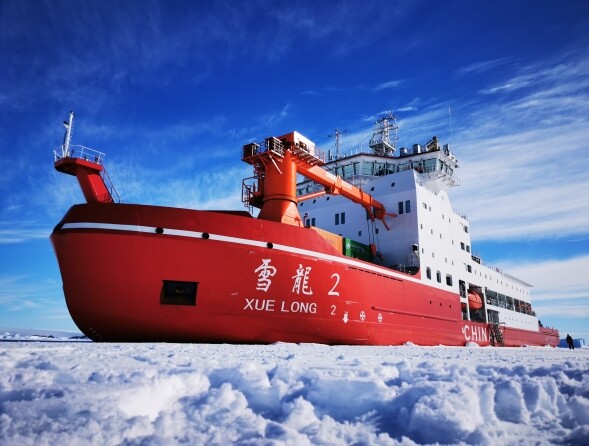
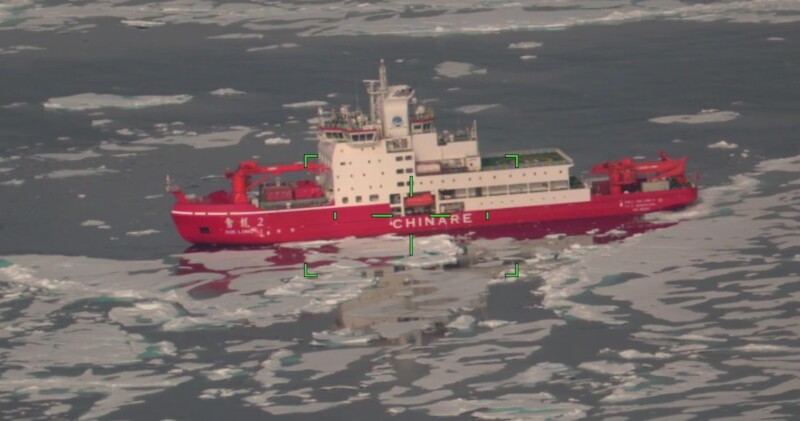
The U.S Coast Guard and Canadian forces tracked a Chinese icebreaking research vessel in U.S. Arctic waters, at one point 290 nautical miles north of Utqiagvik, Alaska, on Friday.
A Coast Guard C-130J Hercules fixed wing aircraft from Air Station Kodiak responded to the Xue Long 2, operated by the Polar Research Institute of China and detected 130 nautical miles inside the boundary of the U.S. Extended Continental Shelf (ECS). The U.S. hold “exclusive rights to conserve and manage the living and non-living resources of its ECS,” Coast Guard officials said in announcing the encounter.
“The U.S. Coast Guard, alongside partners and other agencies, vigilantly monitors and responds to foreign government vessel activity in and near U.S. waters to secure territorial integrity and defend sovereign interests against malign state activity,” said Rear Adm. Bob Little, Commander of the U.S. Coast Guard Arctic District.
Earlier in the week CBC News reported the 410’x73’ Xue Long 2 was tracked by Canadian authorities following its July 6 departure from Shanghai and passage past Japan north to the Bering Strait.
The Xue Long (“Snow Dragon”) 2, commissioned in 2019, has a designed displacement of “about 13,990 tons, a maximum speed of 18 knots, an endurance of 20,000 nautical miles and a capacity of 101 people,” according to an online summary from the Polar Research Institute of China. “It can continuously break through the ice layer of 1.5 meters thick at a speed of 2-3 knots.”
The C-130J aircraft was operating under Coast Guard Arctic District’s Operation Frontier Sentinel, “which is designed to meet presence with presence in response to adversary activity in or near Alaskan waters,” according to the Coast Guard. The CBC reported “the Canadian Joint Operations Command is actively monitoring the vessel Xue Long 2 with a CP-140 Aurora aircraft, based out of Alaska."