



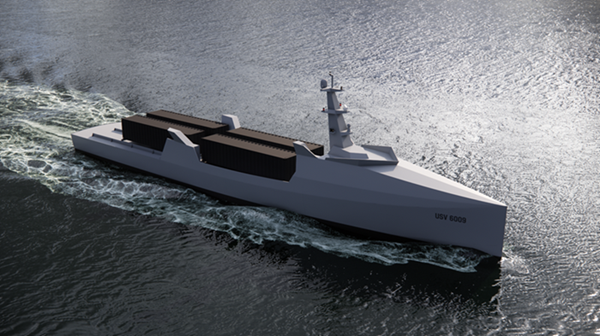
Blue Water Autonomy, Boston, Mass., announced a series of strategic partnerships aimed at scaling production of its autonomous vessels through a distributed manufacturing model that combines traditional shipbuilding capacity with AI-enabled production systems.
The announcement follows the company’s recent unveiling of its Liberty Class autonomous vessel, a 190’ ship designed for the U.S. Navy and currently under construction at Conrad Shipyard. Blue Water said the partnerships are intended to support production growth tied to the Navy’s Medium Unmanned Surface Vessel (MUSV) program, which represents more than $6 billion in funding.
“Traditional shipbuilding doesn’t scale, and pure software approaches don’t deliver hardware,” said Rylan Hamilton, CEO of Blue Water Autonomy. “We’re doing both. Integrating proven marine systems with AI-driven manufacturing and operations to fundamentally rethink how ships are built. By distributing and parallelizing work across proven partners, we’re creating a production system that can move at the pace required for a modern maritime industrial base.”
Blue Water’s manufacturing model relies on multiple industrial partners handling different portions of vessel production and digital coordination.
Tulip will provide the company’s manufacturing execution system, which Blue Water said will allow real-time coordination and monitoring of production activities across shipbuilding operations.
“Shipbuilding has always required extraordinary coordination, and we're giving that coordination a software backbone,” said Erik Mirandette, chief business officer at Tulip. “Tulip connects every step on the factory floor with real-time data and AI-native tools, so Blue Water can orchestrate production at scale, catch issues earlier, and build with the speed and reliability that modern maritime demands.”
Caterpillar Defense will supply marine diesel engines for Blue Water’s vessels, while Precise Power Systems is providing integrated containerized engine modules designed for extended autonomous operation.
Valsted will support the effort with manufacturing automation systems, including modular structural panel kits and robotic fabrication cells intended to support distributed ship production.
Blue Water said the approach is designed to digitize traditionally fragmented shipbuilding processes through software-driven coordination between suppliers and production partners. The company said the model is intended to improve production speed, increase manufacturing flexibility, and expand overall shipbuilding capacity.
The company is currently conducting vessel testing and plans to hold a live autonomy demonstration later this summer.
