



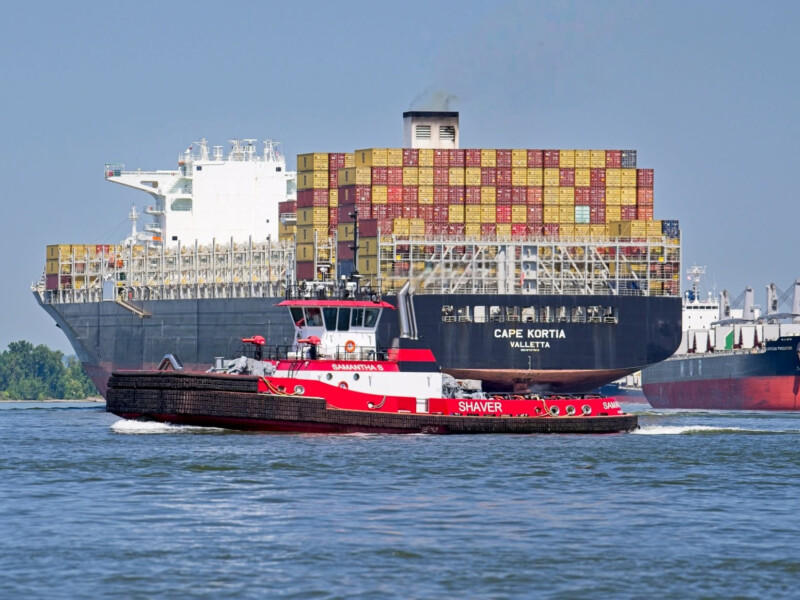
Deepened channels, new or expanded LNG and cargo terminals, and the massive ships that call on them may garner many of the national headlines related to the maritime industry, but behind all those vessel movements are the tugboats that help maneuver and escort ships throughout the deepwater ports and waterways of the United States.
To meet market demands, the nation’s tugboat fleet is changing, whether through newbuilds, acquisitions, or repowers. With regional market pressures determining individual fleet dynamics, builders, owners, and operators generally agree that the near- and long-term outlooks for the nation’s tugboat fleet are strong.
THE LNG FACTOR
A key driver in the South is liquefied natural gas and the liquefaction terminals where LNG is loaded onto vessels for export. Gulf Coast terminals include Plaquemines LNG on the Mississippi River and Calcasieu Pass LNG and CP2 LNG on the Calcasieu River, owned by Venture Global; Sabine Pass Liquefaction and Corpus Christi Liquefaction, owned by Cheniere; Cameron LNG and Port Arthur LNG, owned by Sempra Infrastructure; Golden Pass LNG, a joint venture of QatarEnergy and ExxonMobil; and privately held Freeport LNG. Several additional terminals — including Woodside Energy’s forthcoming Louisiana LNG near Lake Charles, La. — and terminal expansions are in various stages of planning.
Beyond the Gulf Coast, Cove Point LNG, owned by Berkshire Hathaway Energy, is an import and export facility on the Chesapeake Bay near Lusby, Md.
As LNG terminals ramp up production and global energy markets rely more heavily on U.S.-sourced natural gas, increased LNG carrier traffic is translating into greater demand for tugs.
“LNG terminals create increased tug demand because LNG carriers require specialized support during arrival, transit, standby, docking, and departure when requested,” said Ron Droop, senior vice president of Moran Towing Corp. “These operations may require additional assets with qualified crews to meet the safety and operational requirements of the terminal and vessel.”
It’s not just the sheer size of LNG carriers. In some cases, tug availability may be factored into an LNG terminal’s permit application or a requirement of the channels where LNG carriers operate.
“LNG carriers have different ship-assist considerations than containerships or conventional tankers,” Droop said, “because there may be designated escort requirements during portions of a vessel’s transit, particularly in areas with regulated safety zones or where the consequences of an incident are considered significant.
“Docking and undocking also require highly maneuverable, powerful tugs capable of performing to pilot requirements,” Droop added.
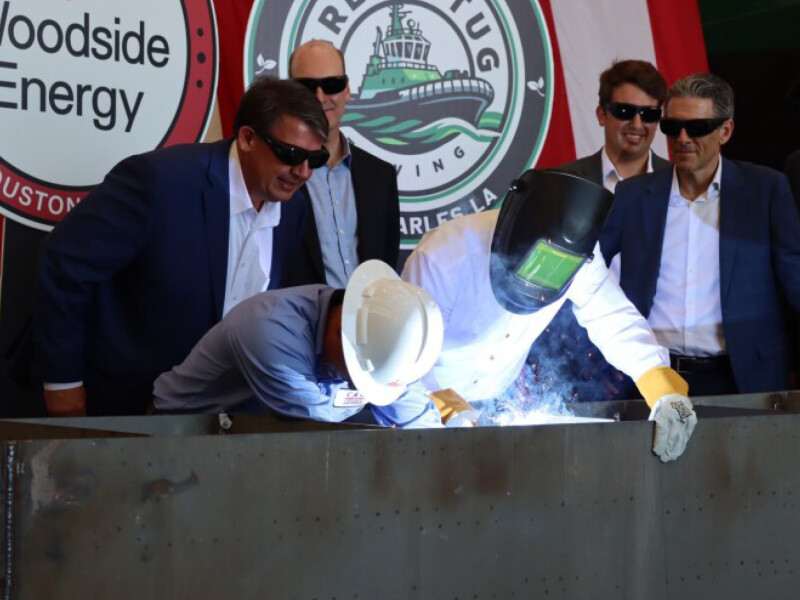
In many cases, tugboat construction projects are directly tied to LNG terminals. C&C Marine and Repair in Belle Chasse, La., is amid an eight-tug build program managed by Harbor Docking & Towing (HDT). Four of those tugboats will support Woodside Energy’s forthcoming Louisiana LNG terminal. Woodside signed a $300 million contract with Green Tug Towing, which will provide towing services for LNG carriers calling on Louisiana LNG under a 20-year agreement. Green Tug is a joint venture between HDTowing and Saltchuk Marine Terminal Services.
Tony Cibilich, president of C&C Marine, said the eight tugboats for HDT and Green Tug Towing will break new ground for the shipyard’s portfolio.
“We’ve built diesel-electric vessels before, but these will be our first diesel-electric escort tugs,” Cibilich said. “They’re Robert Allan-designed vessels with 88 metric tons of bollard pull, accommodations for six, ABS escort tug classification, and FiFi 1 firefighting capability.”
Cibilich added that the hybrid system aboard the Woodside vessels will allow them to operate in four different power modes based on demand.
“It’s a more complex system than a traditional towboat, but we’re comfortable building complicated vessels,” he said. “It gives our team a chance to apply what we already know while expanding into a new part of the market.”
BIG SHIPS, BIG NEEDS
And while several operators and shipbuilders acknowledged that LNG terminals are a significant driver for tug demand today, that’s only part of the picture. New container and general cargo terminals, the overall growth of cargo ships, and the aging tugboat fleet are other factors translating into newbuilds and fleet acquisitions.
“It’s a confluence of all those factors,” said Beau Berthelot, senior vice president of corporate affairs for Maritime Partners, Metairie, La. “As we understand it, the LNG terminals want reliable, dedicated ship-assist and escort services, and there is a safety factor embedded as well. There is also the general phenomenon that ships have increased in size over time, and the tugs built 20, 30, or 40 years ago do not have the same power capacity, maneuverability, fuel efficiency, and reduced environmental impact as modern tugs.”
Maritime Partners, founded in 2015, specializes in maritime financing, leasing, and bareboat charters. While the company focused initially on the towboat and barge industry, Maritime Partners has expanded into the Jones Act tanker fleet and the tugboat market. The company owns two tugs on charter with Signet Maritime in Ingleside, Texas, and is building a series of eight tugboats with Coden, Ala.-based Master Boat Builders. To date, Master Boat has delivered two of those vessels, the Marauder and Titan, which are on charter with E.N. Bisso & Son, New Orleans.
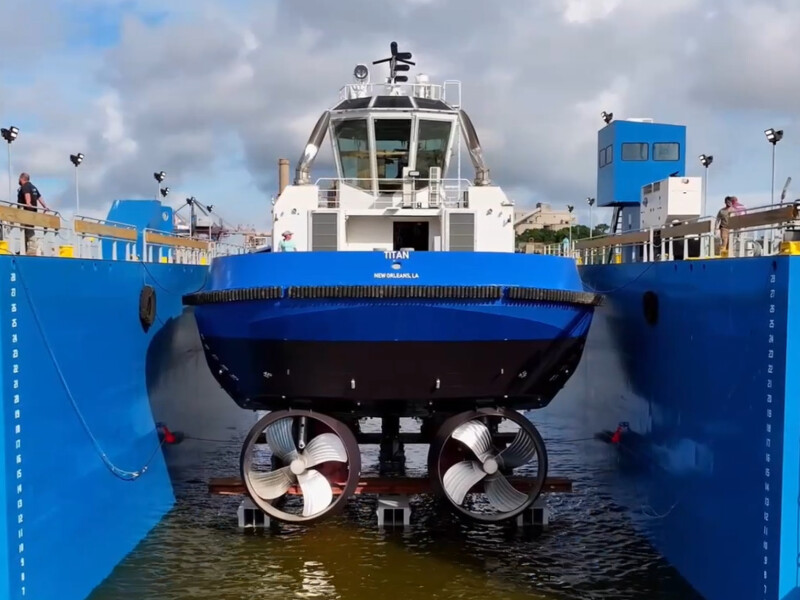
The vessels in the series from Master Boat Builders measure 88'x43' and feature twin Caterpillar 3516E engines that each produce 3,500 hp at 1,800 rpm. The main engines drive Steerprop Z-drives from Karl Senner LLC. The tugs provide more than 90 metric tons of bollard pull and have a top speed of around 13 knots.
Garrett Rice, president of Master Boat Builders, said the combination of Caterpillar main engines and Steerprop thrusters — relatively new for tugboats in the United States — meets a need for modern, higher-horsepower, and higher-bollard-pull tugboats in the fleet.
“The market conditions are there,” Rice said of his long-term outlook on the demand for new tugboats. “The fleet is still aging. China and Korea are still building larger oceangoing containerships and tankers at a rate faster than we’ve ever seen it. International commerce by water is as high as it’s ever been. Every container terminal or tanker terminal is trying to move ships in and out of there faster. They need and want bigger tugs, and they want more of them where it’s economically feasible.” Droop echoed that market assessment.
“The market is not simply asking for more tugs,” he said. “Larger vessels require modern assets with the increased bollard pull and maneuverability to safely and efficiently control, stop, and guide them.”
Since 2021, Moran has been pursuing a newbuild program and modernizing its fleet, adding 22 vessels while also expanding through acquisitions, most recently by taking on 11 vessels from Bisso Towboat.
“That investment allows us to address both sides of the equation: having the capacity to support growing port and terminal activity, while also having the capability to safely handle larger and more complex vessels,” Droop said. “Ultimately, harbor deepening, terminal expansion, and larger vessels are creating a long-term need for tug operators to invest, not just in fleet size, but in fleet capability.”
NEW LIFE FOR OLD BOATS
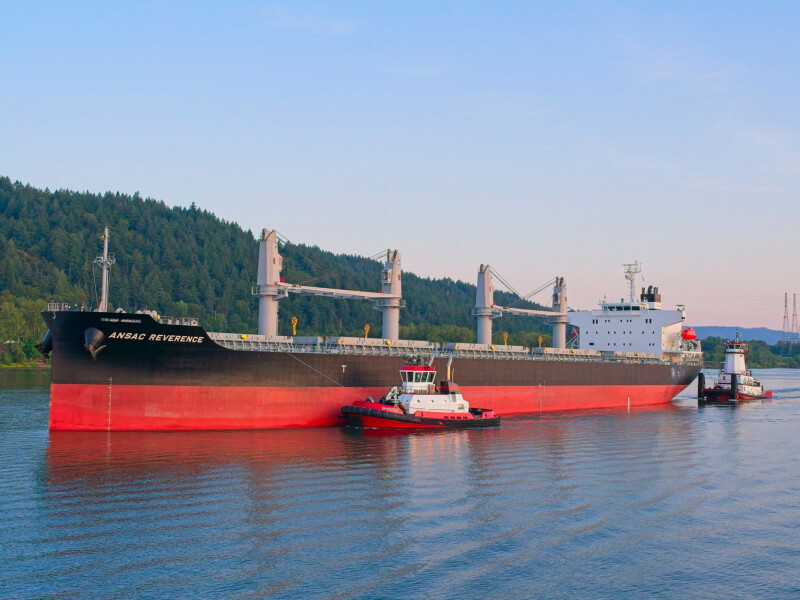
In certain circumstances, operators are opting to extend the life of existing vessels in their fleets through repowers. That approach is attractive in the present high-inflation market, especially if the existing vessel is already meeting an operational need, said Steve Shaver, president of Portland, Ore.-based Shaver Transportation Co.
“A new ship-assist tug is pushing $20 million, whereas you can redo one of the older ones, put in new drives and new engines, for maybe $5 million,” Shaver said. “It makes a lot of sense to upgrade older vessels, and that’s what we’re doing right now with two of our boats. We’re putting Z-drives and Tier 4 engines in both of them right now.”
Shaver compared it to putting a new LS engine into an older Corvette.
Shaver Transportation also has newer vessels at work in the Pacific Northwest, with the Samantha S, built by Diversified Marine Inc., Portland, Ore., in 2018, offering 8,400 hp, more than 100 tons of bollard pull, and a square bow for facing up with ships. The company’s Heather S, also built by Diversified Marine, debuted last year. It features 7,000 hp and 100 tons of bollard pull.
John Buchanan, president of Lake Charles, La.-based Harbor Docking & Towing, said his company is doing the same, though a repower isn’t always feasible.
“The challenge is finding equipment that can be modernized effectively,” Buchanan said. “A conventional twin-screw tug cannot simply be upgraded by adding thrusters. Its beam and draft often do not support [azimuth stern drive] conversions and may create stability concerns for ship-assist work.”
Choosing between a newbuild or a refurbishment depends on a vessel’s market and long-term operational needs, Droop said.
“Newbuilds give us the greatest ability to design a tug around the exact capability and mission we need,” he said. “We can specify the horsepower, bollard pull, propulsion, technology, emissions systems, and crew accommodations from the beginning. That makes newbuilds particularly attractive when we have confidence in long-term demand. The tradeoff is that they are capital intensive, and today’s vessels are increasingly complex to design and build, which can mean longer construction timelines and higher costs.
“Refurbishment can be attractive when you have a fundamentally sound hull and a platform that still has useful life,” Droop added. “It can allow us to extend the life of a vessel, improve its capabilities, and make targeted investments without the cost and timeline of a completely new vessel. But there is a point where you have to recognize that you are putting too much money into an older platform. As the cost of machinery, propulsion, regulatory upgrades, technology, and maintenance increases, there can be a point where a newbuild provides better long-term value.”
JONES ACT CONCERNS
Owners, operators, and shipbuilders across the board expressed confidence in the long-term demand for the tugboat fleet from coast to coast. One vector of concern they expressed, though, was the ongoing Jones Act waiver.
“The Jones Act creates a demand floor to maintain domestic shipbuilding capabilities and maintain a pool of merchant mariners,” Berthelot explained. “When the law that creates this floor is compromised or called into question, capitalists react accordingly — pausing, reevaluating, and in some cases, redirecting investment. The longer the waiver continues, the worse this uncertainty becomes.”
“For C&C,” Cibilich said, “it really comes down to confidence in the future. Shipbuilding decisions are made years before a vessel enters service. An owner signing a contract today has to believe the rules will still be the same two or three years from now. When domestic trade can suddenly be opened to foreign vessels through executive action, it creates uncertainty and makes the decision to invest in new U.S.-built vessels more difficult.”
While the full impact of recent Jones Act waivers on the tug industry remains unclear, Droop said he worries about the precedent they set for the broader U.S. maritime workforce.
“What concerns me is the idea of waivers becoming a routine tool rather than the exception,” Droop said. “If that happens, it doesn’t stay contained to one type of vessel. It works its way through the domestic maritime supply chain and ultimately affects the American mariners, shipyard workers, and other professionals whose livelihoods depend on a strong domestic fleet.”
