


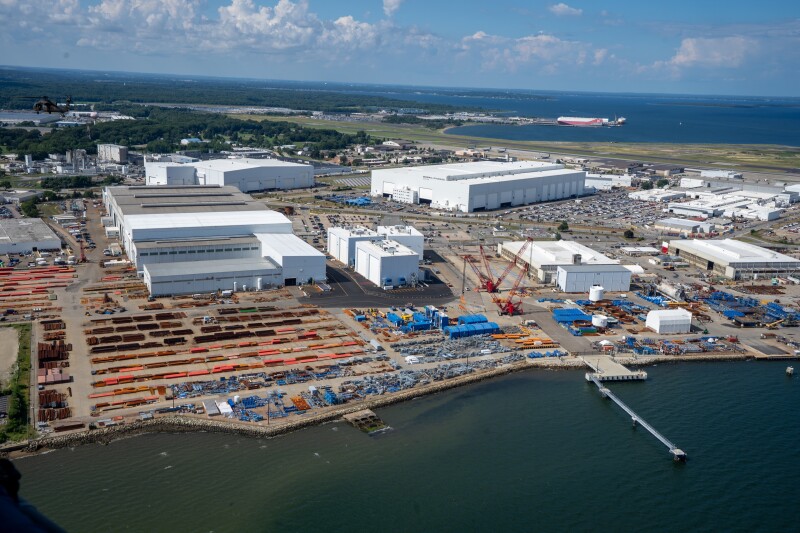
Tucked along the Rhode Island coast, General Dynamics Electric Boat’s Quonset Point facility is humming with activity. This sprawling shipyard is where some of the world’s most advanced ballistic missile nuclear submarines (SSBN) begin to take shape, piece by piece, in a production process that’s equal parts high-tech and hands-on.
As demand ramps up for the Navy’s Columbia- and Virginia-class subs, Quonset Point is expanding, investing in people, equipment, and infrastructure to keep pace with one of the United States’ most ambitious shipbuilding efforts in decades.
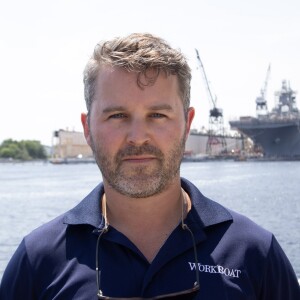
WorkBoat was recently granted rare access to the North Kingstown, R.I., facility through a tour led by Ray Gabriel, Electric Boat’s vice president of strategic operations, as part of a Rhode Island defense sector event organized by the Rhode Island Commerce Corp.
Gabriel, a 32-year Navy veteran who joined Electric Boat in 2016, was appointed in January to lead a new division focused on supplier coordination, off-site operations, barge logistics, and communications.
“The whole bottom line is the business is expanding,” said Gabriel. “This realignment has given us the opportunity to do things like this at an increased pace — with media, with government stakeholders, and with anyone who wants to understand how they can help meet this national imperative.”
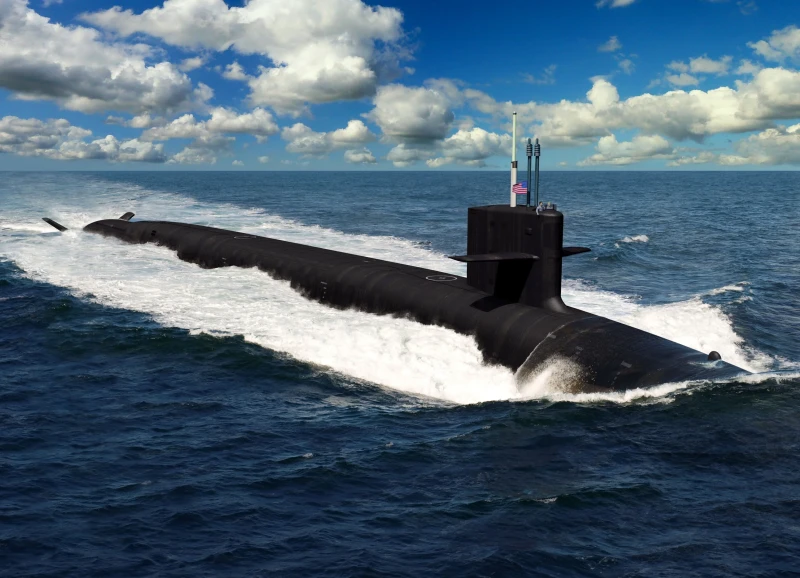
Electric Boat’s business spans several core areas: construction of Columbia- and Virginia-class submarines, engineering and platform design, and sustainment, maintenance, and modernization work at off-site naval facilities, including the Kings Bay and New London submarine bases, as well as the Pearl Harbor, Portsmouth, and Puget Sound shipyards.
Electric Boat’s modular construction process begins at Quonset Point. There, raw steel is cut, shaped, and welded into large pressure-hull cylinders. These sections are initially positioned vertically, which allows crews to efficiently install tanks, pipe systems, and other major components using overhead cranes. Most of the outfitting is completed while the cylinder remains in this vertical position, prior to painting. Once outfitting is complete, the cylinder is rotated to its horizontal or “ship’s position,” where it is prepared to receive the deck package that will be inserted into the hull.
Currently, there are roughly six hulls on the production floor, with four in the manufacturing stage. “No space goes unused,” he said, noting that each component and weld is tagged and documented by both the welder and an inspector.
PERSONNEL
Workforce development remains a priority. Electric Boat hires between 700 and 1,000 welders annually, training all in-house. Gabriel emphasized that productivity goals are secondary to safety and workmanship, he said. “Our safety record is the best ever,” he said. “We’re very proud of that.”
The facility uses 19 different hard hat colors to identify trades across the construction floor. Gabriel noted that approximately 5,000 new workers have been hired in recent years, with plans to bring in an additional 2,000. Training pipelines are designed to ensure workers are productive from day one.
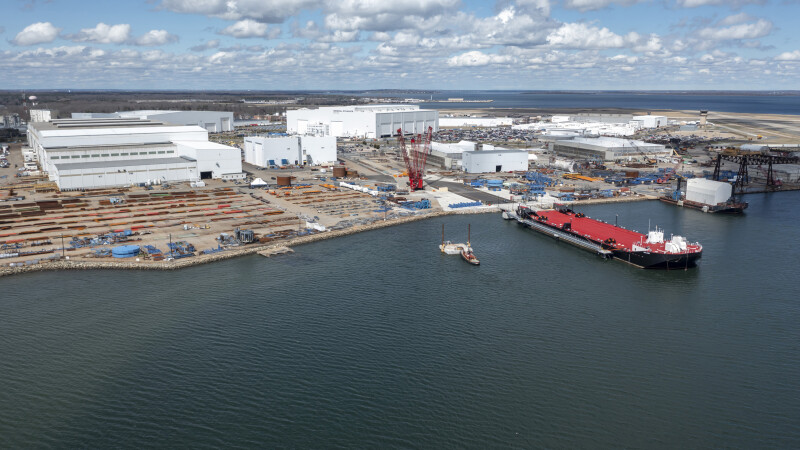
As hull modules progress through construction, they eventually become super modules. These are shipped via the company’s 400'x100' ocean transport barge Holland to Electric Boat’s Groton, Conn., facility or Huntington Ingalls Industries Inc.’s Newport News (Va.) Shipbuilding, for final assembly and testing. For Columbia-class subs, Electric Boat is the lead shipyard and assembles the entire platform in Groton. For the Virginia class, work is split between the two shipyards. Newport News is responsible for the bow and stern sections of the submarine.
Transport is managed by Connecticut tug operators such as Mohawk Northeast Inc., Plantsville, and Moran Towing Corp., New Canaan. The Holland, built by Bollinger Shipyards LLC, Lockport, La., was delivered to Electric Boat in December 2021. The company is due to receive its floating drydock, Atlas, also Bollinger-built, which will be used to launch Columbia-class submarines at Groton.
Electric Boat is serious about increasing production, Gabriel said. “In the Cold War, we were spitting out Los Angeles-class boats [at a rate of] almost three per year,” he said, referencing a historic production peak. “The goal now is to reach a steady-state production of one Columbia and two Virginias per year. That’s like delivering four and a half Virginias annually if you normalize for Columbia’s size.”
The 560'x43' Columbia class is the Navy’s top shipbuilding priority, said Gabriel. The program is being built in parallel with Block IV and Block V Virginia-class submarines, the latter featuring the Virginia payload module (VPM), which extends the 377' hull by 84' and increases the submarine’s Tomahawk missile capacity.
Challenges persist, as is typical for a production facility of this scale, said Gabriel, citing supply chain disruptions, reduced foundry capacity, generational workforce turnover, and the lasting impacts of the COVID-19 pandemic. Additionally, only three vendors currently produce castings for critical components such as hatches and trunks that meet Navy specifications. “That remains a bottleneck,” he said.
According to Electric Boat, collaborative robots (cobots) have increased efficiency by as much as 60%. Cobots are used for cutting, welding, and beveling thick steel plates, with machine and computerized welding increasingly common throughout the yard. Each robotic weld is overseen by at least one human worker, said Gabriel.
To support increased production and collaboration, Electric Boat has invested more than $2.2 billion in infrastructure upgrades across it’s Groton ($1.4 billion) and Quonset Point ($860 million) facilities. That includes a new advanced manufacturing center dedicated to missile tube construction for both Columbia-class and VPM-equipped submarines. The yard also supports a joint missile compartment program with the U.K.
Electric Boat will hold the keel laying for SSBN-827 Wisconsin on Aug. 27, marking another milestone in the Columbia program’s production ramp-up, said Gabriel. The yard is actively cutting parts for SSBN-829 and assembling major modules for several Virginia-class submarines as the company moves toward full-rate serial production by 2028.
Gabriel noted the Navy’s emphasis on accelerated deployment timelines. “The fleet is training the crews faster and putting these boats on mission earlier than they ever had,” he said. “But the safety and quality necessary for the sailors to go out remains the foundation, and it’s never compromised.”
Throughout the tour, Gabriel reiterated Electric Boat’s focus on production efficiency and quality control: “We’re very proud to say, of us and Newport News, the ships that we deliver to the fleet score the highest of any platform in the Navy’s in-service inspection.”
