



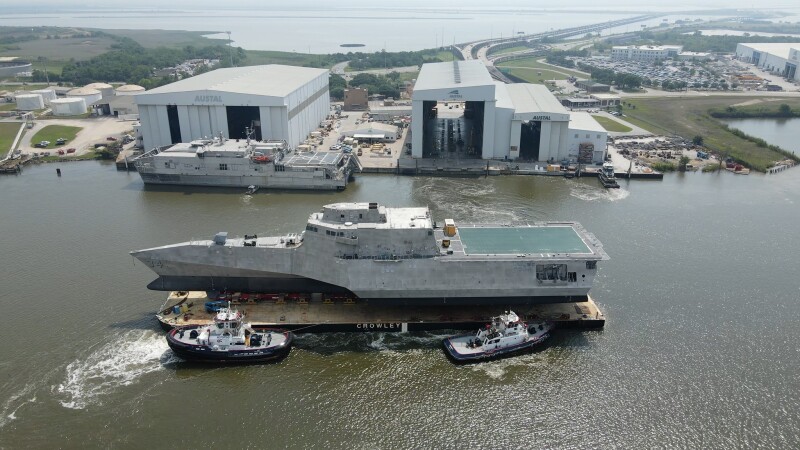
Austal USA has finalized a $100 million loan agreement with Export Finance Australia (EFA) to support expansion at its Mobile, Ala., shipyard, where the company builds vessels for the U.S. Navy and Coast Guard.
Austal said the EFA financing will assist construction of Final Assembly 2 (FA2), a new facility designed to increase production capacity for large steel-hull vessels. Austal broke ground in July 2024 on the 192,000 sq.ft. covered manufacturing facility, with final completion expected in the summer of 2026.
The shipyard said the 10-year loan reflects Austal’s long-term U.S. government contracts, including up to 11 U.S. Coast Guard Offshore Patrol Cutters and as many as seven U.S. Navy ocean surveillance ships (T-AGOS).
“Securing Australian government funding for our U.S. infrastructure expansion is a major milestone for Austal, enabling the company to execute on its $13.1 billion order book,” said Austal CEO Paddy Gregg. “It also facilitates the shared defense objectives between the Australian and U.S. governments and validates the relationship that exists between both governments and Austal.”
The Albanese Government is backing Australian defense companies to grow and export their world-class capabilities by securing lucrative international contracts,” Farrell said. “Austal’s expansion shows the strength of Australian businesses to export, invest, and support shared Australian-U.S. priorities such as defense.”
Austal said it is also advancing construction of its Module Manufacturing Facility 3 (MMF3), part of its broader effort to expand both shipbuilding and submarine production capacity in the United States.
The loan announcement follows last month’s memorandum of understanding between Austal and Master Boat Builders Inc., Coden, Ala.
Under the agreement, Austal USA and Master Boat Builders will collaborate on current Austal programs and future projects, creating flexibility to meet evolving fleet requirements. By distributing work across complementary facilities, the two companies intend to reduce production bottlenecks, shorten build schedules, and establish surge capacity for future demand. The partnership also includes plans to co-invest in workforce development initiatives to address skilled labor needs across the Gulf Coast shipbuilding sector.
