



When billionaires get together, their ambitions can get big.
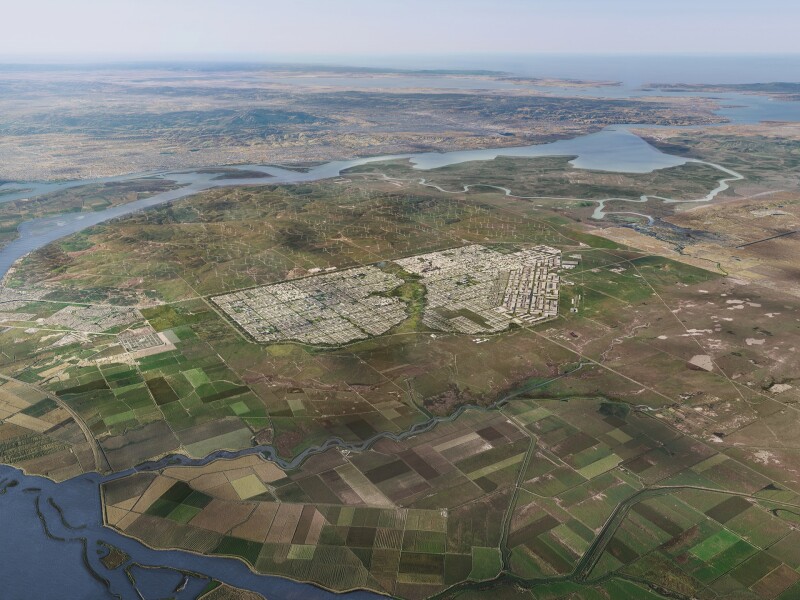
And they don’t get more audacious — or more expensive and controversial — than the proposed “California Forever” development northeast of San Francisco. Over the next 40 years, the project seeks to create the largest shipyard in the world, the biggest new manufacturing park in the United States, and a brand-new master-planned city of 400,000 people, larger than Cleveland, Ohio.
All plunked down in what is currently classified as “greenfield” farm country: rolling hills of undeveloped pastures and windfarms in rural Solano County, halfway between San Francisco and Sacramento. Initial funding for the massive project is being bankrolled by an elite group of wealthy Silicon Valley tech entrepreneurs who are pushing to sidestep normal regulatory reviews and break ground quickly.
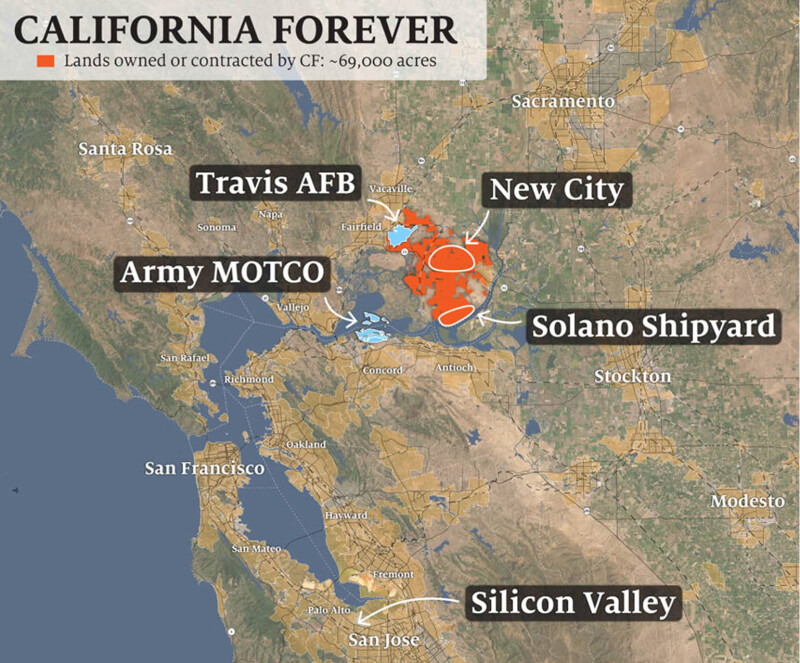
Among other things, California Forever would transform an empty 7,500-acre maritime industrial site on the banks of the Sacramento River (a tributary of San Francisco Bay) into a shipyard complex more than twice the size of the biggest shipyard in China. If ultimately built out, it would be the largest shipyard in the U.S., strategically located on the Pacific Coast, dwarfing the size and capacity of all existing private shipyards in the U.S.
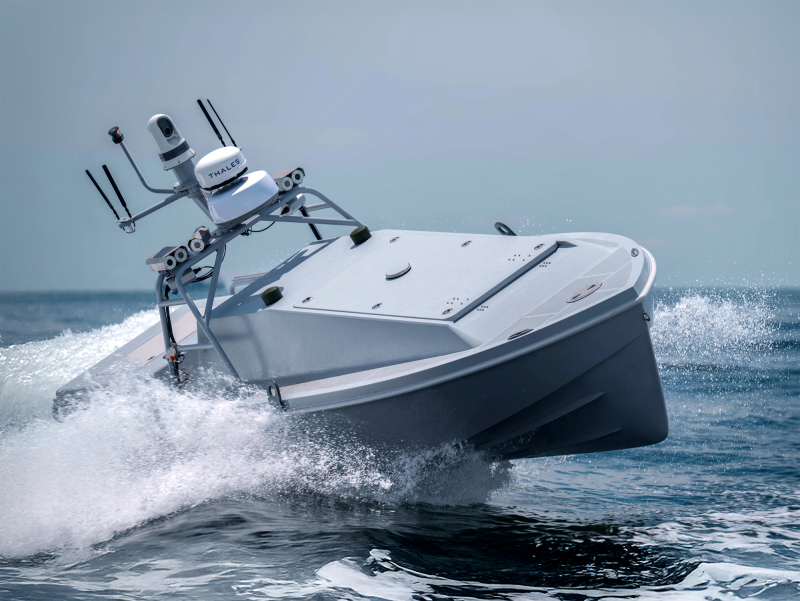
Despite the proposed shipyard’s remote location and total lack of infrastructure, a defense technology firm with ties to California Forever is considering the site (among others) for building a large-scale industrial plant (code-named “Port Alpha”) to produce autonomous surface vessels (ASV), also known as “drone boats,” for the U.S. Navy. The relatively new defense technology firm, Saronic Technologies of Austin, Texas, is said to be planning a $3 billion drone factory that would create an estimated 10,000 jobs.
California Forever touts its development as a “once-in-a-generation economic opportunity” while also expanding critical national security industries. Playing to the Trump administration’s goals of cutting regulations and stimulating domestic shipbuilding and manufacturing, sponsors of the project hope to cut through a jungle of red tape and start construction within a matter of months.
Since 2018, they have spent about $900 million quietly buying up about 70,000 acres (110 square miles) of land for the project; conducted soil, environmental, and other analyses; and built a strategic coalition of supporters. Earlier this year, they unveiled what they call “the largest construction agreement in history” to use union labor in building California Forever, a concession that brought organized labor groups on board.
Opponents of the project accuse California Forever of dishonesty, abusive behavior, and trying to evade or defeat local land-use rules. Given the growing resistance from a broad coalition of residents and groups against California Forever’s well-funded and well-connected determination to prevail, the political battles have become fierce and bitter.
“Our distrust of this organization goes back to the very beginning when they began buying up land without telling anybody at all what they were up to and refusing to give any information about who they were and what their intentions were,” said U.S. Rep. John Garamendi, whose district includes part of the development.
His colleague, U.S. Rep. Mike Thompson, whose district also shares some of California Forever’s land, echoes that skepticism. “There is nothing they have done that makes me believe they are trustworthy, and there’s nothing in their proposal that will allow for verification,” he said.
While each of the three parts of the California Forever plan has its own challenges, the shipyard faces some special obstacles — not least the inherently difficult economics of American shipbuilding. It also faces the volatile politics and heavy regulation of water resources in a very big, very thirsty, and dangerously dry state.
THE PROJECT
California Forever is the brainchild of Jan Sramek, founder and CEO, a tall, visionary, 39-year-old former Goldman Sachs trader turned real estate entrepreneur. Sramek grew up in post-Soviet Czechoslovakia, graduated from the London School of Economics, and moved to California.
California Forever evolved from Sramek’s interest in the “new urbanism” movement: creating a dense, master-planned, environmentally friendly city with walkable neighborhoods. He promotes the project as an enlightened way to bring long-term and much-needed economic growth to a struggling area while simultaneously enhancing national security.
As he lined up investors and focused on Solano County — a region with significant unemployment, close but not too close to Silicon Valley, and (at the time) relatively cheap land — Sramek’s project evolved to include three pillars:
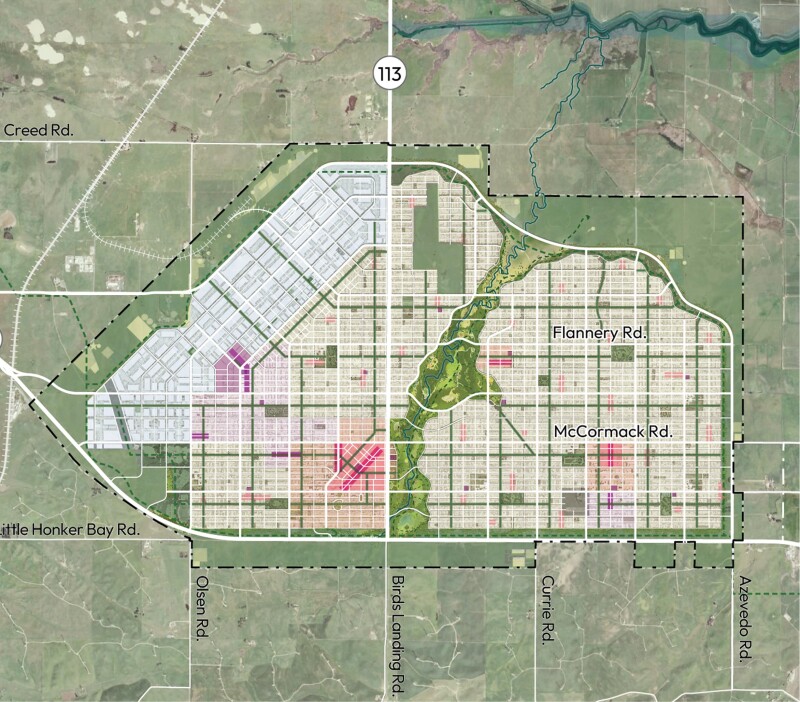
- A brand-new city ultimately providing 170,000 homes for about 400,000 people, located on 15,000 acres of what it says are non-prime (grazing) farmland. The dream-like drawings on its website depict a mixed-use city “with a comfortable, human-scaled street grid, a network of local parks, and local shopping streets,” drawing on “the best tradition of American town planning.”
- The Solano Foundry, described as “the largest advanced manufacturing park in America,” covering 2,100 acres and providing 40 million square feet of building space for “innovative industries” such as artificial intelligence, robotics, aerospace and defense, transportation, and research.
- The Solano Shipyard, with 6.5 miles of waterfront near where the Sacramento River meets San Francisco Bay. The developer’s website notes the site is on a deepwater ship channel, has long been designated by the county for maritime industrial use, and would be a complex for multiple shipbuilding operations constructing both military and commercial vessels.
Sramek’s investors in California Forever include some of the wealthiest venture capitalists in California’s high-tech industry and even the world: Laurene Powell Jobs (Apple founder Steve Jobs’ widow and founder of the Emerson Collective, one of the country’s leading philanthropic organizations); Reid Hoffman (co-founder of LinkedIn); and Marc Andreessen, co-creator of the Mosaic and co-founder of Netscape browsers, and Chris Dixon (major tech venture capital principals), among others.
Andreessen is co-founder of Andreessen Horowitz (also known as a16z), a major investor in both California Forever and Saronic Technologies. Saronic won its first Navy contract last December ($392 million) to build a fleet of its 24' Corsair drone boats.
Sramek evokes California’s history as a leader of big and innovative projects, such as construction of the Golden Gate Bridge; creation of the American aviation industry and Hollywood; Southern California’s role in developing missile technology and the aerospace industry; and Northern California’s formation of Silicon Valley as a global center of high technology.
With the name California Forever, Sramek portrays his plan as a revival of the state’s spirit for big and bold projects, which he and others complain have been suffocated by environmental, land-use, and anti-development regulations. “We believe California can build great things again,” the project’s website says. “All we need is permission to get to work.”
GOVERNANCE: WHO CONTROLS?
Central to the project’s success will be its ability to short-circuit the byzantine regulatory processes that currently make any development in California expensive and time-consuming. As the developer’s website phrases it: “The path depends on streamlining [the] entitlements process.”
Sramek’s strategy is to have California Forever obtain the power to pre-approve permits for all the construction projects that would be built later by businesses and homeowners on the land it owns — either through the developer itself or the local government. Commercial and residential applicants would be exempt from going through protracted regulatory review procedures with multiple authorities. “We’re doing the entitlements and permits up front, so you can go fast,” he told a Roots of Progress Institute conference last December.
“We’re permitting for a city of 400,000 people plus about 45 million square feet of advanced manufacturing in advance. What that means is, when you come to us, and you want to build a factory or if you want to build a home, we can give you a permit, and you can start construction in 60 or 90 days, or the city will give you a permit.”
The effect, he said, is “pre-clearing all of the environmental work in advance, which then allows you to go very quickly.”
How California Forever achieves that power is a big political question. Among Sramek’s more vocal backers is California YIMBY (for “Yes In My Back Yard”), a pro-development group aggressively lobbying the state and local governments to deregulate and accelerate construction of new housing. It has also drawn support from California GO-Biz, the Governor’s Office of Business and Economic Development.
Opponents say the developers will destroy long-established and voter-approved land-use policies in Solano County. If implemented, they say, the plan would gut decades of carefully negotiated protections of farmland and open space, effectively end democratic governance in much of the county, and cause sprawl, over-crowding, traffic gridlock, and pollution.
Many residents complain that wealthy and heavy-handed outsiders are undercutting local government to impose existential changes the community did not ask for and a majority does not want. That anger has created some unusual alliances: The main coalition opposing California Forever, called Solano Together, includes both the local Republican and Democratic parties, as well as environmental groups (Audubon and the Sierra Club) and farm groups (the American Farm Bureau Federation and Family Farmers Alliance).
COSTS
There remain disagreements about costs and who will end up paying for what.
The developer’s website says that, over the next 40 years, California Forever will bring in $215 billion in private investment and create 530,000 new jobs, 170,000 new homes, and more than $16 billion in annual local, state, and federal tax revenue. Developers have promised to contribute to new infrastructure costs, but local residents fear they’ll pay most of the taxes for all the highways, roads, water, sewer, and electrical lines that would have to be built.
A 2024 analysis by the Solano County government concludes that California Forever’s sprawling new city violates the voter-approved general land-use plan (concentrating development in existing urban areas to protect open space and farmland); would cause major traffic congestion and negatively affect nearby Travis Air Force Base (the county’s largest employer); damage the environment; and result in new taxes to pay for new infrastructure.
Specifically, the county report estimates a full build-out of California Forever would create a budget deficit each year of $103 million for the county government and almost $89 million annually for the fire district. “It appears the [California Forever] New Community may not be financially feasible,” the report says.
THE SHIPYARD: PROS
Historically, the San Francisco Bay Area has been one of the most important natural waterways in the United States, with deep tributaries flowing into a big harbor on the Pacific. During World War II, it was quickly mobilized with more than 30 shipyards to become the largest combined shipbuilding complex in the world, stretching from Napa in the north, Sacramento and Stockton in the east, to San Jose in the south. Almost all the shipyards were redeveloped after the war for a civilian economy.
California Forever’s proposed Solano Shipyard is about 20 miles up the Sacramento River from the old Mare Island Naval Shipyard, the first U.S. Navy base established on the Pacific Ocean. Mare Island was in service from 1854 to 1996 and served as the primary West Coast submarine port during the war. It was closed in 1996 as part of the Base Realignment and Closure (BRAC) process.
Sramek said the Solano Shipyard site “happens to be one of the best places to build ships in America,” because of its waterfront location on a deep river with ocean access and its existing designation by the county for maritime development. California Forever’s website says the 7,500-acre parcel would be a complex for multiple private shipyards engaged in both naval and commercial ship construction and repair, with shared waterfront infrastructure such as dry docks and ship lifts or cranes.
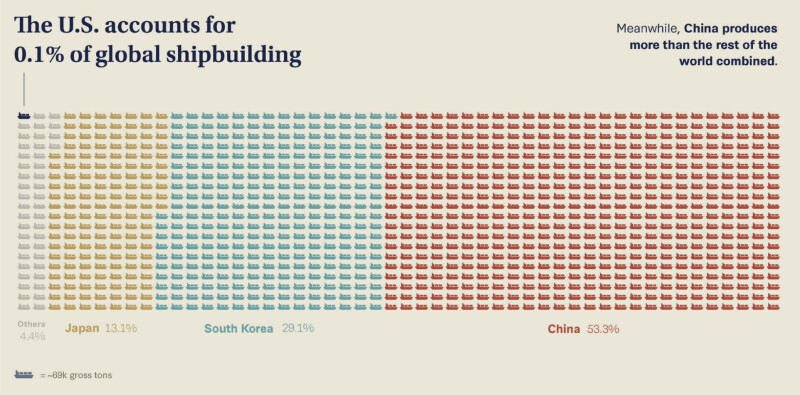
The size of the parcel is the point: “If we’re going to build on any kind of reasonable scale, this happens to be probably the only place in America where we can do it on that scale,” he said. “China builds about 1,000 ships a year. We build about five, and it’s getting worse. So if we’re going to do anything about it, it’s gonna have to be a Manhattan Project for shipbuilding.”
The proposed Solano Shipyard would have more than twice the acreage of the massive Changzine Island shipyard, China’s largest. Sramek described China’s competitive advantage over the U.S. as “pretty staggering: They produce 55 percent of global ships, 80 percent of consumer drones, and 90 percent of solar panels.”
Building the new shipyard — especially on the West Coast — is needed to ensure the U.S. can compete with China in naval strength and commercial trade, he said, and would also reduce the vulnerability of American warships having to transit the Panama Canal.
Sramek said a major strategic advantage of his proposal is that it co-locates research and development and the production/foundry resources (in the northern part of the California Forever development) near the Solano Shipyard, where vessels would be built (in the southern part of the development). This would create a “vertically integrated supply chain… creating a mutually reinforcing industrial ecosystem” that concentrates resources and greatly improves efficiencies.
The lack of skilled labor has long been a problem for American shipbuilding and the maritime industry as a whole. Sramek envisions both American and foreign shipbuilding firms locating new yards on the Solano complex and sees automation solving the industry’s labor shortages. In his view, the idea of “onshoring” manufacturing (bringing manufacturing jobs back to the U.S. from foreign factories) is unrealistic.
“You just physically cannot do it. There just aren’t enough people who can and are willing to work in manufacturing in America,” he said. “The only way you can do it is by robotics and automation. And if you’re going to do that, you need AI [artificial intelligence] talent, and 95 percent of the AI talent is in the [San Francisco] Bay area. So good luck doing that in Ohio, with all of the engineering out here.”
Implicit in this approach is that automation might also reduce the likelihood of a huge new West Coast shipyard poaching limited talent away from existing East and Gulf Coast shipyards. Automation and unmanned ASV drone boats could also help the Navy deal with its own manpower shortages.
Earlier this year, California Forever unveiled a Maritime Prosperity Zone (MPZ) proposal that would broaden the Solono County shipyard proposal to encompass the entire four-county California Delta region. The concept is to create “Opportunity Zone–like incentives and coordinated federal support across the broader California Delta,” significantly expanding the business case for long-term maritime and industrial investment.
If implemented, it would be the first MPZ in the country and could help revive other regional shipyards such as the old Mare Island Naval Base. It has received considerable support from a coalition of business groups and won the support of Rep. Garamendi since it would promote the SHIPS Act legislation he has co-sponsored in Congress.
THE SHIPYARD: CONS
Solano Together, the coalition opposing California Forever, promotes “city-centered growth and protection of working lands and open spaces” — a policy, it notes, that’s been ratified by county voters three times over the years. The group strongly disputes many of the developer’s statements and data. It argues that what California Forever portrays as a major asset for the shipyard (a huge tract of open space) is actually a big liability.
Because the proposed Collinsville port site is currently vacant, and building the Solano Shipyard from scratch would take so much time and money, “any significant development at this remote site is highly unlikely,” the group’s website says. It cites several reasons:
- Lack of infrastructure: The remote location and lack of industrial-scale road, rail, water, and sewage service.
- Inadequate site conditions: The port at Collinsville would require significant dredging if big ships are to be built there — expensive and damaging to farming (because of saltwater intrusion) and the environment.
- Water protections: Because water is such a critical issue in California, the development “would face significant hurdles and legal challenges” over water quality issues. The Sacramento-San Joaquin River Delta, a vital source of drinking water for some 30 million people, is heavily regulated.
- Cost: All of the shipyard infrastructure would have to be created and connected to the rest of the county by transportation that does not exist. Instead, the group recommends reviving the nearby Mare Island shipyard.
- Lack of market: The group notes that major shipbuilders, which are investing in the U.S., are buying and revitalizing existing shipyards for far less than what a new Solano Shipyard would cost.
The group notes that shipbuilding is a capital-intensive, low-profit (or even money-losing) business that depends on huge government subsidies and low-wage labor — such as in China, South Korea, and Japan, the current leaders in global shipbuilding. With U.S. shipbuilding financially uncompetitive and largely limited to military vessels with only a handful of commercial ships annually, “a massive, long-term commitment would be needed for the Solano Shipyard to ever become reality.”
The Trump administration in February released its Maritime Action Plan, a comprehensive strategy aimed at restoring the nation's maritime industrial capacity to meet national security and economic objectives. It complements related legislation that’s been pending in Congress for years (the SHIPS Act).
But Solano Together notes these are mere proposals and far from being funded. “If the SHIPS Act and other federal actions do move forward, there will be nationwide competition for any federal shipyard funding,” Solano Together says.
Reinforcing that point, the nonpartisan Congressional Budget Office recently highlighted the economic risks of new record-breaking federal deficits, the result of President Trump’s big tax cut enacted by Republicans in Congress last year. As Solano Together suggests, the U.S. may not be able to afford the massive long-term cost of reviving its shipbuilding industry, especially given other new spending priorities such as the war with Iran and a likely revival of the nuclear arms race.
THE POLITICS
If California Together wanted a public relations disaster, its rollout of the project could not have been much worse.
Through a shell company called Flannery Associates, the developers quietly bought up 70,000 acres of farmland, becoming the largest private landlord in Solano County. To avoid land speculation, they refused to disclose who was behind the company or what it was up to. Predictably, secrecy led to suspicion and distrust.
Alarm bells really went off when Flannery bought land next to Travis Air Force Base. That caused the Air Force and the FBI, at the request of the local congressmen, to investigate the company and whether national security was at risk. Flannery became even more unpopular when it sued local ranchers who refused to sell their land and cancelled grazing rights on land it had bought (the lawsuits have since been settled).
Their cover was finally blown in 2023, when The New York Times published an exposé of California Forever, who their billionaire funders were, and what they planned to do. Sramek quickly launched an expensive charm offensive touting the plan’s economic and jobs benefits and held a series of public meetings to sell the idea. He scheduled a referendum asking voters to repeal the county’s general land-use plan so construction could begin.
But it was far too late. The meetings turned into a buzzsaw of public anger, critics attacked the accuracy of Sramek’s disclosures and economic projections, and polling showed his referendum headed for a crushing defeat. California Forever canceled the vote in July 2024.
Since then, Sramek has made certain concessions (such as moving the proposed city farther away from Travis Air Force Base, which the Air Force has approved), but his new strategy is “annexation”: Having Suisun City and possibly neighboring Rio Vista, the two smallest and most financially strapped cities in Solano County, expand their borders to annex California Forever’s unincorporated land into their municipalities.
That would allow the new city and foundry to move ahead with only a majority vote by the city council, avoiding voters. Suisun City officials, facing declining tax revenue, systemic budget deficits, and public service cuts, see the project as their economic salvation. California Forever has submitted the required formal annexation proposal to Suisun City, which appears likely to approve it sometime later this year.
The project would still face lengthy environmental and other reviews, notably by a special county-wide commission that must consider annexation’s fiscal sustainability, service delivery, water resources (water rights are contested), and regional impacts.
However, annexation does not affect the Solano Shipyard, which is on a separate regulatory track that involves the state government. California Forever’s lobbyists in Sacramento last December successfully introduced legislation (which ultimately failed to pass) that would expand the maritime industrial zone and exempt the shipyard from key environmental reviews. They’re expected to try again.
As of now, it remains unclear how or when (or if) California Forever’s Solano Shipyard will get all the approvals it needs. Or whether both government and industry will come up with enough money — for long enough — to create “a Manhattan Project for shipbuilding.”
