



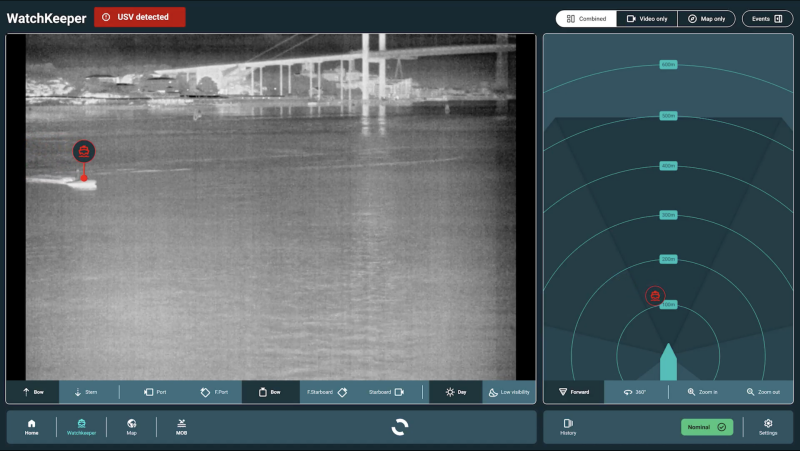
AI-based maritime safety and security system developer, Zelim, announced a signed cooperative research and development agreement (CRADA) with the U.S. Navy’s Naval Undersea Warfare Center (NUWC) Division Newport. The agreement will allow Zelim to trial its ZOE detection system during BlueTIDE 2025, a demonstration event scheduled for Aug. 28 in Narragansett Bay, R.I.
A Zelim press release said the U.K.-based company is one of several international finalists in the 2025 BlueTIDE Prize Challenge, organized by 401 Tech Bridge, NavalX, and the Northeast Tech Bridge. This year’s scenario focuses on protecting subsea infrastructure against hostile activity involving small crewed and uncrewed vessels. Zelim’s role will be to detect covert remotely operated surface craft that could indicate potential sabotage threats.
The company’s ZOE system was originally developed as a man overboard (MOB) detection and tracking system and is already in use in the cruise and offshore industries, the statement said. The same AI engine powers ZOE Shield, a new system under development that applies similar detection and classification capabilities to small surface craft not broadcasting AIS.
Zelim said the system integrates automated threat classification and early warning logic, designed to give operators improved response times. Unlike radar or GPS-based systems, ZOE Shield is resistant to jamming and GPS denial scenarios. The Navy will assess the system’s performance during the in-water trial as part of its interest in layered surveillance technologies.
“This agreement gives us a unique opportunity to trial ZOE Shield in an operational defense scenario at a U.S. Navy facility, where multiple assets, including USVs, will be deployed on the mission,” said Sam Mayall, CEO and co-founder of Zelim.
CRADAs allow non-federal entities to collaborate with Navy personnel and facilities outside the federal acquisition framework, while protecting intellectual property during the research phase. Data collected during the BlueTIDE demonstration will support the Navy’s evaluation of ZOE’s potential for operational use, the Zelim statement said.
“This is about closing the gap between detection and decision, especially in domains where the threat is small, fast-moving, and unpredictable,” Mayall said. “Our mission is to help operators identify anomalous behavior earlier, whether the goal is rescue or protection.”
