



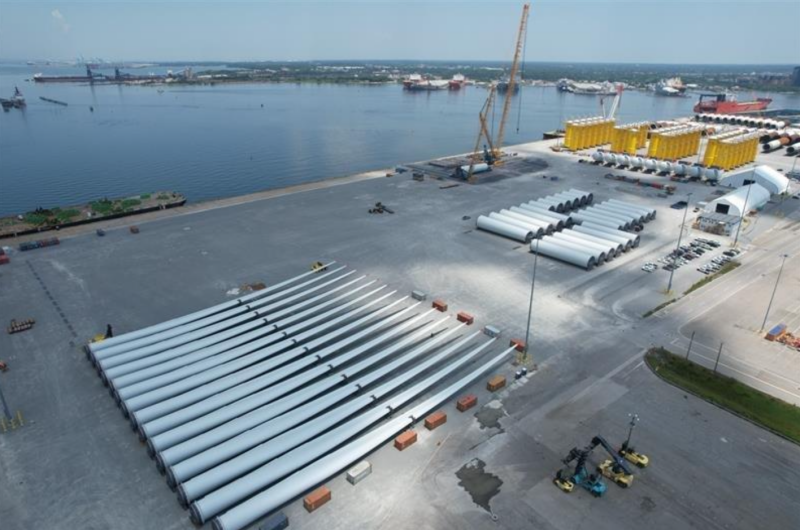
A federal judge in Virginia granted the Trump administration more time to prove its allegations of national security dangers from the Coastal Virginia Offshore Wind power project, while other East Coast wind developers lodged their own challenges of the administration’s claims.
In the last days of December 2025 in Virginia, U.S. District Court Judge Jamar Walker did not rule on Dominion Energy’s request for a temporary restraining order to undo the Interior Department’s Dec. 22 stop-work order on the Coastal Virginia Offshore Wind project.
That Interior directive shut down most work on CVOW and four other East Coast wind turbine arrays, citing a new claim that the Trump administration has classified information detailing security risks from those projects.
Judge Walker directed administration lawyers to submit that information to the court by Jan. 9, and set a hearing date for Jan. 16 to consider if a preliminary injunction should be ordered on Dominion’s request for relief.
The company says the stop-work order is costing it $5 million a day and endangers its timeline for bringing the 2.3-gigawatt array fully online by the end of 2026
In their complaint against the Bureau of Ocean Energy Management’s shutdown order, Dominion lawyers were dismissive of the Trump administration’s “national security” argument.
“But this rationale is not plausible. BOEM studied national security considerations extensively in the course of the permitting process for CVOW,” Dominion says. BOEM took public comments, consulted with the Department of Defense, Coast Guard and other agencies, and the final construction and operations plan “contain extensive requirements to address national security, navigational and aviation safety, and other considerations.”
Dominion also “developed mitigation agreements with DoD. BOEM’s order provides no basis to believe that BOEM has received any new information undercutting these comprehensive analyses. Nor does summarily deeming any ‘new’ information as ‘classified’ excuse BOEM from rationally supporting its (stop-work) Order.”
Likewise, on Jan. 1, Ørsted and Skyborn Renewables, joint venture developers of the Revolution Wind project off Rhode Island, sought to overturn BOEM’s new order.
The developers temporarily beat back an August shutdown order in federal court, and in a statement said their legal position still stands. Now reported to be 87% complete at the time of the latest stop-work order, Revolution Wind would provide up to 704 megawatts nameplate capacity for Rhode Island and Connecticut power grids if completed as scheduled in 2026.
“While Revolution Wind continues to seek to work constructively with the administration and other stakeholders towards an expeditious and durable resolution of this matter, it believes that the lease suspension order violates applicable law,” the companies said.
Equinor’s Empire Wind LLC, developers of the Empire Wind project off New York Harbor, filed a lawsuit Jan. 2 in Washington D.C. federal court to challenge its federal permit suspension.
“As part of that case, Empire plans to seek a preliminary injunction and allow construction to continue while the litigation proceeds,” according to the developers. “While Empire continues to work closely with Bureau of Ocean Energy Management and the other relevant authorities to find a prompt resolution to the matter, the order is in Equinor’s view unlawful and threatens the progress of ongoing work with significant implications for the project.”
Reporting their project has passed 60% completion, Empire says more than $4 billion has been invested including $2.7 billion under project financing. Empire maintains it has coordinated closely with numerous federal officials on national security reviews since it executed its lease for the project in 2017,” and “complied with relevant national security related requirements identified as part of the regulatory process."
"In addition, Empire meets regularly with officials charged with oversight of security issues for the project, including weekly meetings with the U.S. Coast Guard and other marine first responders.”
