



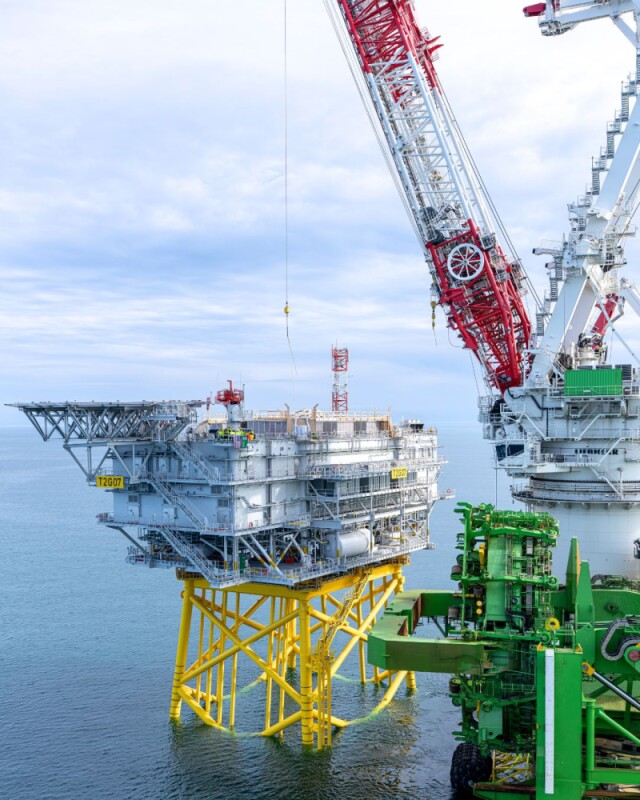
The Department of Interior made a new, sweeping move to shut down five ongoing East Coast wind energy projects, claiming that “recently completed classified reports” by the Department of Defense show the projects pose national security risks.
Interior Secretary Doug Burgum announced Dec. 22 the agency is “pausing, effective immediately,” leases on wind turbine arrays already well underway: Vineyard Wind and Revolution Wind off southern New England, Empire Wind and Sunrise Wind off New York, and the Coastal Virginia Offshore Wind project.
Burgum’s declaration follows a Dec. 9 ruling by a federal court judge in Massachusetts that President Trump’s initial Jan. 20 order to halt all approvals for wind power projects on federal lands was “arbitrary and capricious” in violation of the law.
U.S. District Court Judge Patti B. Saris said the Interior Department had failed to provide a “reasoned explanation” why it has stopped approving wind power projects. Government lawyers merely “candidly concede that the sole factor they considered in deciding to stop issuing permits was the president’s direction to do so,” the judge noted.
The national security claim has been made before by the Trump administration, in citing likely military radar interference in an Aug. 22 stop-work order issued against Revolution Wind, when that project off Rhode Island was around 80% complete. Work resumed after a federal judge issued a temporary restraining order in September.
Burgum’s announcement noted a history of earlier reports by the Department of Energy on radar interference, but played a new hand in claiming new classified information.
“Today’s action ensures that national security risks posed by offshore wind projects are appropriately addressed and that the United States government retains its ability to effectively defend the American people,” according to the Interior statement.
Offshore wind advocates with the Oceantic Network dismissed the new national security claim, saying it “contradicts years of rigorous, interagency reviews, as these projects have already passed explicit clearances from the Department of Defense and the Pentagon before construction began.”
“The U.S. offshore wind industry has continuously worked with the Department of Defense to address national security concerns, and its own Clearinghouse has signed off on every offshore wind lease ahead of construction,” said Oceantic CEO Liz Burdock.
The Trump administration likewise took aim again at Equinor’s Empire Wind 814 MW project underway off New York Harbor, targeted in mid-April with a stop-work order by Burgum’s agency. Work resumed there in mid-May, reportedly after the administration bargained with New York Gov. Kathy Hochul and allowed Empire Wind to progress in exchange for the state dropping opposition to a new Northeast natural gas pipeline.
Now the battle is joined again.
In Virginia, bipartisan political support for Dominion Energy’s Coast Virginia Offshore Wind array had allowed construction to proceed on the planned 176-turbine array scheduled to go online in late 2026.
But with the Nov. 4 election of former Democratic Rep. Abigail Spanberger as Virginia’s next governor was a setback to Republican hopes for capturing state government.
“Stopping CVOW for any length of time will threaten grid reliability for some of the nation’s most important war fighting, AI, and civilian assets,” Dominion Energy officials said in a statement objecting to the administration’s 90-day suspension order. “It will also lead to energy inflation and threaten thousands of jobs.”
“The project has been more than ten years in the works, involved close coordination with the military, and is located 27 to 44 miles offshore, so far offshore it does not raise visual impact concerns,” according to the company. “The project’s two pilot turbines have been operating for five years without causing any impacts to national security.”
“Offshore wind is delivering a more secure maritime industry, investing in shipyards and steel plants and ports to further protect our nation,” said Burdock. “The U.S. needs an all-of-the-above energy strategy, not an all-out assault on renewable energy based on personal preference.”
Recurring chaos from the political battles between renewable energy and legacy oil and gas industries is raising unease in the offshore sector. The National Ocean Industries Association sought to lower the temperature Monday.
Under existing policy, the Department of Defense “provides a timely, transparent, and repeatable process to evaluate potential impacts and mitigation options related to offshore energy compatibility,” according to NOIA. “The Department of Defense coordinates at every stage of planning, permitting, and development.”
