



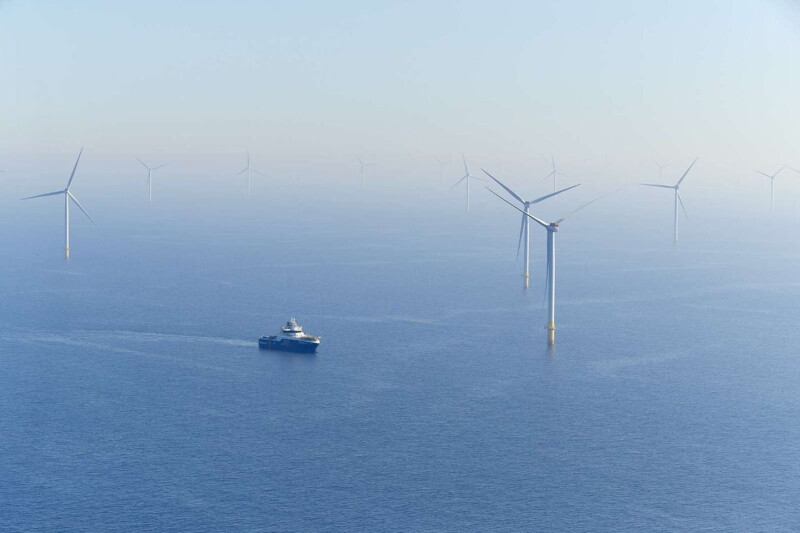
With five offshore wind projects proceeding again despite roadblocks from the Trump administration, some renewable energy advocates express hope the industry has survived 14 months of intense political and legal opposition.
The Department of Justice did not appeal a federal court’s temporary injunction blocking the administration’s stop-work order on the Revolution Wind project off southern New England.
The administration’s Dec. 22 claim of new national security dangers from turbine arrays stalled in the face of skepticism from judges, and developers have continued construction. With Vineyard complete and Revolution at 95%, Dominion Energy’s Coastal Virginia Offshore Wind project is close behind at 75%, said Kris Ohleth, director of the Special Initiative on Offshore Wind, a cooperative of wind power advocacy groups.
With 6 GW of potential future wind generation in the pipeline, that survival “feels like an accomplishment” from the past 14 months, Ohleth said at a March 18 seminar hosted by the Monmouth University Urban Coast Institute in New Jersey. “They will show the incredible resiliency of offshore wind.”
After politics, inflation, and escalating costs shook market confidence, the U.S. prospects for new offshore wind may be “now near rock bottom,” said Ohleth. “To restore market confidence, we will have to secure permitting reform.”
The Trump administration’s determined attacks on wind developers have managed to quietly alarm some interests in the legacy oil and gas sectors, who lived through the Biden administration’s attempts to limit offshore drilling prospects.
“Nobody in the energy sector wants to have permitting uncertainty,” said Kira Lawrence, director of the University of Massachusetts Clean Energy Extension and a former scientist with the New Jersey Board of Public Utilities. “The market is pretty spooked now.”
The travails of offshore wind developers look like “a playbook for other administrations to attack energy technologies they don’t like,” said Josh Kaplowitz, formerly vice president for offshore wind at the American Clean Power Association.
With the administration’s repeated attacks on permitted projects, “the response here was predictable,” Kaplowitz said. “All five developers went back to court.”
“The big lesson to be learned from this is, all the work that went into permitting these paid off,” he added.
Two ranking Democratic senators on March 5 issued a statement, suggesting the administration’s recent federal court setbacks might set the scene for permit reform in Congress and limiting future ideological attacks on offshore energy.
“After discussions with our colleagues, we have decided to reopen negotiations on permitting reform,” said Sens. Martin Heinrich, D-N.M., of the Senate Energy and Natural Resources Committee, and Sheldon Whitehouse, D-R.I., of the Environment and Public Works Committee.
“We are hopeful that recent developments are indicative of a positive direction from the Trump administration. As we move forward, we expect that there will be no further interference with already-permitted wind projects and that the initial movement we’ve seen on solar project permitting will accelerate, and other renewable projects will move forward as well.”
“Seeing permits continuing to be approved by the administration is critical for ensuring that talks can continue. Further mischief will undo our willingness to resume negotiations. We look forward to working on a bipartisan bill that will speed infrastructure development, lower energy costs, and create good-paying jobs.”
That proposal for settlements would pay developer TotalEnergies $928 million for its leases for two wind arrays off New York and North Carolina.
