


Whether patrolling harbors, interdicting offshore smugglers, or responding rapidly to emergencies, patrol boats are among the most versatile assets relied upon by state and local agencies, federal operators, and international partners to enforce laws, safeguard waterways, and support military and homeland security missions.
Builders across the U.S. are meeting demand for these boats with a steady pipeline of new designs, technology upgrades, and deliveries. From compact center consoles to larger offshore interceptors, patrol boats are evolving to give agencies more range, speed, and multi-mission capability.
SAFE BOATS
SAFE Boats International produces more than 100 boats a year at its Bremerton and Tacoma, Wash., facilities, ranging from 21’ to the 85’ Mk VI patrol craft.
The company continues to deliver vessels under the Foreign Military Sales program, including four 41’ interceptors and four patrol boats to the Bahamas police, as well as a series of patrol craft to the Turks and Caicos defense force and police department.
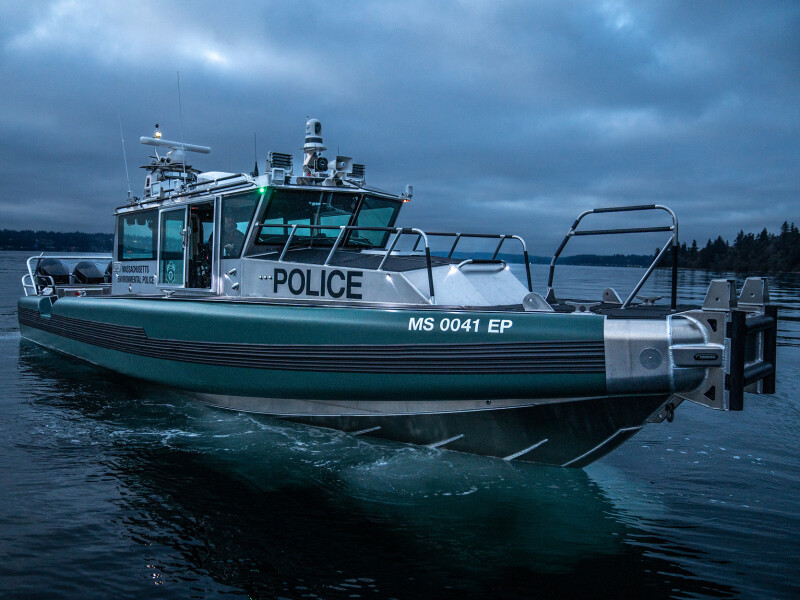
State and local agencies remain SAFE Boats’ “bread and butter,” according to Scott Clanton, who oversees Gulf and East Coast sales. “We just delivered New Jersey State Police a 38’ full cab patrol boat. Mass Environmental got a 41’ full cabin offshore interceptor.”
SAFE Boats is currently building a second Offshore 41 for the Florida Fish and Wildlife Conservation Commission (FWC), and the boat will be on display at the International WorkBoat Show this year, said Clanton.
The 41’ platform comes in three configurations: center console, walkaround, and full cabin, Clanton said, noting that the FWC’s delivery demonstrates how smaller, faster patrol boats can be more cost-effective than larger offshore platforms.
“They were running an 83’ offshore patrol boat… Three to five days of operation is what they would do,” Clanton explained. “It cost so much to get out to that area of operation that it only made sense to stay out there.”
By shifting to a 41’ interceptor, “we can run from Florida 100 miles out to their target area, and they could do their job and come back the same day,” he said. “It was such a cost savings for the government, for the state of Florida. They’re giving them an asset that gets them out there faster, cheaper, and the guys weren’t spending overnights away from their families.”
According to Cole Christianson, SAFE Boats’ business development person for the West Coast, first responder customers are adopting advanced technology faster than federal buyers. “Agencies are looking to put more into their boats,” he said. “You’ll see them going with more comprehensive electronics packages, multiple [multifunction displays], boat cameras, augmented reality kits…collision avoidance. Those kinds of overlays are becoming more and more standardized.”
Long-term quality should matter more than initial cost, Clanton stressed, pointing to the company’s legacy 25’ response boat–small, or RBS, program for the Coast Guard as an example of staying power. “Every one of those old boats has been put back into service by either towboat operators, police departments, or private individuals. It’s like a cult following,” he said.
NORTH RIVER BOATS
North River Boats (NRB), Roseburg, Ore., has been active in the patrol sector with deliveries to local and state agencies, ongoing builds for major police departments, and new projects that incorporate multi-mission capabilities.
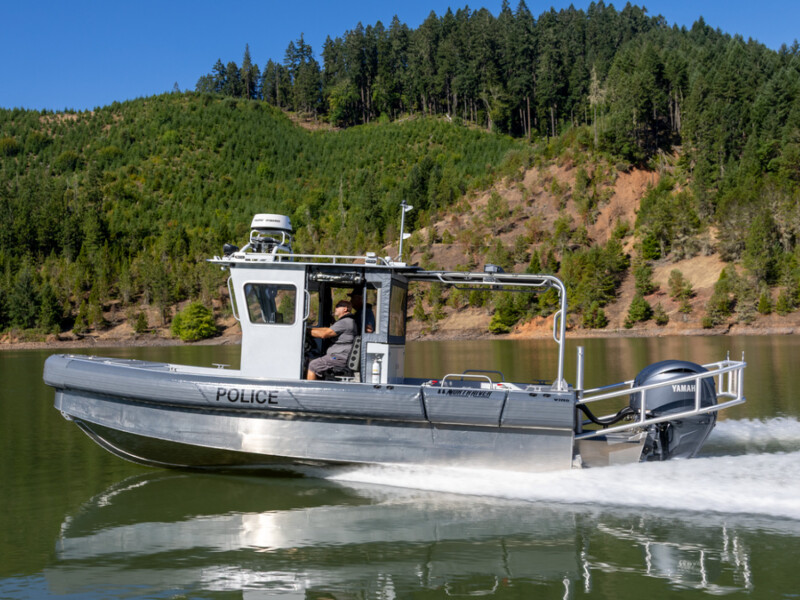
“In the last year, we delivered two 23’x9’ Liberty collared boats for Austin PD for their patrol sector,” said Jesse Faunce, commercial sales for North River Boats. The company also has two vessels in production for the Detroit Police Department: Valor models coming in 33’x12’ and 26’x10’.
The Washington Department of Fish and Wildlife remains a steady customer, with NRB delivering one to two patrol boats a year. Faunce noted the vessels are mostly for use across the Puget Sound, from the Columbia River up to Canada, along with smaller inland boats in Eastern Washington.
Los Angeles County Parks is adding two 24’ Seahawk hardtops outfitted for inland lake patrol, with added firefighting capability. “The main focus is patrol, but they can also do some fire suppression, too,” said Faunce. He added that more patrol customers are seeking multipurpose boats. “We are starting to see that more, where things are crossing over into multi-use boats,” he said.
NRB has also seen more technology integration across its newbuilds, from updated Raymarine software to advanced stabilization systems, according to Faunce. “The SeaKeeper Ride trim tabs and the SeaKeeper gyrostabilizers have become a lot more popular in the last year and a half or so,” he said. “What a night-and-day difference with the tabs on,” he said, referencing a recent demonstration of the technology in rough water.
RIBCRAFT USA
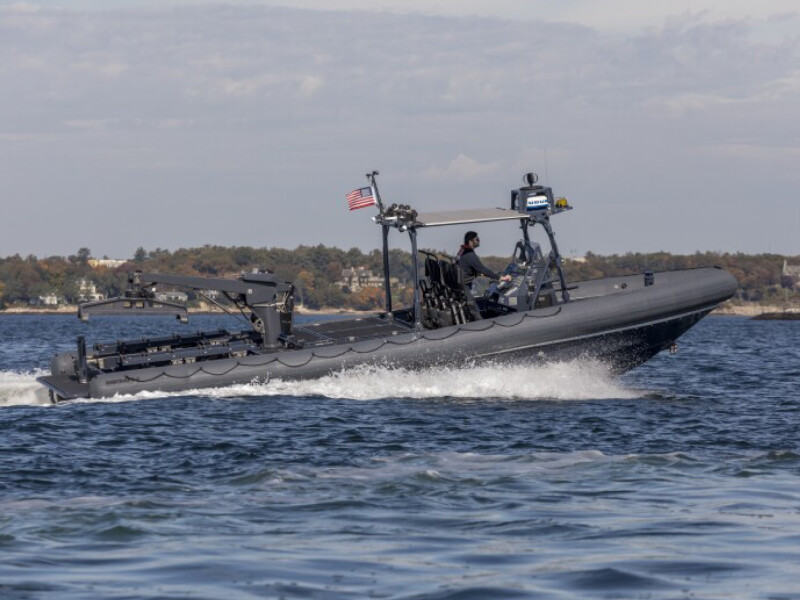
Ribcraft USA, Marblehead, Mass., continues to supply rigid inflatable boats (RIBs) for military, law enforcement, and first responders across the U.S., with a production schedule backed by three multi-year federal contracts and steady demand from municipal agencies.
Matthew Veluto, chief operating officer, said the company’s contracts with the Navy remain a major driver of production. “Those multi-IDIQ (indefinite delivery, indefinite quantity) contracts with the Navy are in full production. And those take us well out into the next several years.”
“We have three, five-year IDIQ contracts with the U.S. Navy right now to build the 11-meter (36’) Expeditionary RIB for counter-mine measures, the seven-meter (22.9’) shipboard RIB, and the 11-meter shipboard RIB,” he said. One of those five-year IDIQ contracts is an $80 million order for 278 seven-meter RIBs, believed to be the largest single Navy award by number of boats.
In addition to its Navy contracts, Ribcraft delivers boats to state and municipal agencies across the country. “We’re based in New England, but our contracts — at least at the state and local level — are all over the country,” said Veluto. Recent deliveries have gone to California, the Southeast, the Mid-Atlantic, New York, and Texas.
One size has stood out in recent law enforcement demand. “This year we seem to have delivered a fair amount of patrol, law enforcement boats that are in that 21-foot range, 19 to 21 feet,” said Veluto, noting that the size offers versatility for both inland and coastal agencies. “It’s easy to be transported, so it can be trailered and deployed by a single operator. But at the same time, it’s big enough where you can operate it with a couple of officers as well.”
SILVER SHIPS
Silver Ships, Mobile, Ala., continues to supply patrol boats to U.S. and international customers, with recent deliveries supporting counterterrorism operations overseas and law enforcement along America’s coasts and inland waters.
“Silver Ships has a very broad customer base,” said Sean Lobry, who manages military contracts for the company. “The federal customers, such as the U.S. Navy and other members of the military, they are our biggest customer base. But we also have a lot of state and local customers.”
Two projects have dominated the shipbuilder’s military patrol boat schedule in the past year.
“One was for the Philippines, and it was a 40-foot patrol boat, diesel powered with waterjets. And those were armed and armored boats. And they’re used for pretty heavy counterinsurgency, counterterrorism ops in the Philippines… Those were delivered last year — six total,” said Lobry.
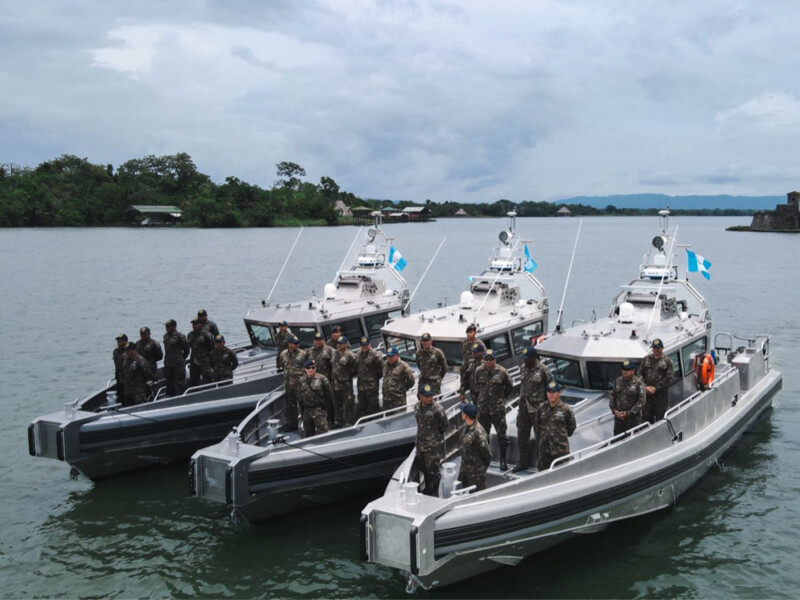
A second program delivered seven of Silver Ships’ 43’ Coastal Fast Response Boats (CFRBs). Four vessels went to Montenegro, with two weeks of training conducted with the Montenegrin Navy. Three more were delivered to Guatemala in August, also accompanied by training.
Lobry described the CFRB as “a super capable … multi-mission workhorse” that comes with advanced equipment. The platform includes the RHOTHETA Direction Finder for search and rescue operations, FLIR night-vision cameras, satellite radios, and a cuddy cabin with berths for extended missions.
In addition to foreign military sales, Silver Ships is producing a Coast Guard law enforcement interceptor. The 36’ design is currently operating in Miami, South Carolina, Texas, and Southern California. Lobry noted that cybersecurity and advanced electronics, like encrypted radios, have become standard requirements.
On the law enforcement side, Silver Ships’ Freedom-series and Ambar-series RIBs remain the most common patrol boat platforms.
David Hunt, who oversees state and local projects for Silver Ships, said the current lead time for new vessels typically runs between 18 and 24 months. Recent facility expansions have helped improve throughput, but delivery times remain lengthy, particularly for fireboats compared to law enforcement craft. Demand is spread evenly across state and local police departments, conservation enforcement agencies, and sheriff’s offices. A five-year contract with the state of Alabama also covers both coastal and inland patrol craft.
Hunt outlined Silver Ships’ current production schedule for law enforcement patrol craft, highlighting the company’s longstanding partnership with the Mississippi Department of Marine Resources. The builder is currently delivering the fifth and sixth vessels in a series for the state of Maine. New Hampshire Fish and Game recently became a customer, while the New Hampshire Marine Patrol has relied on the company for over 30 years. Additional contracts in Michigan, Alabama, Georgia, Florida, and California underscore Silver Ships’ broad nationwide customer base.
“We do a very good job adapting the same hulls to various missions, whether they be combined to a single or multi-mission vessel,” said Hunt.
MOOSE BOATS
California-based Moose Boats continues to carve out a niche in patrol and response craft, with recent deliveries ranging from hybrid patrol vessels to dive platforms.
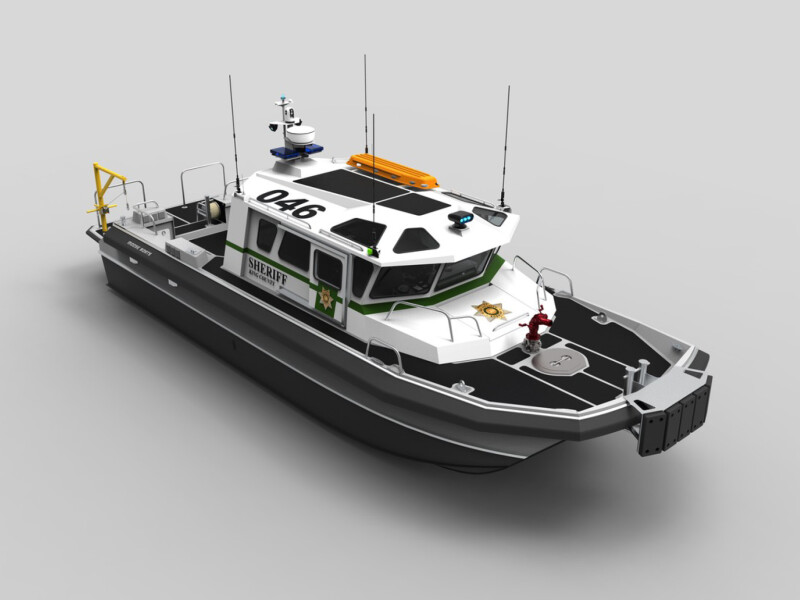
“What’s really notable for us at this point, especially with the [Pacific Marine] Expo being up there in the Pacific Northwest, is our recent contract with King County Sheriff … in the Seattle area,” said Ken Royal, vice president of sales. “And that one is gaining a lot of attention because it’s the first diesel-electric hybrid patrol boat for America.”
The King County Sheriff’s vessel will be based on Moose Boats’ M146 platform, stretched to 48’. Designed for patrol and sonar operations on Lake Union, the boat integrates a hybrid package that allows for electric-only operations. “Since they use sonar equipment, we have a vessel that we’re building for them that will incorporate a hybrid electric engine so that they actually can motor along with their sonar equipment under full electric power,” Royal said.
The vessel is powered by twin Volvo Penta D11 engines, each rated at 620 hp, paired with Corvus Energy batteries, HamiltonJet waterjets, and a Danfoss electric motor. “What we’re targeting is going to be five to six knots for two hours under electric propulsion until [the batteries] need to be [recharged],” Royal said.
The hybrid package also supports tactical operations. “When they do patrols, like for boarding ferry boats, if there’s a threat there, they have a high-end usage with that diesel-electric combination by having a boost from the electric motor, which kind of gives them an additional … five knots of boat speed,” Royal said. Despite carrying 30,000–32,000 lbs. of equipment and gear, the vessel is expected to reach 40 knots.
The King County Sheriff’s Office purchased this vessel using Government Service Agency discount pricing and grant funding from Washington State’s Climate Commitment Act, which supports climate action by investing in projects that reduce pollution, create jobs, and improve public health.
Moose is also nearing completion on a contract for the Sacramento County Sheriff’s Dive Team. “We should have that vessel delivered by the holidays at the end of the year,” Royal said. Built on the M238 platform, the boat will serve as a dive platform in the California Delta.
“In their area of response, the California Delta region has a lot of debris, including cars that get rolled into the river for whatever reason,” said Royal. “Some of it’s crime-related. Some of it is just dumping, unfortunately, hazards into the water like that, and they’re charged with the responsibility of having to mark all those cars and eventually pull them all out of the river. And so this platform … will serve them in that capacity.”
While Moose builds both monohulls and catamarans, the company is best known for twin-hull platforms suited to command, dive, and fire operations. “Our vessels are really known for kind of more command center and dive operations because of that,” said Royal. “If you can envision having to, if you have to shoot rounds from a stable platform versus a monohull that’s rolling and pitching … So that’s kind of the scenarios in which law enforcement will look to our boat.”
Royal estimates that about 60% of the boatbuilder’s output leans toward fire service applications. “For example, I’ve got a vessel I’m building for San Francisco International Airport for airliner down scenarios. That’s a large catamaran that will handle a lot of life rafts in the event of an airliner down,” said Royal. That vessel, also an M146, will be powered by twin Cummins QSC 8.3-liter engines rated at 600 hp and outfitted with fire suppression equipment.
The patrol boat sector continues to be one of the liveliest arenas in the small-craft world, with American builders rising to meet demand from a diverse client list that spans local sheriff’s offices to far-flung international navies. As agencies navigate the ever-tightening dance between budget constraints and mission readiness, U.S. manufacturers are stepping up with flexible, purpose-built designs that keep pace with the shifting tides of security and public safety, both on domestic waters and global shores.
