



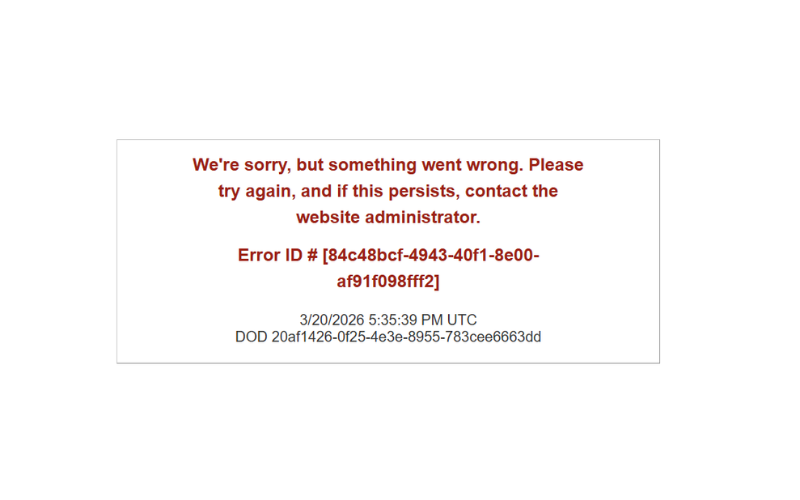
If you tried to submit an application through the National Maritime Center's ASAP portal on Friday afternoon, you already know that the system went down around midday Eastern on March 20. As of Sunday, it has not come back online.
ASAP is the only way to submit MMC applications, medical certificate applications, and responses to Awaiting Information requests. Email submissions were eliminated in January when ASAP launched. There is no backup channel to submit if the portal is down.
As of this writing, there has been no announcement posted about the outage on the NMC website. There is no estimated time for restoration, and no instructions for mariners who need to submit while the system is offline.
A History Worth Understanding
This is not the first time the maritime credentialing system has experienced a significant disruption, and understanding the pattern helps explain why this matters.
Before ASAP existed, mariners submitted applications by email. That system had its own challenges. Applications were sometimes lost in transit, and a mariner might not discover the problem until weeks later when a rejection arrived or nothing came back at all. But email gave mariners a timestamped record of the exact documents they sent and the ability to resubmit if something went wrong on the receiving end. ASAP does provide mariners with a submission confirmation, but that record does not contain the documents submitted. Processing errors can still occur, leaving mariners with no recourse when pages are lost or forms are incorrectly reviewed due to human errors that understandably sometimes happen.
The Coast Guard's Homeport platform was the other piece of the system. It was the primary way for maritime employers to verify that their crews were legally credentialed, the main way for mariners to check application status, and the way for training providers to submit course completions. Homeport ran on Microsoft SharePoint 2013, software that Microsoft ended support for in April 2023. Instead of choosing to upgrade to more modern tools on a normal maintenance schedule, the system continued running on unsupported software for two more years.
For at least the last several years of its life, Homeport was unreliable. The credential verification tool, the application status tool, and the course submission system would go down without warning, come back without explanation, and break again days later. Think of it like never updating your phone. Eventually the apps stop working, security breaks down, and one day it just will not work correctly. That is essentially what happened to Homeport.
On April 12, 2025, Homeport was permanently shut down. For the next 104 days, the maritime industry had no online access to credential verification or application status. If a maritime employer needed to verify a mariner's credentials, they called, chatted, or emailed the NMC Customer Service Center and waited for a response. When the replacement arrived on July 25, it was two basic Microsoft Forms for Government pages. Those forms work well and are still operational today. What is worth noting is that Microsoft Forms for Government has been available to federal agencies since 2018. A planned migration could have avoided that 104-day gap entirely.
The NMC Staff Deserve Better Tools
When these disruptions happen, the NMC takes the heat. That is understandable since the NMC is the public face of credentialing and the main point of contact for mariners, employers, and training centers. But it does not tell the whole story.
The people at the NMC are the ones processing your applications, answering your calls, and doing the daily work of getting mariners credentialed. They have been working through a massive backlog from the recent government shutdown, and they are doing it with the tools and resources they are given. Under the leadership of recent Commanding Officers, the NMC has made real progress on communication, responsiveness, and transparency. That progress is real and it should be recognized.
But the NMC does not choose its own tools. It does not set its own technology strategy. It does not decide how its systems are designed, maintained, or replaced. Those decisions are made at Coast Guard Headquarters by the Office of Merchant Mariner Credentialing (CG-MMC). CG-MMC writes the policies, selects the technology, and directs how the credentialing program operates. The NMC executes the mission with whatever CG-MMC provides.
The long-standing pattern of technical issues described in this article reflects decisions made at the Headquarters level over many years. This history includes email systems that lost applications, the choice to keep vital functions on the unreliable Homeport platform while it ran on unsupported software, and a 104-day service gap despite a replacement being available since 2018. Now, the ASAP portal has launched without any backup submission method in place. The NMC staff deserve reliable tools that match the seriousness of their mission.
What This Means for You
Right now, there is no alternative submission method. The portal is down and there is nothing to do but wait.
The maritime industry operates around the clock, every day of the year. Ships do not stop sailing because it is Saturday. The Office of Merchant Mariner Credentialing is responsible for ensuring that the credentialing system works for mariners, employers, and training providers every day. That means modern technology, contingency plans, and the expectation that when something breaks, it gets fixed before the next mariner needs it.
