


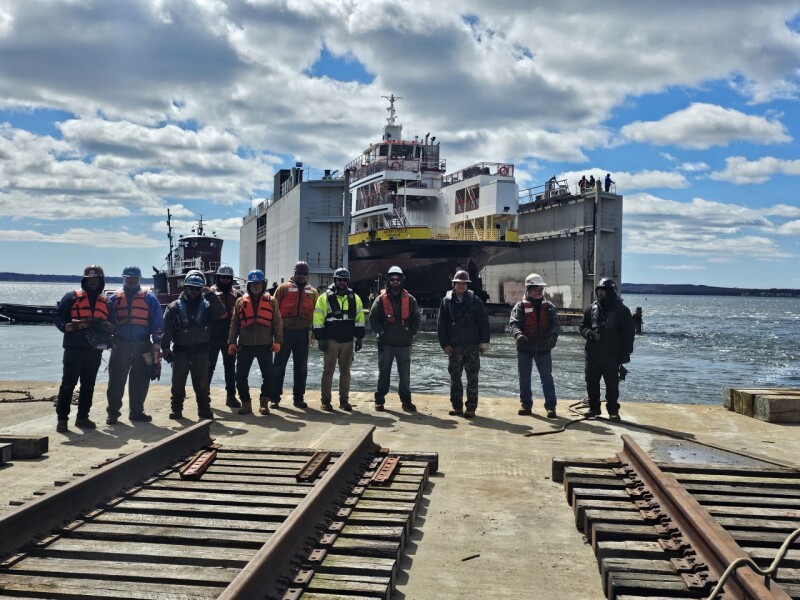
Senesco Marine, North Kingstown, R.I., has launched the electric-diesel hybrid ferry Battery Steele, marking a construction milestone for what the builder describes as the first electrically propelled ferry built in New England.
The vessel was recently transferred onto a drydock at the shipyard and is expected to be floated in the coming days, according to Senesco Marine president Ted Williams, who noted the launch reflects the team’s progress on the project.
Senesco is building Battery Steele for Casco Bay Lines, which provides year-round ferry service throughout Casco Bay from Portland, Maine. The double-ended ferry was designed by Elliott Bay Design Group, with hybrid propulsion and automation systems supplied by ABB.
Nick Mavodones, operations manager at Casco Bay Lines, previously told WorkBoat that the operator evaluated multiple propulsion configurations before selecting an electric-diesel hybrid system. The setup uses electric motors for propulsion, supported by an onboard energy storage system as the primary power source, with diesel generators providing backup. The operator determined that the hybrid configuration offered the best balance of lifecycle cost, environmental performance, and onboard experience.
The vessel’s design represents a shift in configuration for the operator. Moving from a twin-screw, single-ended ferry to a double-ended platform with propulsion at both ends is expected to improve maneuverability and responsiveness, particularly when paired with electric motors.
The ferry will primarily serve the Portland–Peaks Island route, where the relatively short transit distance allows the vessel to complete a full round trip on battery power. Wabtec shoreside charging infrastructure in Portland is expected to support rapid turnaround between runs, enabling the vessel to meet a demanding schedule that can reach up to 17 round trips per day during peak season.
Onboard diesel generators are intended to provide redundancy and operational flexibility, including support during periods of high electrical demand or in the event of grid interruptions.
The project has received financial support from the Federal Transit Administration, the Maritime Administration, and the State of Maine through its Department of Transportation.
In December, Senesco Marine was awarded a $78.6 million contract by the Delaware River and Bay Authority for the construction and outfitting of a new diesel-hybrid ferry for its Cape May, N.J.–Lewes, Del., route. The vessel is expected to enter service following completion in 2029 and will replace the Cape Henlopen, a diesel-powered ferry that has operated on the 17-mile bay crossing for more than 40 years.
Once in service, Casco Bay Lines expects the vessel to reduce operating costs by approximately $100,000 annually through lower energy consumption and reduced maintenance requirements, helping to stabilize fares for passengers.
A February progress update from Casco Bay Lines indicated the vessel was expected to launch in early April, followed by a series of commissioning steps including dock trials and sea trials. Pending successful testing and U.S. Coast Guard approval, the vessel will be delivered to Maine for final commissioning work tied to shoreside charging infrastructure and crew familiarization.
