


Ulysses, San Francisco, is a robotics company made up of engineers and operators who have previously built championship-winning Formula 1 cars, satellites, space lasers, drones, underwater vehicles, hyperloops, and self-driving cars.
The company is now turning its attention to the marine industry — specifically offshore surveying, cable laying, offshore oil, gas, and wind structures, and port infrastructure.
The main challenge is cutting the cost of working offshore. The Ulysses autonomous underwater vehicles (AUV) fleet handles end-to-end subsea work: high-resolution surveys, condition assessment, and light inspection, repair, and maintenance (IRM).
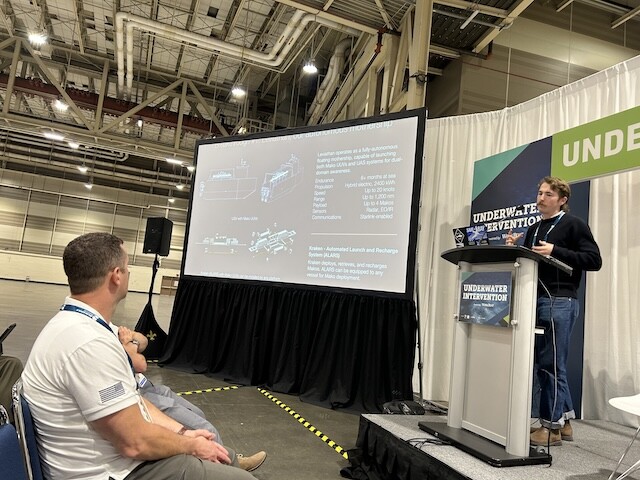
“It remains prohibitively expensive to work at sea,” Will O’Brien, Ulysses’ co-founder and president told those in attendance at an Underwater Intervention Think Tank session on the floor of the recent International WorkBoat Show in New Orleans.
O’Brien said that most of the operating expenses in the offshore survey industry are due to the need for manned surface assets, but the assets that drive capital expenses can be made much cheaper.
The current system can be improved upon, according to Ulysses. “Profit margins get squeezed, projects get cancelled or stalled due to excessive costs, and critical infrastructure does not get protected or surveyed as often as it should,” said O’Brien. “We need a new technological paradigm.”
By using fleets of Ulysses’ AUVs, an operator can reduce the costs of survey missions by 50% over traditional survey operations, O’Brien said, as an autonomous mothership can stay at sea for months at a time and deploy AUVs with a few minutes notice, allowing for more frequent surveys.
The mothership is fully autonomous and capable of launching both Mako (underwater drones) UUVs and UAS systems for dual-domain awareness. The mothership can remain at sea for more than six months at a time. Powered by hybrid-electric propulsion, it can reach speeds of up to 20 knots, has a range of 1,200 nm, and can carry a payload of up to four Makos.
Ulysses is currently working on a project for the California Energy Commission (CEC) offshore California monitoring the organization’s floating offshore wind structures with special emphasis on structural integrity and biodiversity monitoring, detecting and reporting instances of entanglement, and intercepting and clearing any entangled debris.
