



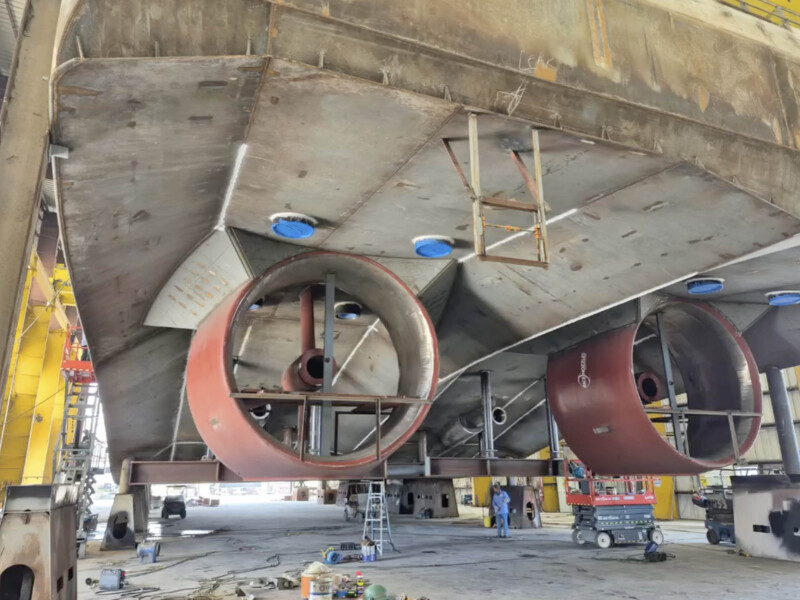
At the heart of any well-designed workboat is a well-designed propulsion system. From engines to propellers and the components in between, careful calculation is required to ensure these systems are suited to their operational demands. It also takes a team of trained and well-prepared professionals to keep them operating as intended.
Manufacturers, distributors, and service providers are upping their game in response to evolving market demands.
HIGH THRUST
Anna Vaurio, technical product manager for thrusters at Kongsberg Maritime, Kongsberg, Norway, said, “Offshore operators are increasingly demanding higher propulsion efficiency, particularly in dynamic-positioning-heavy operations, where fuel consumption and emissions are major operational concerns.”
In December, the company unveiled two additions to its range of L-drive azimuth thrusters. The underwater mountable thrusters feature permanent magnet (UUC PM) motors mounted low between the steering gear and are suited to high-power, high-precision offshore applications such as wind turbine installation vessels, cable-lay vessels, heavy-lift and heavy-transport vessels, and drillships, Vaurio said.
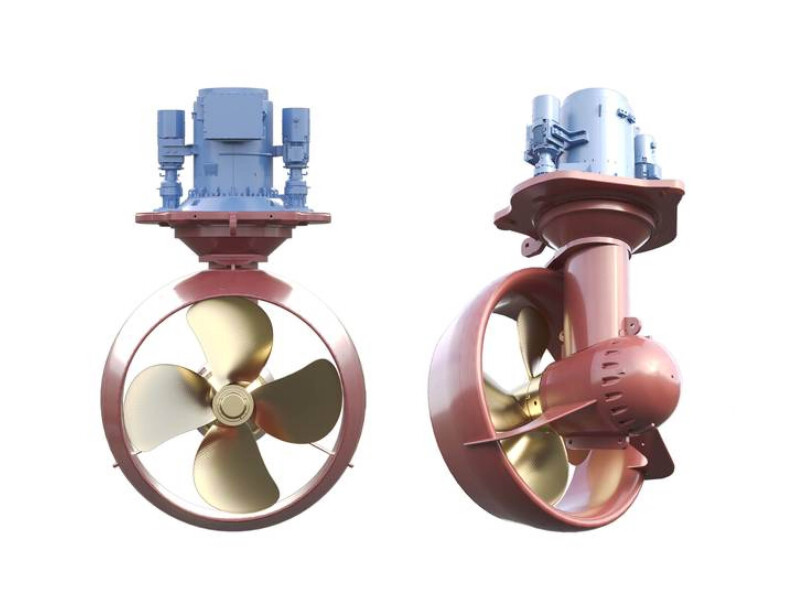
The new 4,500-kW UUC PM 405 units, with 3.8- and 4.1-meter propeller diameters, deliver 86 and 91 metric tons of thrust, respectively. The 4,200-kW UUC MP 355, with a 3.7-meter propeller and 81 metric tons of thrust, was introduced in 2024.
According to Vaurio, the latest thrusters’ combination of PM motor technology, spray lubrication, electric steering, and optimized propeller design reduce energy consumption by up to 28% compared with previous models.
In addition, because the thrusters are fully mountable and demountable underwater, maintenance can be performed without drydocking the vessel, Vaurio said, adding, “Installation is simplified as the PM motor mounts directly onto the thruster without intermediate shaft alignment.”
“Vessel designs are becoming more space- and weight-constrained, creating a need for more compact propulsion machinery — an area where PM motors offer clear advantages over traditional induction technology,” she said.
There are currently no confirmed orders for the UUC PM 405 thrusters, though several active tenders specify the PM 405 or larger PM variants, according to Vaurio. A larger, 5,000-kW thruster, the UUC PM 455 — available with a 4.3- or 5-meter propeller — is scheduled to be released by the end of 2026.
SLOWING DOWN
Waterjet propulsion systems are typically designed for fast, high-performance vessels, generally operating most efficiently at speeds above 30 knots. Most waterjets are less efficient at lower speeds, where conventional propellers are often the preferred option.
HamiltonJet, Christchurch, New Zealand, turned this thinking on its head with the introduction of its LTX series waterjets, engineered specifically for medium- and slow-speed applications.
“It’s a radical change from our regular range,” said Diego Muller, future products manager at HamiltonJet. “It looks very much the same from the outside, but it’s quite a different application.”
Prototype development began about five years ago when Michael Eaglen, CEO of EV Maritime, Auckland, New Zealand, inquired about a waterjet optimized for electric vessels, which generally operate at slower speeds due to the added weight of onboard battery energy storage systems.
“We didn’t know how it would perform. We had tried that before, but there was never a good reason to progress with it,” Muller said. “Suddenly, we had a customer who wanted something a bit more sophisticated and highly efficient for his fully electric boat, and we agreed to build prototypes.”
The prototype evolved quickly into a full product launch after feasibility studies showed promising results and customer demand increased, he said.
The LTX series — available in two sizes, LTX36 and LTX53 — differs fundamentally from conventional jets by moving larger volumes of water at lower speeds rather than smaller volumes at higher speeds, Muller explained. The design features an optimized intake for low-speed operation and a pump engineered to handle higher water volumes at lower velocities.
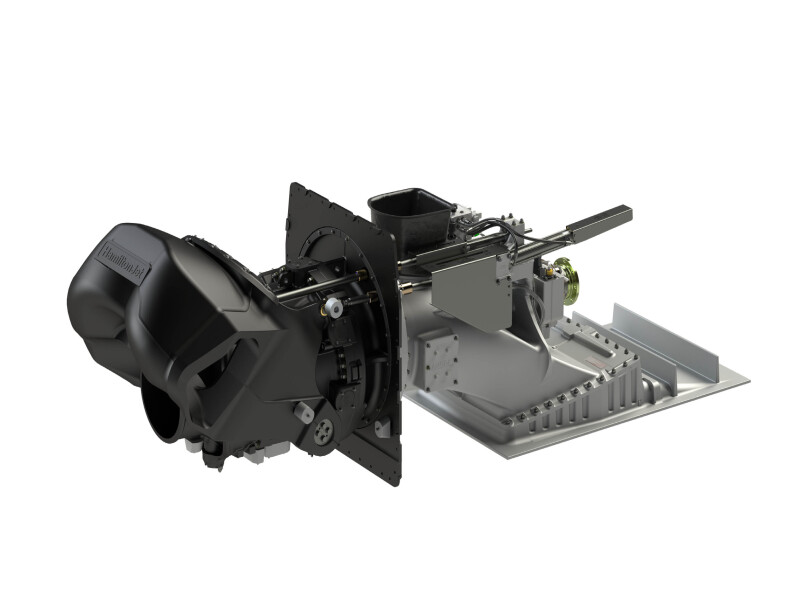
The LTX design found success with applications outside the electric vessel space, as well. The first vessel constructed with the new jets was the Inselexpress 2 — a 68'x20' aluminum ferry featuring twin LTX36 jets and Volvo Penta D8MH diesels (425 hp at 2,200 rpm) — built by Next Generation Shipyards, Lauwersoog, the Netherlands, for public transport operations serving islands in shallow-water areas where existing jet-propelled boats were experiencing operational inefficiencies. Its top speed is 23.5 knots.
“Waterjets were needed [due to the shallow draft]. But the existing jets that operators had were not very successful,” said Igor Sarsgård, HamiltonJet’s regional sales manager for Middle and Southern Europe. “They were not really optimal. They were overloading engines. There were lots of issues.”
Both Muller and Sarsgård stressed the importance of application engineering and close collaboration with naval architects and shipyards to optimize vessel designs around the LTX jets. When integrated successfully, the LTX line can reduce fuel consumption as well as engine size and draft requirements while also providing superior maneuverability compared with propeller alternatives, according to Sarsgård.
The LTX expands the market for waterjets by challenging the industry stereotype that jets are inefficient below 30 knots, extending viable operation down to 15 knots or lower, Sarsgård said. LTX waterjets also deliver up to 40% more bollard pull and greater sway thrust than other jets on the market, according to the manufacturer.
Success aboard the Inselexpress 2 has led to several follow-on orders, Sarsgård added, noting that multiple vessels under construction across the Netherlands, the United Kingdom, and Asia are being built with LTX jets. Current applications include passenger ferries, river cruises, and wind farm support vessels.
OPTIMIZED
When Marquette Transportation Co., Paducah, Ky., set out to build the 10,000-hp towboat John Paul Eckstein, the company used an existing design as a starting point but made strategic modifications to optimize performance and fuel efficiency.
“The biggest difference is that John Paul is the only boat on the river running what you refer to as a high-lift steering rudder system,” said Jerry Jarrett, the company’s senior vice president of engineering.
Built by C&C Marine and Repair, Belle Chasse, La., and delivered in late 2025, the 189'x50' vessel features a TwinDIFF rudder design, a patented system developed with CT Marine, Portland, Maine, that uses two steering rudders positioned aft of the Kort nozzle instead of the traditional single “barn door” rudder configuration. “That rudder design changes the water flow,” Jarrett said. “You have an advantage of having a low-pressure, high-pressure side on a rudder, which helps you to maneuver.”
The shorter dual rudders are less prone to damage than conventional designs, and the unique blade design — developed by Marquette in collaboration with CT Marine — features what Jarrett described as a bulb on the front. “Reaching out to the wheelman on board, I would say this vessel probably steers better than any other boat that they’ve operated,” he said.
Marquette also specified 122" propellers with 152" of pitch and a 1.24 disc area ratio, meaning the blades overlap by 24% when viewed from behind. “I know of no propeller with this much pitch,” Jarrett said.
The company operates the twin Caterpillar C280-12 engines at 900 rpm rather than 1,000 rpm, which extends engine life while maintaining performance. “I’m also saving probably 15 to 18% on fuel,” Jarrett said. “At the end of the day, I’m getting the same results as they would spinning that wheel faster. They’re just burning more fuel.”
TROUBLESHOOTING
Today’s powerful and often complex propulsion systems present operators with new challenges.
When propulsion problems occur, they may come on suddenly as catastrophic failures. In other cases, they develop gradually with early warning signs along the way: an intermittent hum, a quiet rattle, or a subtle vibration that emerges at certain speeds and disappears just long enough to be ignored until something goes wrong.
According to Rich Merhige, president and owner of Advanced Mechanical Enterprises (AME), Fort Lauderdale, Fla., many newer vessels are experiencing propulsion system integration problems, along with broader structural issues, as operators push for higher performance.
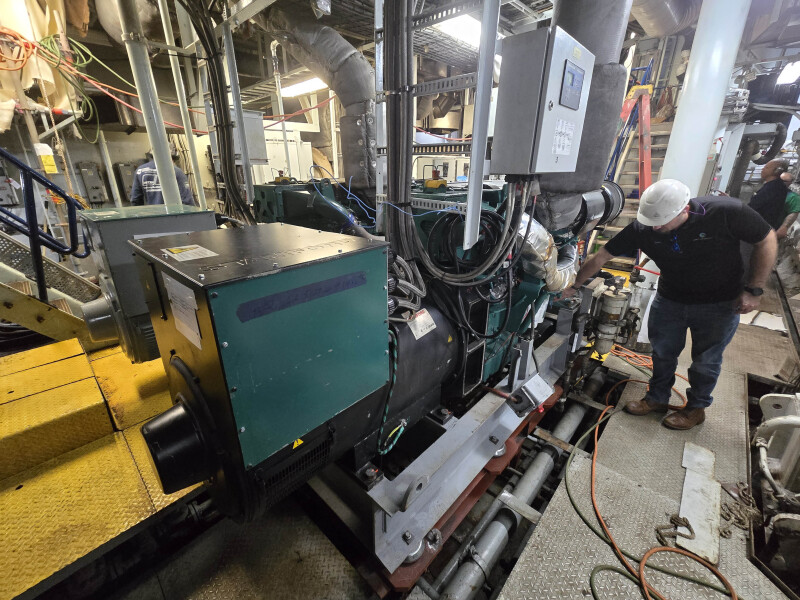
“You have more complex systems integrations like hybrid propulsion inputs to the gearbox and long drive shafts that are positioned in a way to accommodate more components,” he said. “You’ve got all these various components, and they’re not always talking to each other. Manufacturers do their engineering, but sometimes nobody’s looking at the system holistically. Issues can fall through the cracks.”
“Companies are building boats with more power, and the power is higher power density,” he said. “It’s not so much that it’s too much power. It’s more power concentrated in a smaller area of the hull.”
That concentration can excite natural frequencies in the structure. “We’re running into structural resonance issues where a previous design is taken, and a lot more power is packed into it. The structure isn’t always capable of handling it,” Merhige said.
“At certain RPMs, all of a sudden you’ll get this violent vibration,” he said. It may not occur across the full operating range, only at specific speeds, which makes it harder to diagnose — and easier to dismiss until it worsens.
AME employs a team of specialists who are dispatched worldwide to test rotating and reciprocating machinery, diagnosing vibration and alignment issues aboard vessels. Using accelerometers and multichannel data acquisition — sometimes with more than 100 channels measured simultaneously — they map how the structure is moving. They often supplement that data with video motion amplification, a technique that visually reveals movement invisible to the naked eye. “We’re able to amplify the movement and slow down the frame speed,” Merhige said, “to see where the structure is physically moving and where it would be best reinforced.”
Typically, the AME team is called in after propulsion problems surface, but Merhige said the best time to solve these issues is before they exist. “That would be ideal — for us to come in the build stage,” he said.
Vessel owners and naval architects should prioritize comprehensive system integration evaluation and installation planning, as well as establish baseline vibration measurements during builders’ trials, Merhige said. He suggests using torsional vibration analysis, mathematical modeling, and six-degree-of-freedom calculations (which model the movement of a rigid object in 3D space) to ensure mounting systems won’t create resonance.
No propulsion system is immune. Z-drives, straight shafts, nozzles all come with tradeoffs. “Every system has its pluses and minuses,” Merhige said. The key, he believes, is understanding those tradeoffs early and planning accordingly. Once a boat is in service, the cost of stopping is enormous. “Nothing costs more than downtime,” he said. “Component costs are cheap compared to downtime.”
