



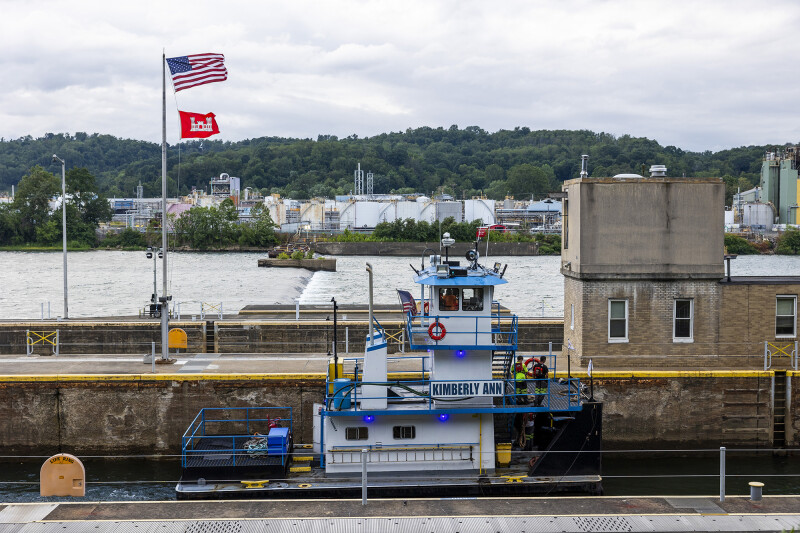
The American Society of Civil Engineers (ASCE) has given the inland waterways a barely passing grade for providing a reliable lock-and-dam transportation system, citing old structures, funding shortfalls, delays, and closures as key problems.
In its 2025 Infrastructure Report Card, the inland system received a grade of C-, just slightly better than the D+ it earned in the last report in 2021.
This small improvement “is not enough to reassure shippers, carriers, or logistics professionals navigating daily delays and disruptions,” the report said, calling the 12,000 miles of inland navigation and 11,000 intracoastal channels “the hidden backbone of the nation’s freight network,” that cost-effectively transports $158 billion worth of goods a year.
This supply chain relies on strong infrastructure to keep goods moving efficiently, but “the U.S. still has work to do.”
Every four years, the ASCE evaluates 18 categories of infrastructure using a letter-grade scale. The results are a widely referenced benchmark for understanding the condition of critical systems like roads, bridges, ports, railways, and waterways.
The overall grade for all U.S. infrastructure was a disappointing C, while American ports were a standout, scoring a strong B, which was the highest of any infrastructure category, suggesting that recent private and federal investments are starting to pay off.
The ASCE acknowledged an increase in federal funding over recent years for waterways, but it said a $7.5 billion construction backlog is causing lock closures and long delays. Contributing is the age of the infrastructure, with 80% of the nation’s locks and dams exceeding their 50-year design life and needing frequent maintenance and repairs.
The report also noted that unpredictable water levels and drought, fueled largely by climate change, often render parts of the system unnavigable by barge, which increases transportation costs as vessels are unable to load to full capacity.
Despite increases in federal funding for waterways modernization, operations, and maintenance, sustained funding remains a challenge, and project cost overruns are more frequent, as original cost estimates don’t reflect current inflation and market conditions.
The engineers call for efficient funding for operations, maintenance, and backlogs, as well as ensuring that programs are funded at authorized levels and that funds are disbursed to inland projects. This reflects the priorities of the Water Resources Development Act, which seeks to improve U.S. rivers and harbors.
A low grade for the waterways is not a surprise to those involved in using the system or advocating for its financing.
The Waterways Council Inc. (WCI), which advocates for waterways funding with financial backing from the barge industry, said increased budgets over the past decade have helped, but “the reality is that it still takes far too long to construct a lock-and-dam project in America,” said Tracy Zea, WCI president.
“While it used to take 7 to 10 years to complete a project to become operational in the 1990s, it can today take 30 years or more to build inland infrastructure,” he said. “And we continue to see catastrophic emergency outages on the system. There are numerous reasons for this such as supply chain delays, workforce challenges, and inflation.”
But, Zea added, “there are also ways to improve the Corps’ project delivery with earlier contractor involvement, more efficient project scoping and design, more streamlined project planning, more accurate cost estimations, and better industry communication.”
