



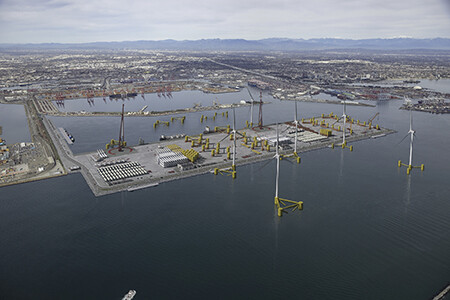
As the Trump administration moves to offer the first West Coast offshore drilling leases since the 1980s, California state energy planners carry on with their own future vision of floating wind turbine arrays in years to come.
California state legislators in September passed a first $228.2 million installment from Proposition 4, a $475 million fund approved by state voters in November 2024 to upgrade California ports to assemble and deploy floating wind turbines.
“For the next three years, California has much of what it needs to continue advancing offshore wind – on ports, transmission, and more,” wrote Adam Stern, the executive director of Offshore Wind California (OWC), a trade group of offshore wind developers and technology companies.
The California moves come against the backdrop of the Trump administration’s aggressive – and, on the East Coast – largely effective campaign to interfere with already permitted offshore wind projects and block all future plans.
Along with reversing the Biden administration’s promotion of wind power, the Trump administration’s Department of the Interior in August stepped up long-term offshore leasing, with 30 oil and gas lease sales in the Gulf and six in Alaska’s Cook Inlet through 2032.
The Gulf is the center of U.S. offshore production, accounting for about 14–15% of national crude oil output, with the next lease sale scheduled for Dec. 10. The Bureau of Ocean Energy Management plans for Gulf offshore lease sales to continue in subsequent years through 2040.
Off Alaska, Cook Inlet annual March lease sales are scheduled for 2026-2028, and 2030-2032. The Interior department pitches the leases as creating new jobs and investment in Alaska and building both a local energy source and a strategic hub for U.S. Arctic interests.
A new front opened on offshore energy with reports this week that Interior officials are looking for six new oil and gas lease offerings off California during 2027-2030. California Gov. Gavin Newsom, attending the UN Climate Change Conference in Brazil, declared any West Coast leasing possibility “dead on arrival,” with bipartisan opposition from state leaders.
On Oct. 8 the Port of Long Beach was awarded $20 million by the California Energy Commission to fund the ongoing development of Pier Wind, a proposed 400-acre terminal to assemble and deploy floating offshore wind turbines.
It’s the largest recipient of the agency’s Offshore Wind Energy Waterfront Facility Improvement Program from state bond funding. The port “will match $11 million to complete engineering, environmental, business planning and community outreach requirements needed to begin construction on Pier Wind,” according to a statement from port officials.
“Our Pier Wind project will ensure California’s offshore wind energy goals are achieved,” said Port of Long Beach CEO Mario Cordero. “We thank the California Energy Commission for funding the Pier Wind project, which will enhance the nation’s energy independence and strengthen the electric grid to support electrification investments across the supply chain.”
Those efforts include:
• Alliance for Sustainable Energy, LLC – A $3.25 million grant to develop a standardized concept for
• Integral Consulting Inc. – A $3 million grant to develop marine mammal entanglement and environmental monitoring
• Sofar Ocean Technologies, Inc. – A $2.99 million grant to develop and test a multi-modal system to detect
“State workers and residents who will benefit from gigawatts of reliable, clean offshore wind power. These awards– funded by the state’s utility customers under the auspices of the California Public Utilities Commission – are another signal of the state’s determination to deploy floating wind turbines 20-30 miles off the California coast,” said group director Stern in a Nov. 12 statement.
“California is demonstrating its continued commitment to be a clean-energy leader, despite the new federal headwinds.”
