



When it comes to diesel engines, the holy grails are reliability and efficiency. Sometimes the two do not go hand in hand.
Advanced digital solutions, conceived by manufacturers to help monitor engines and drive performance, can backfire when so-called “smart” technology fails, triggering an alert that brings an engine offline. Many marine operators have described the tech as both a blessing and a curse. Modern technology is great, except when it isn’t.
“Most of the engines we sell are what we call dumb engines. They don’t have any computers on them,” said Brian Laborde, president and CEO of Laborde Products, Covington, La., the North American distributor of Mitsubishi, Tokyo, marine engines. “A lot of the challenges our customers deal with from our competition aren’t engine issues; it’s minor sensors and electronic components that shut engines down. We don’t have that on our equipment.”
A hallmark of Mitsubishi engines is that their simplicity makes them more reliable, Laborde said. “The marine environment is very unforgiving, and salt and electronics don’t mix very well. The Mitsubishi engine line is completely mechanical.”
The company supplied 171 engines in 2025, supporting 18 newbuilds and 26 repower projects in the river, coastal, and inland marine markets.
“We’re focused on the marine business, so we’re not trying to take this engine and sell it into a bunch of different applications. Everything we work on with [the Mitsubishi] design team is how to make the engines better for the marine environment,” Laborde said. “We’re very focused on eliminating complexity, keeping things simple, keeping [products] very customer oriented.”
The approach carries over to Laborde Products view on service. When something breaks while the boat is “in the middle of nowhere,” Laborde wants the owner to have the ability to get the boat back up and running as quickly as possible.
“We’re putting more and more power into our customers’ hands,” Laborde said, noting that some engine manufacturers are restricting customers’ ability to log into an engine to fix simple problems. “We’re doing the exact opposite.”
Laborde Products is investing in a new onsite training facility at its Covington headquarters to train customers, dealers, and crews on “how to be the first line of defense,” Laborde said. “Many times, an engine problem is not necessarily a complex fix. It’s something small that we can help them do themselves, and ultimately get back to work.”
WHAT’S NEW?
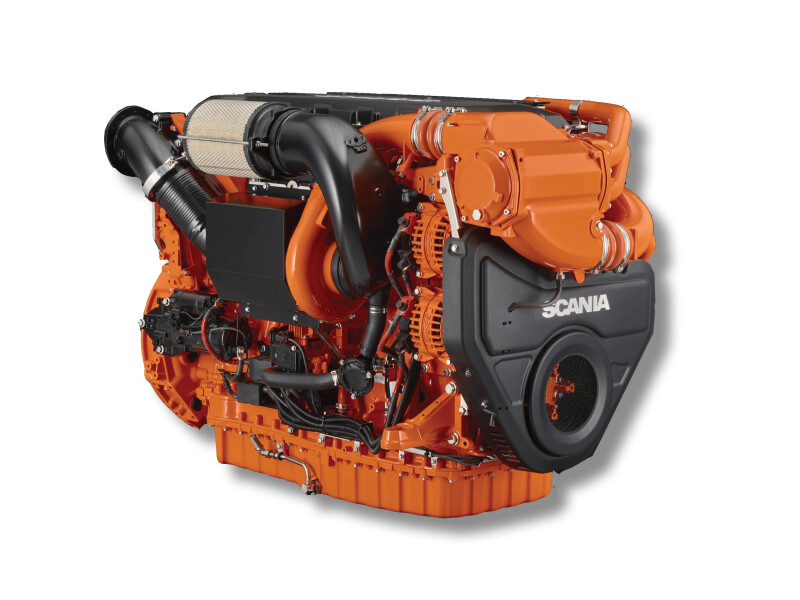
The latest offering from Scania, Södertälje, Sweden, unveiled to the North American market at the 2025 International WorkBoat Show in New Orleans, is engineered to be both reliable and efficient.
The new 13-liter marine engine has been available in Scania trucks and an off-road version in Europe but is being launched in phases for the marine market. “We’ll have the first ones stateside in late 2026,” Ernie Ortega, marine sales manager at Scania, told WorkBoat’s sister publication, National Fisherman.
“One of the biggest selling points is the increase in fuel efficiency,” Ortega said. “Up to 7%.”
The efficiency gains come from multiple design improvements, including better geometry in the combustion chamber and an updated engine management system. “This is the most advanced marine engine Scania has ever built,” Ortega said. “It’s been designed from the ground up to deliver greater power and reliability while consuming less fuel and producing less CO2.”
The new design features reduced internal friction, optimized fuel injectors, and improved cooling, among other upgrades. The engine platform will be available in power ratings from 350 hp up to 1,050 hp.
In addition to the fuel efficiency increase, the new design is also “alternative fuel ready,” Ortega said, noting compatibility with 100% hydrotreated vegetable oil (HVO) and up to 20% biodiesel. “One hundred percent HVO use would mean up to a 90% reduction in CO2 as compared to the current platform.”
Almost every part of the engine has been changed to facilitate and reduce maintenance, including a newly designed engine block, mono-block cylinder head, and an improved rotating assembly with crankshaft, pistons, and dual overhead cams. “Those all make contributions to an engine that is built to be reliable,” Ortega said.
The Next Generation 13L features one-side maintenance, providing access to fuel filters, cartridge oil filters, engine oil fill point, seawater pump impeller, and a unified electric customer interface for engine diagnostics, all on the same side of the engine.
CALIFORNIA
MAN Engines, Nuremberg, Germany, has been swift in its efforts to meet California’s stringent Commercial Harbor Craft (CHC) emissions standards, becoming the first engine manufacturer to offer certified V12 engines that meet the demanding “In Use Performance Standard.”
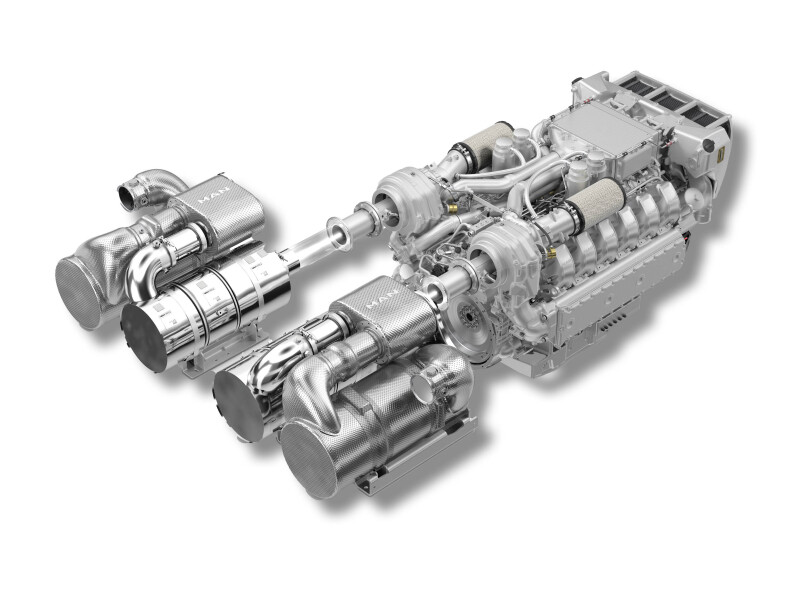
The updated CARB CHC Regulation, which went into effect in early 2023, requires CHC vessels to drastically reduce pollutants. Only engines equipped and certified with diesel particulate filter (DPF) and selective catalytic reduction (SCR) systems receive approval. MAN Engines has rolled out a fully integrated exhaust gas aftertreatment system that coordinates the engine, DPF, and SCR to guarantee maximum efficiency and reliability.
“MAN Engines has been able to stay ahead of the market with its CARB-verified offerings by leveraging years of experience with advanced aftertreatment systems across multiple sectors beyond marine,” said Jason Blume, sales manager for marine engines in North America at MAN Engines.
MAN Truck & Bus in Germany has long operated in highly regulated on-road and off-road applications, including commercial trucks, agricultural equipment, and industrial machinery, where stringent emissions standards have made the use of DPF and SCR systems commonplace, Blume explained.
“This extensive experience has allowed MAN to effectively transfer proven DPF and SCR technologies to its marine engine portfolio,” he said. “In particular, MAN’s compliance with Euro Stage V regulations for Europe’s inland waterways provided a strong foundation that aligned closely with California’s harbor craft emissions requirements.”
The engines that meet these strict emission requirements are based on EPA Tier 4 engines from MAN’s current portfolio. Four performance variants of the 12-cylinder MAN D2862 are available for the CARB CHC In-Use Performance Standard, ranging from 735 kW (1,000 hp) for heavy-duty applications to 1066 kW (1,450 hp ) for medium-duty applications.
Several reference projects featuring MAN’s CARB-compliant offering were delivered in 2025. The U.S. ferries Karl and Zalophus, both built by Mavrik Marine, La Conner, Wash., for San Francisco Bay Ferry, meet CARB CHC standards. The research vessel North Wind, built by All American Marine, Bellingham, Wash., for California Polytechnic University, Humboldt, is also equipped with MAN engines and is already in operation.
Early reference vessels in California have reinforced the importance of hands-on installation support when integrating aftertreatment systems, Blume said. “These projects highlighted the need to carefully address space constraints, serviceability clearances, and proper ventilation early in the vessel design and installation process.”
In early 2026, MAN Engines expanded its portfolio with the new MAN D3872 LE437 with 920 kW (1,250 hp) for heavy-duty applications. It features a displacement of 30 liters, a heavy-duty rating, and the same modular, compact DPF+SCR exhaust gas aftertreatment system.
