



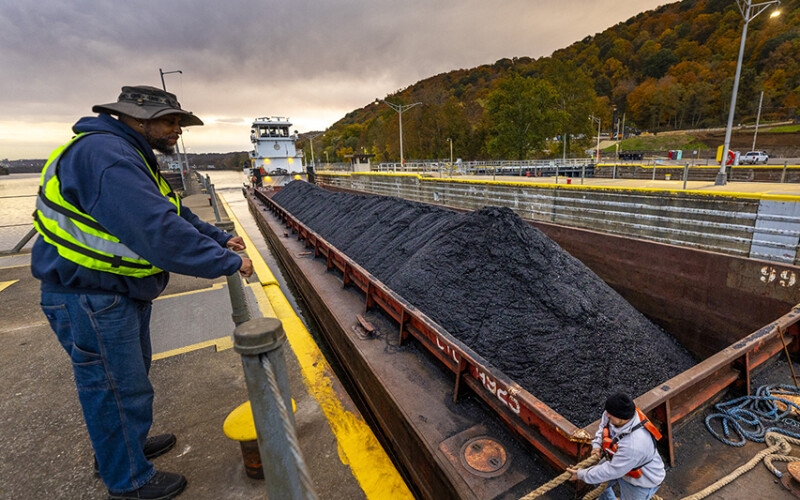
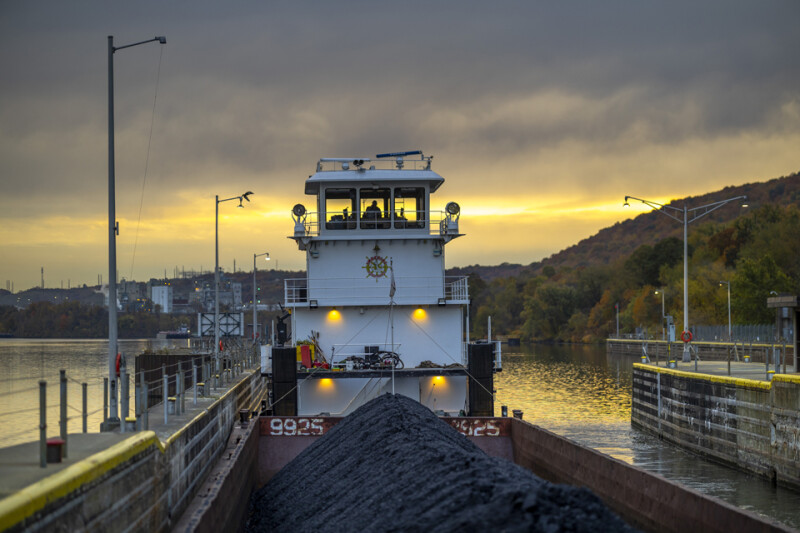
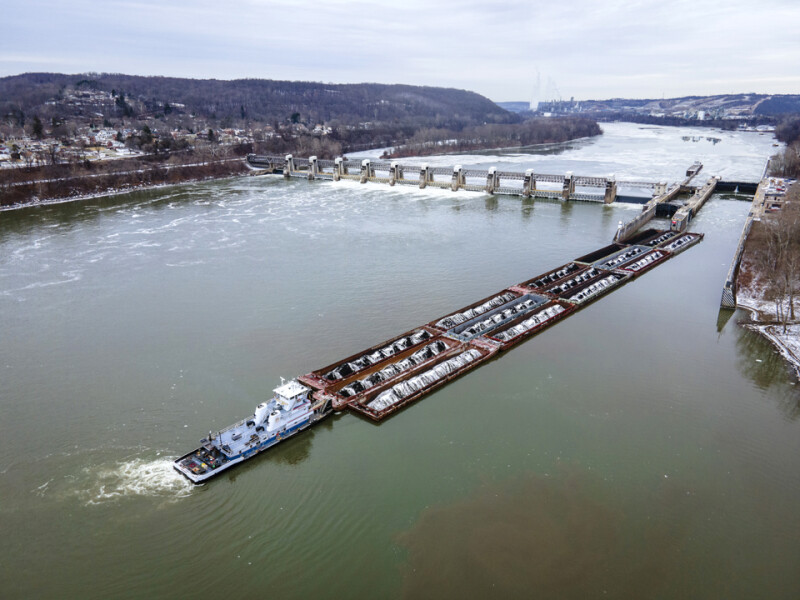
Three hundred times a month, commercial vessels on the Ohio River, largely barge tows, lock through the Montgomery Locks and Dam’s two chambers on their way to or from the Port of Pittsburgh. Built in the 1930s, the structure is the poster child for being ridden hard and put up wet, and the Army Corps of Engineers, tasked with keeping traffic moving through the nearly century-old structure, has done a Herculean job of keeping traffic flowing as efficiently as it does.
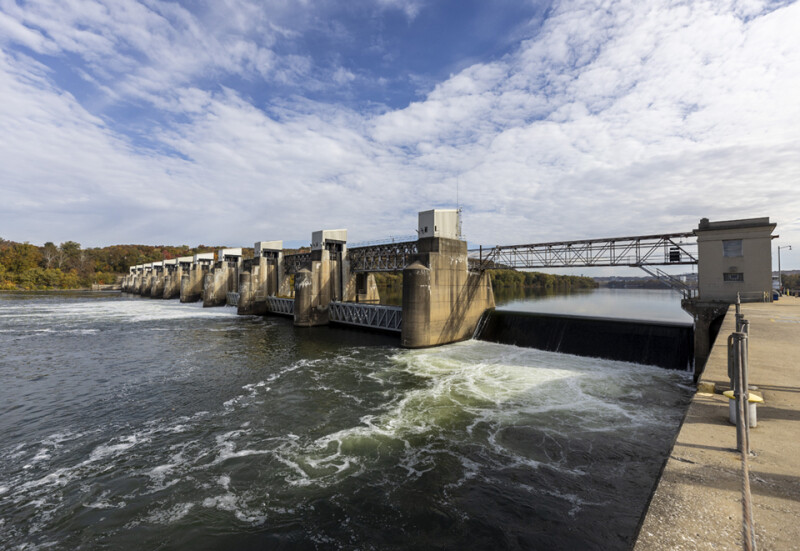
Continuing to perform maintenance and rehabilitation piecemeal brings risk and carries steep economic consequences. A single year-long closure at Montgomery could cost nearly $150 million and force shippers to reroute cargo to more than 100,000 railcars or 400,000 trucks — significantly increasing emissions, congestion, and costs.
But even the agency’s best efforts can’t stay ahead of the decay while moving the Montgomery Locks and Dam into the future. A drastic change was needed, and that change has come in the form of the Montgomery Lock Chamber Project.
As it now stands, “It’s one of the hardest locks to make,” Shane Checkan, a western rivers pilot and general manager of Industry Terminal & Salvage Co., Industry, Pa., said during a media tour of Montgomery in August. The tour was organized by the Waterways Council Inc., a trade group that advocates for a modern and efficient inland waterways transportation system.
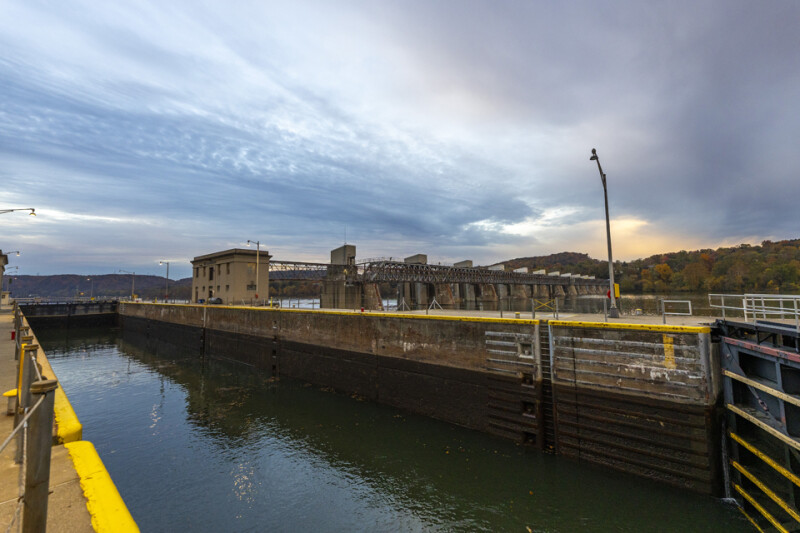
In short, the object is to strip the concrete retaining wall from one side of the auxiliary chamber and lay a new, larger chamber over the top of the auxiliary’s footprint. The project involves replacing the 56'x360' auxiliary chamber at Montgomery — that can only lock through one barge at a time — with a new 110'x600' lock that can lock through multiple barges at once.
REHAB AND EXPAND
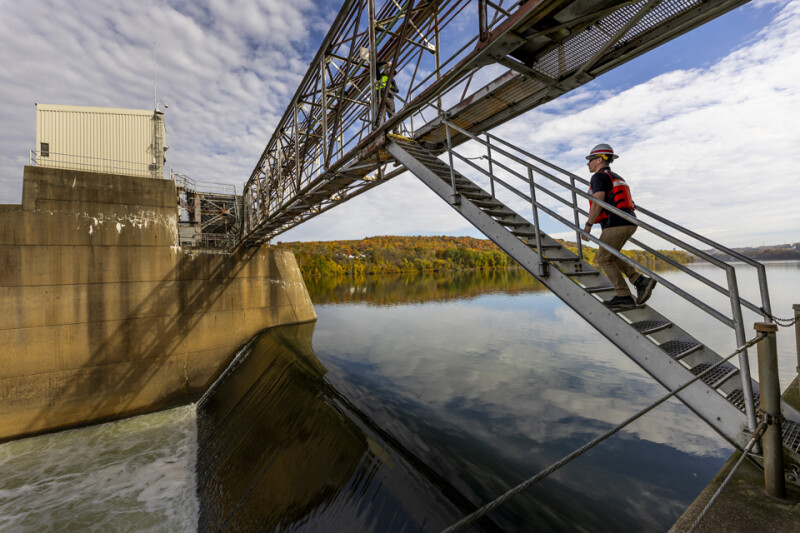
The Montgomery Locks and Dam were built between 1932 and 1936 to gain increased control over the water level in the navigation pool upriver of the dam.
Late last year, the U.S. Army Corps of Engineers Pittsburgh District awarded a $770 million contract to a joint venture between Trumbull Corp., Pittsburgh, and Brayman Construction Corp. of nearby Saxonburg, Pa., to build a new primary lock chamber at Montgomery. The project is part of the Biden administration’s Bipartisan Infrastructure Law.
According to the Corps, the modernization effort addresses aging infrastructure that is increasingly at risk of failure.
Construction activities began this spring with the removal process of the existing auxiliary lock chamber. River traffic continues to use the current primary lock while construction is underway. Once completed, the new chamber will address the industry’s need for larger infrastructure capable of handling modern commercial barges.
“This is one of the main benefits of receiving bulk funding at the outset,” Jenna Cunningham, the project’s resident engineer, said earlier this year. “Because we’re using a single contractor with a base-plus-options structure, we’re minimizing the need for repeated mobilization, separate contract awards, and long procurement timelines.”
The current primary chamber can lock through nine barges at a time, while the existing auxiliary chamber can only handle one at a time. So, the choice of which chamber to close during construction was obvious, said Chris Dening, project manager for the Corps’ Pittsburgh District.
“That would be almost like shutting down the whole system,” he said. “The auxiliary chamber is the problem. Can only fit one barge at a time in there.”
About 12 million tons of goods move through Montgomery annually. A failure of the locks could cause severe disruptions, including an estimated $180 million economic impact from a one-year closure, according to the Corps.
To prevent that, the Bipartisan Infrastructure Law allocated over $1.5 billion to the Upper Ohio Navigation Project, which includes the modernization of locks at Montgomery, Dashields, and Emsworth along the Ohio River. The Montgomery project is the most significant and the most expensive, representing the largest Bipartisan Infrastructure Law-funded initiative in Pennsylvania.
Corps officials told the media group that the project is bringing significant employment benefits to the area. The Corps estimates that the construction of the new Montgomery lock chamber alone will support over 13,000 jobs, while the broader Upper Ohio Navigation Project is expected to create more than 28,000 jobs during construction and 5,300 jobs annually upon completion.
Dening said the Montgomery locks are the oldest and smallest that service the Port of Pittsburgh. Everything downstream is twice as big, with 1,200' capacities. Montgomery’s 360' auxiliary chamber creates a bottleneck for vessels transiting in and out of the port. “They’re coming up on 100 years old at this point. They’ve seen a lot of wear and tear,” he said. “They were rehabbed in the eighties, and that was to extend their life another 25 years. So, if you do the math on that, you know we’re in overtime.”

CONCRETE
Once the old retaining wall is removed, workers will build a coffer dam around the old auxiliary dam, drain it, then lay the new chamber over the auxiliary’s old footprint.
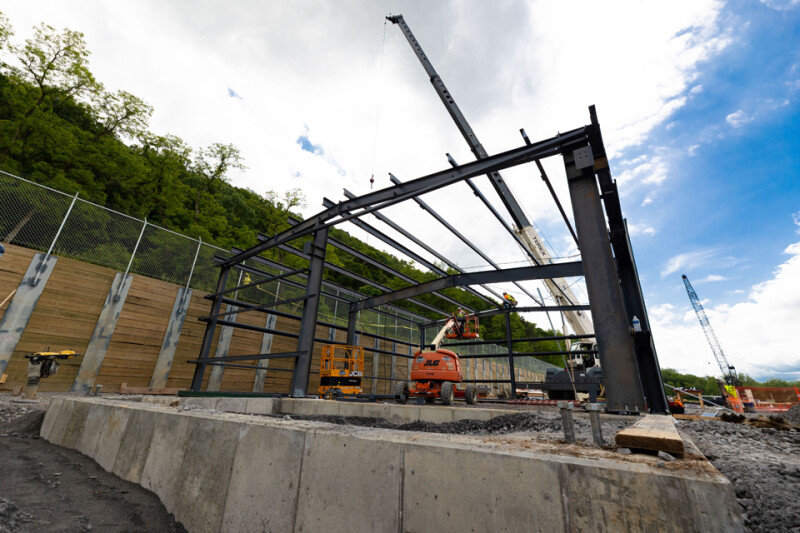
Since the initial contract award, contractors have installed temporary field offices, erected fencing and power infrastructure, constructed new stormwater drainage systems, and begun demolishing the lower guard wall. The contractors have started constructing the foundations for the batch plant equipment.
As of August, the project was less than 10% complete. Most of the work has been preparing for the creation of the new lock. That lock will be made of concrete — lots of concrete.
In fact, the Corps determined it would be more practical and cost-effective to build a dedicated on-site plant to produce the large volume, more than 400,000 cu. yds. — of specialized concrete needed for the project, rather than trucking it in. Building the batch plant on-site, along with a quality assurance and control lab, enables the contractors to mix at least 150 cu. yds. of high-quality concrete per hour and will minimize logistical delays.
The road to the river already has its share of potholes. The number of trucks needed and the wear and tear on the roadway they would cause made trucking in the cement both physically and financially impractical. Road improvements are part of the Corps’ future plans.
“This is a generational investment,” said Cunningham. “It’s about modernizing our navigation infrastructure in a way that’s smarter, more reliable, and sustainable.”
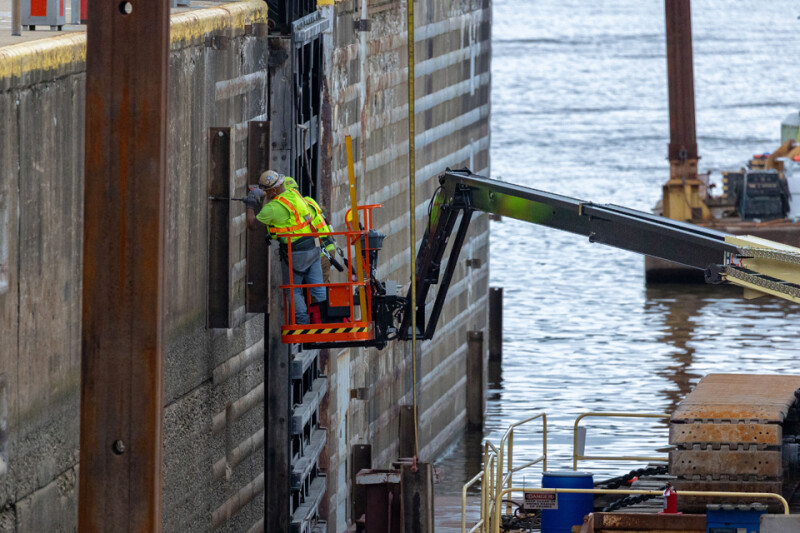
Along the middle lock walls, contractors are installing inclinometers — long, vertical instruments that detect subtle shifts in the earth.
“These inclinometers are designed to measure any horizontal movement of the wall during and after construction,” Andrew Aceves, a geologist with the Corps’ Pittsburgh district, said in June. “Each one is installed in a cored shaft that extends several dozen feet along the lock wall, with outer casings secured to ensure long-term integrity.”
More than 50 inclinometers will continuously monitor the lock wall during construction to alert engineers to any movement by providing real-time updates through an automated system. The system is essential for preventing unintended structural shifts and ensuring industry vessels can continue to lock through during construction.
“This project shows you what the Corps can do with a large construction project,” said Col. Nicholas Melin, district commander. “It really represents the way the Corps wants to do big projects, and our mission is to deliver for the nation at or under budget.”
The project is scheduled for completion in 2033.
