


How do professional mariners learn to handle huge, oceangoing ships? For some, the educational voyage goes through a small freshwater pond near Cape Cod.
Just 10 minutes north of the Massachusetts Maritime Academy (MMA) campus on Cape Cod Canal is Great Herring Pond, 300-plus acres of generally shallow water that is home to the academy’s collegiate sailing and rowing center.
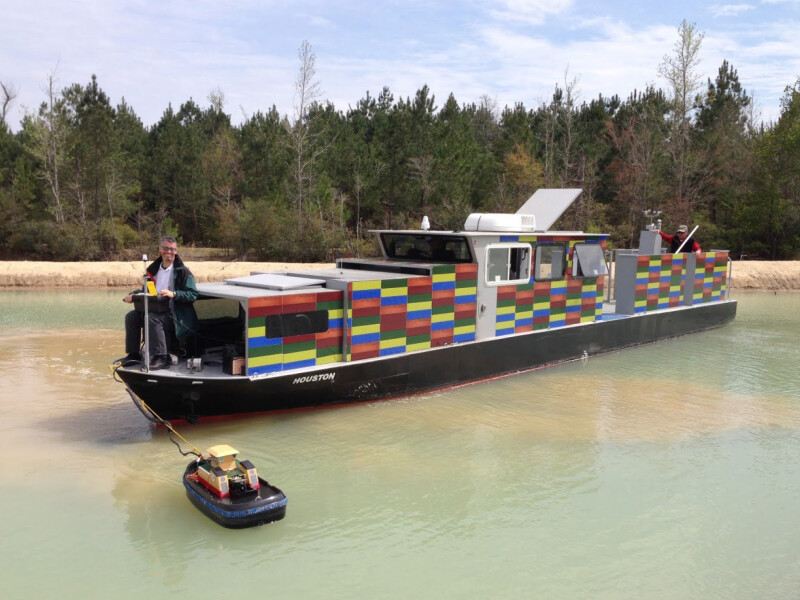
Docked between the rowing shells and one-design daysailers are four fully functional 1/25th-scale ships — manned models — based on big commercial vessels:
A 37' model (Massachusetts) of a 925' very large crude carrier called the Antigun Pass.
Two 36.5' models (Bay State and Patriot State) of 912' U.S. Navy combat stores ships, reconfigured as containerships.
A 24.6' model (Boston) of the American Phoenix, a 616' product carrier.
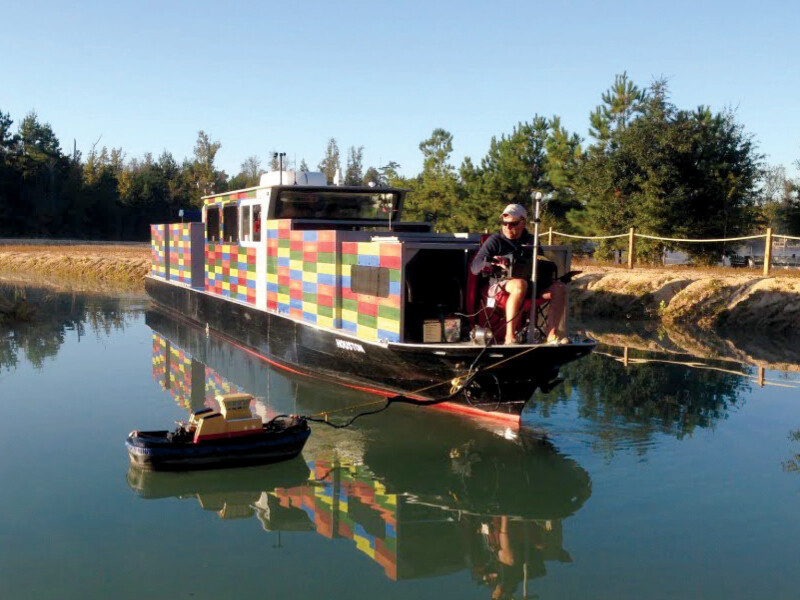
All are powered by electric motors (from 1-4 hp) and fully loaded with water or brick ballast so they sit as low in the water as possible, with draft ranging from 18" to 26". Each model handles exactly the same as the ship it’s patterned after, which means they go slow, are hard to turn, slow to stop, and subject to all the same complex physics and hydrodynamic forces that bedevil any big vessel on the water. Two electric winches at the bow allow for anchoring practice, and remote-controlled tugboats are used in docking and undocking exercises.
About 10 times a year, MMA holds a five-day, graduate-level class that takes six active professional mariners (pilots, masters, mates, navigational officers) out in the models, giving them real-life continuing education in shipping control, navigation, and safety, so they can grow their certifications and advance in the industry. Since the training program started in 2002, some 1,200 mariners have graduated from the course.
MMA, other maritime academies, the U.S. Navy, and the shipping industry all depend heavily on sophisticated computer simulators for primary navigational training. Manned models supplement that by providing working mariners a unique opportunity to experience, in representative, small vessels at safe speeds, exactly how big ships react on the water to various situations they will encounter at sea.
“What sets this program apart from a traditional simulator class is that students train in actual models — underway, in the water,” said Capt. Michael Burns, director of the program since 2008 and an MMA graduate with thousands of sea miles under his keel. “You can feel the wind in your face. You can feel the model moving beneath you.”
MMA’s course, funded by tuition and support from the Boston Marine Society — the oldest association of sea captains in the world — is one of two manned-model ship training programs in the United States and seven in the world (in France, Britain, Poland, Australia, and Panama). The other U.S. program is offered by the industry-funded Maritime Pilots Institute (MPI), which has four 1/25th-scale ship models at its Port St. Tammany base in Bush, La., along with remote-controlled tugs. MPI also offers research simulation and expert maritime consultation in support of pilot activities.
Neither program receives government funding and is therefore unaffected by recent federal spending cuts.
THE MMA PROGRAM
MMA has carefully mapped out different parts of Great Herring Pond with red, green, and yellow buoys, as well as floating docks, which the model fleet uses in a wide variety of training exercises including shallow water, deepwater, and narrow channels. Students practice close-in passing and overtaking scenarios (to experience how vessels interact with each other); turning; rafting with an anchored ship; docking both upwind and downwind; anchoring. Inevitably, there are a few harmless mishaps (groundings and minor collisions).
Each model holds two or three students, sitting above and behind a professional pilot who drives the boat. The students act as pilots, quietly ordering rudder and engine changes, which, as maritime procedure requires, are acknowledged and repeated by the helmsman. They can be a strange sight for the summer vacationers who share Great Herring Pond.
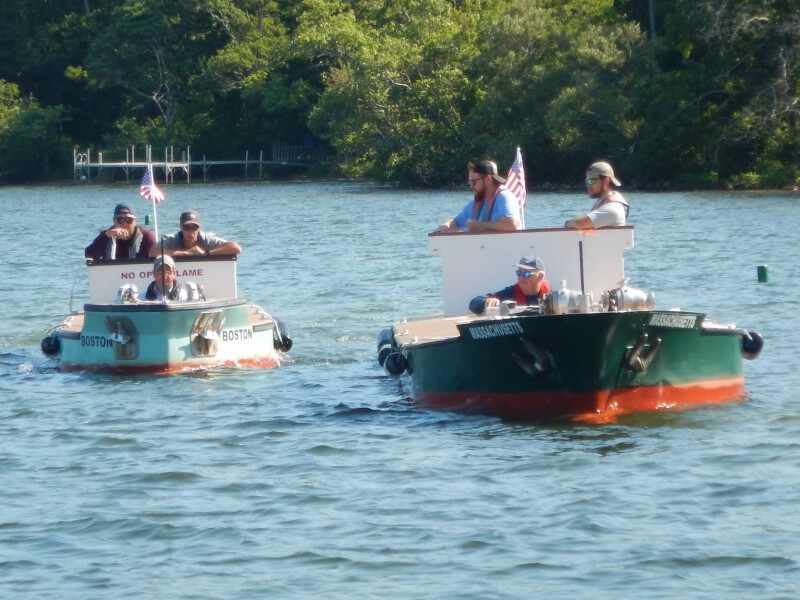
“I like to say it’s the most fun you can have at two knots,” joked Capt. Robert McCabe, a 1990 graduate of MMA, currently a Boston harbor pilot and one of the manned-model instructors. “It’s a great course for professionals. You get to do things you can’t do at sea.”
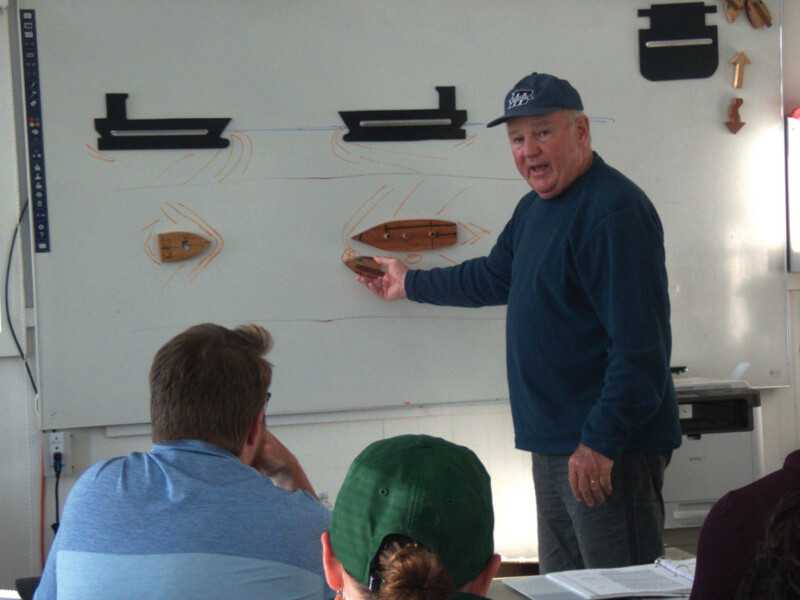
Classroom instruction precedes each exercise, and students go through a rigorous exam at the end of the course. The lead instructor is Capt. Robert Blair, a Massachusetts state pilot for the past 43 years who covers the waters from Boston north. Blair starts with a refresher of the venerable laws of physics that govern how objects move through water: Archimedes’ principle of buoyancy (circa 246 BC,) Newton’s laws of motion (1687), Bernoulli’s principles of fluid dynamics (1738).
“We’re dealing with the physics of motion and the hydrodynamics of what vessels are going to do and why they’re going to do it,” he explains. He describes the constantly changing “3-D force field” that surrounds moving ships as they displace water, and how those forces can push vessels apart or pull them together, depending on where the positive and negative pressure zones happen to be on a passing hull at any given time. Students then pilot to the models to experience these forces at work on the water.
Riding along in the Massachusetts recently, I witnessed a classic display of those physics when the Bay State passed to port a tad too close.
Just as predicted in the classroom, positive pressure from Bay State’s bow wave pushed our stern away, causing our bow to pivot even closer to the passing ship. Then, as Bay State moved up, negative pressure at the bow of the Massachusetts pulled the Bay State into and across our bow, resulting in a collision. Both models came to a dead stop, the containership perfectly T-boned amidships by the bow of the crude carrier. This would be twisted metal, possible injury or death, and big money in real life, but the models didn’t even get scratched.
Back in class, Blair made the most of the collision’s teachable moment. “I can sit up here and draw pictures, but out on the water, that T-bone, there it is! Plain as day, these forces are real. You have to recognize and deal with them.” He added, “If you’re gonna have an accident, this is the place to do it.”
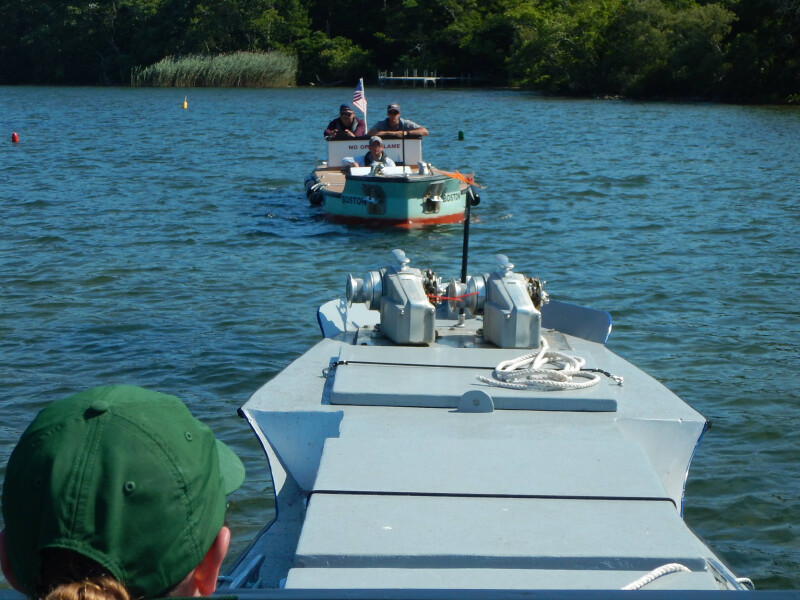
I also witnessed some excellent boat handling and “precision docking” skills. The best was when one student in the Massachusetts came upwind of a dock, dropped and “dredged” the port anchor for several dozen yards; swung into the wind and dropped the starboard anchor, and then dropped back on the V-set of both anchors into a perfect stern-to Med-moor (short for Mediterranean mooring) right off the end of a narrow dock.
Pure grace and artistry, executed in the longest, heaviest, and least maneuverable of all the models in the fleet.
It was clear, having sat in on the course, that the students who take it are both experienced and clear-eyed about what it takes to succeed.
Brian Sarapas, a senior dynamic positioning officer on a drillship, took the course to earn his chief mate license. Currently a second mate, he focuses on keeping the ship stationary at sea but has done voyages in the past and hopes to return to them. “Right now, I do ship handling, but in a much different way. This class was terrific at knocking off the cobwebs,” he said.
Pedro Flores, a master's on the cruise ship Viking Mississippi running between New Orleans and St. Paul, Minn., claims to have “the best job on the Mississippi River,” but wants to grow his skills and be ready if opportunity knocks. “I absolutely loved this course. It’s an invaluable experience for anyone looking to advance their careers,” he said.
