



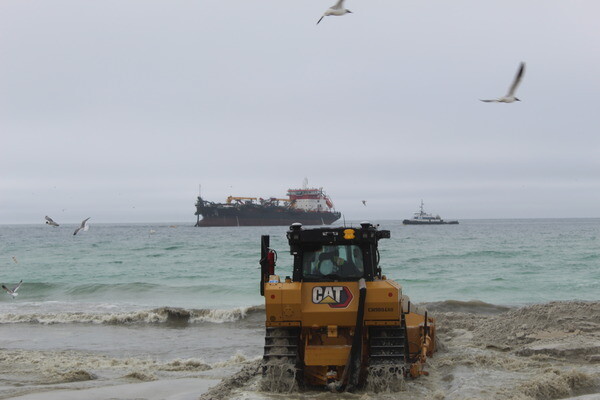
Manson Construction Co., Seattle, held a christening ceremony Saturday in New Orleans for the Frederick Paup, the largest self-propelled trailing suction hopper dredge ever built in the United States.
The new vessel continues a streak of significant recapitalization within the U.S. dredging market as contractors build new dredges to remain competitive. “It’s a really exciting time, and you can see it in bids with the U.S. Army Corps of Engineers that there’s a lot of fierce competition out there,” said Manson Chairman of the Board Frederick Paup, the dredge’s namesake. “We’re excited to compete.”
Designed by Manson in partnership with Hockema Group Inc., Seattle, the Frederick Paup was built by Seatrium AmFELS, Brownsville, Texas. Measuring 420'x81' with a 28'6" draft and with hopper capacity of more than 15,025 cu. yds., the Jones Act-compliant newbuild surpasses Manson’s 13,500-cu.-yd. Glenn Edwards — built by Alabama Shipyard, Mobile, Ala., in 2006 — as the largest self-propelled hopper dredge ever constructed in the U.S. “We built the new big dog,” Paup said.
There are much larger dredges operating internationally — including the world’s largest, Cristobal Colon and Leiv Eiriksson, with capacities exceeding 60,000 cu. yds. — but a dredge of that size could not feasibly be built for U.S. operations.
“The U.S. market is unique compared to the international market because you have a lot of waterways, channels, and rivers where you don’t have that much room,” Paup said. “At a certain point, if the dredge is too big, then you can’t turn around anymore.”
Triple Schottel RudderPropellers type 510 L FP azimuthing stern drives and twin Brunvoll bowthrusters allow the Frederick Paup to rotate 360° in tight areas. “We can turn around on our own axis,” Paup said.
The vessel boasts approximately 25,000 hp. It is powered by three Tier 4 Wabtec 16V250MDC diesel-electric main engines and two 12V250MDC gensets, also from Wabtec. “[Diesel-electric power] makes the vessel more fuel efficient,” Paup said. “Our cost per cubic yard of material dredged for fuel is dramatically lower than it would have been [with conventional diesel].”
In addition, the Frederick Paup is the first dredge in the Manson fleet to have in-hull pumps instead of less efficient bow-mounted boosters. “We believe the Frederick will be every bit as productive as all of our competitors’ dredges out there on beach projects,” Paup said.
The ABS-classed dredge features dynamic positioning, integrated dredging systems, and power management systems. It features a suite of Furuno electronics, including radar, FE-800 depth sounders, FA-170 AIS, GP-170 GPS, and Inmarsat-C Mobile Earth Station FELCOM18 GMDSS, as well as Simrad AP70 MK2 autopilot control.
Ordered in 2020, the Frederick Paup was originally scheduled for delivery in 2023, but the project faced significant delays as the shipbuilder grappled with other large Jones Act builds, including a pair of LNG-powered containerships and the first U.S.-built wind turbine installation vessel. The delivery marks Seatrium’s last from the Brownsville shipyard, which was sold to Karpowership, Istanbul, in September 2025.
The Frederick Paup was delivered in January. Its first assignment was maintenance dredging near Mobile, Ala., to ensure access for deep-draft vessels. Earlier this month, the dredge moved to Pensacola, Fla., for beach work. The vessel will next reposition to the Mississippi River for additional maintenance dredging.
“She’s already doing her first pumpout job. She’s already done maintenance dredging,” Paup said. “She’s already addressing America’s navigation issues.”
