



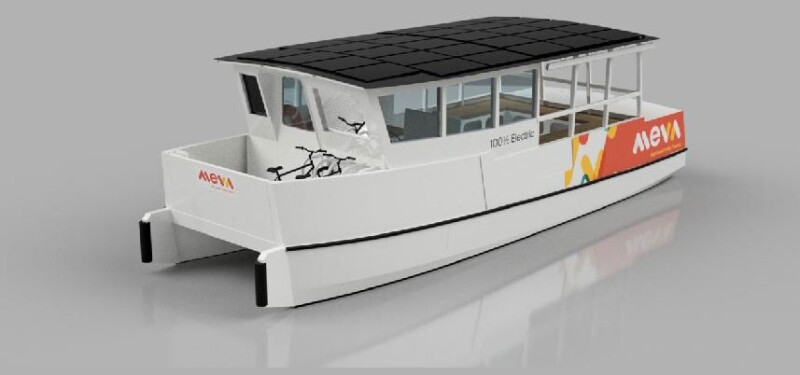
Lyman-Morse, Thomaston, Maine, has been selected to build three aluminum, solar-powered passenger ferries for Merrimack Valley (MeVa) Transit.
MeVa Transit Administrator Noah S. Berger told Wavelength Haverhill (WHAV) the boatbuilder won the procurement through a bid process that evaluated technical specifications in addition to price. Lyman-Morse will receive $3 million to build the fleet.
For the vessel design, Lyman-Morse will partner with William Lincoln of Response Marine, Newburyport, Mass. The ferries will also incorporate a propulsion and solar-charging system supplied by Vita Power, Southampton, England.
Each vessel will be a 33' double-pontoon catamaran equipped with twin 150-hp electric outboards and designed to cruise at 10–12 knots. A single battery charge is expected to cover the full Haverhill–Newburyport route. Solar panels mounted on the cabin roof will provide supplemental power.
Lyman-Morse’s fabrication division director Jonathan Egan told WHAV that each docking station will include a fast-charging system, allowing crews to connect the ferries for a charge while passengers load and unload.
Capacity is expected to range from 18 to 22 passengers, along with space for two bicycles or scooters. Exact deck layouts are still being finalized, though MeVa plans flush decks to accommodate wheelchairs and electric mobility devices.
According to WHAV, MeVa secured a $4.2 million federal grant nearly three years ago to procure at least two electric ferries. Berger told WHAV the transit agency was able to stretch the award to cover three boats, additional battery capacity, and a backup propulsion system.
The first vessel is expected to be completed in time for demonstration runs next summer. Full seasonal service is slated to begin in 2027, contingent on dock readiness in Haverhill, Amesbury, and Newburyport. WHAV reported that Amesbury is currently upgrading its waterfront infrastructure to support the operation.
WorkBoat reached out to Lyman-Morse for further specs on the vessels.
