



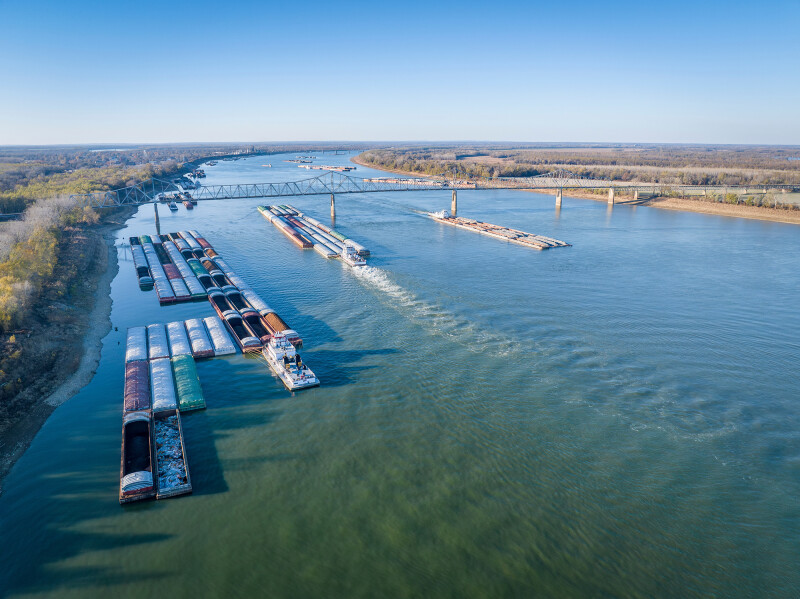
The inland towing industry is asking the Trump administration to drop or modify a host of existing federal regulations or policies that it says are negatively impacting towing operations.
The nine-page wish list was submitted to the White House Office of Management and Budget (OMB) in response to the agency’s nationwide call for industries to suggest ways to reduce regulatory burdens on their businesses.
This deregulation initiative is part of an executive order issued by President Trump in January that directed federal agencies to rescind “unlawful regulations and regulations that undermine the national interest.” A White House fact sheet said, “Overregulation stops American entrepreneurship, crushes small business, reduces consumer choice, discourages innovation, and infringes on the liberties of American citizens.”
In a letter sent to OMB in May, the American Waterways Operators (AWO), which represents the towing industry, offered recommendations for deregulation that touch on vessel inspection, marine casualties, navigation safety, cybersecurity, pollution control, and mariner credentialing.
“This list is inclusive of regulations we recommend for rescission because their costs exceed their benefits, they are outdated, or they impose unreasonable burdens on towing vessel and barge operations,” AWO said in its submission. “This list also includes recommendations for regulatory modifications and clarifications that would have a deregulatory effect.”
AWO’s “action items” include:
- Reducing annual vessel inspection fees for inspected towing vessels.
- Eliminating requirements that a copy of a Towing Safety Management System Certificate that shows compliance with Subchapter M regulations, and certificates of inspection must be kept on board, and instead allowing these documents to be maintained in electronic form.
- Dropping the requirement that towing operators using the Towing Safety Management System option be randomly selected for external audits, a rule that “significantly limits operational flexibility, imposes unnecessary costs on operations and third-party organizations, and arguably results in less consistent safety oversight.”
- Clarifying a requirement for high bilge level alarms to indicate where these alarms should be located on vessels.
- Modifying the definition of a “major marine casualty” that has been defined by Congress at $2 million or more in property damage but has not yet been updated by the Coast Guard, which applies a far lower threshold of $500,000 to trigger notification to the National Transportation Safety Board. “This exposes vessel operators to costly and burdensome investigations that do not meet the legal threshold.”
- Delaying implementation of minimum cybersecurity requirements on U.S. vessels to give operators more time to train personnel, and exempting barge fleeting facilities from minimum cybersecurity requirements, as these operations are located in rural areas with little infrastructure, electricity, or internet access.
- Reducing frequency of cybersecurity drills, which are now required at least twice a year.
- Reconsidering the requirement for mariners with national towing vessel officer endorsements to take firefighting training because these officers are responsible for managing the crew’s response to a fire, not fighting it.
- Updating Coast Guard chemical drug testing regulation to permit testing of oral fluids as well as urine testing, which would offer more flexibility to vessel operators.
- Eliminating requirements for seagoing, uncrewed, unpowered barges to meet the numeric ballast water discharge standard because most of these vessels are towed on wires, have no crew, and can’t be retrofitted with ballast water treatment systems.
AWO says the list was based on recommendations from the group’s executive committee.
“Regulations that compromise the safety of towing vessels and their crewmembers, that impose unnecessary costs and other burdens on companies operating towing vessels and barges or that result in the diversion of cargo to other freight transportation modes are bad not only for our members and our industry, but also for our nation’s economy and security, U.S. producers and consumers and the American public at large,” the letter states.
AWO is consulting with the Coast Guard to advance these recommendations. The agency has already updated several policies and streamlined processes that have helped the industry, and more changes are expected, according to Caitlin Stewart, AWO’s vice president for regulatory affairs.
President Trump launched a similar deregulation initiative during his first term, and based on industry suggestions, several reforms were made by the Coast Guard. These include allowing vessels to carry electronic charting systems instead of paper charts and syncing the expiration dates for merchant marine credentials and medical certificates, Stewart said.
