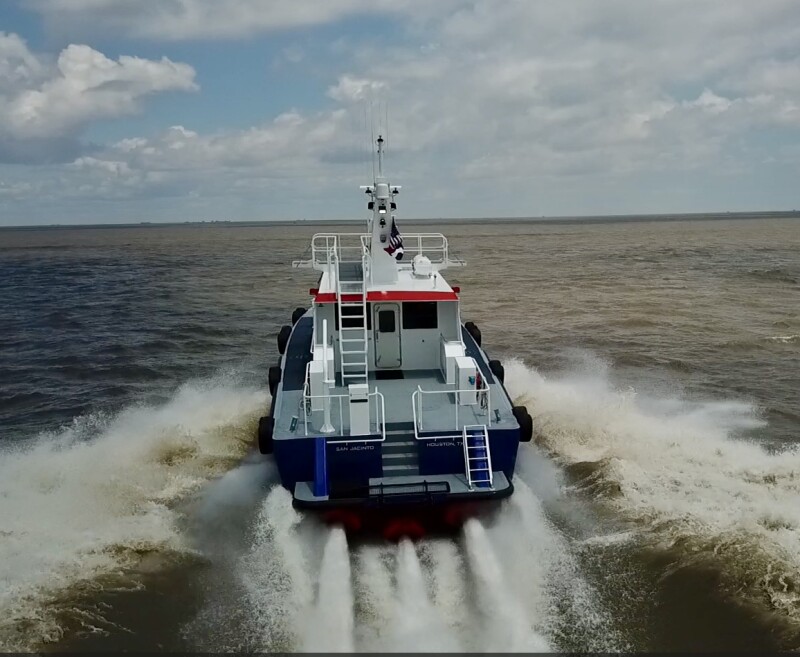
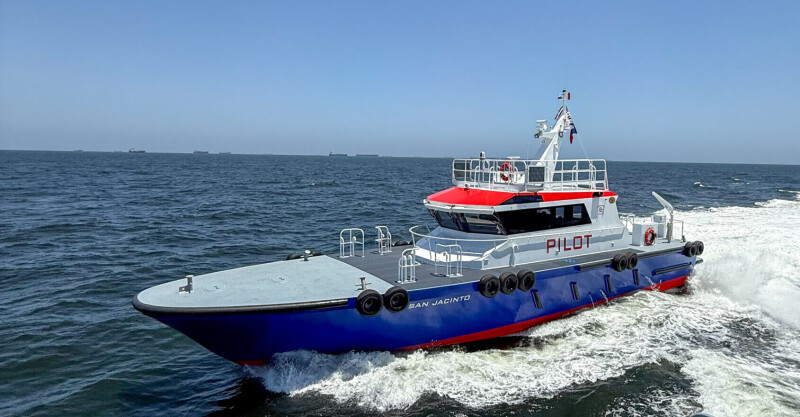
The Houston Pilots, Deer Park, Texas, is one of the busiest pilotage services in the U.S. Its two new boats from Breaux’s Bay Craft, Loreauville, La. — the 80'x21' San Jacinto, delivered in May, and sister vessel Juan Seguin, scheduled for delivery later this year — feature several innovative design elements.
Each boat is powered by three MAN D2862 LE 438 Tier 4 engines supplied by Performance Diesel. The engines are rated at 1,200 hp apiece and paired with Twin Disc MGX 5204 SC gears and triple HamiltonJet HTX47 waterjets. Gulf Coast Filters supplied the fuel polishing system, and Driveline Service of Portland supplied one steel and two composite cardan shafts.
Capt. Billy Kern, third executive officer, is in charge of boat operations and crew and said the Houston Pilots have been “very happy” with the MAN engines aboard its two station boats, Bayou City and the Houston, leading the group to choose the same manufacturer for its new launches. “We wanted continuity for our maintenance and repairs,” he said. “We’re trying to streamline our maintenance process. And we wanted fuel efficiency, of course.”
The San Jacinto and Juan Seguin are among the first EPA Tier 4 pilot boats, and the first in the U.S. with the MAN three-engine setup, according to Kern. Initially, the pilots were hesitant to try the configuration, he said, “but we figured out that running those three engines, but not running them at full power, has given us about four knots faster than our old boat, but burning less fuel.”
“We had a clause in our contract that we wanted to be able to operate that boat at 30 knots at or around 80% load,” said Kern, noting that the compact MAN engines weigh less than offerings from other manufacturers in a similar horsepower range. “We run about a 10- to 12-mile stretch from shore out to our bar vessel, and we wanted to be able to make that run in under an hour — really about 40 minutes — due to the frequency of our traffic here in the port and the number of pilots that are working at any time. [The speed] helps us speed up the process and stay on schedule.”
Designed by ECS Marine with an inverted deep-V hull, the San Jacinto surpasses the contract’s speed requirement, cruising at 32.5 knots at 1,950 rpm and 80% load, with a top speed of 37.5 knots. The boat consumes 43 gals. of fuel per hour, per engine, with 2,200 gals. fuel capacity.
The San Jacinto features water-cooled exhaust systems on the main engines with selective catalytic reduction systems mounted in the overhead designed by Soundown, and three 145-gal. stainless steel tanks for diesel exhaust fluid. The boat is also equipped with a fixed CO2 system installed in the engine room, including two 100-lb. CO2 bottles with automatic engine shutdown and vent closure, along with a manual pull located in the machinery space that was supplied by Total Safety and installed by Burner Fire Control.
A Seakeeper 40 stabilization system significantly improves the boat’s stability and crew comfort, especially when operating slowly or at idle. “The boat already rides great. Breaux designed us a really great hull and size for what we need, but a lot of times, the boat’s moving slow, or waiting for a pilot, or just hanging out offshore. That Seakeeper just keeps the boat so stable,” said Kern.
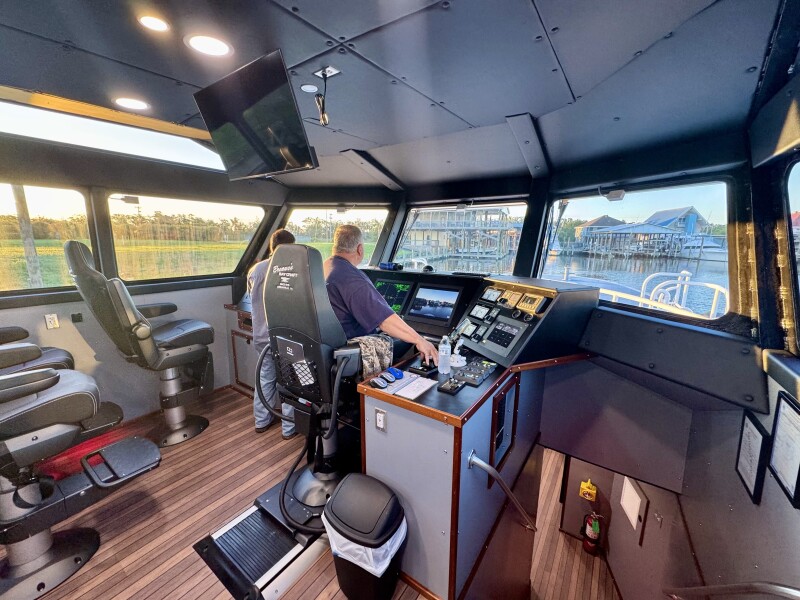
The vessel is outfitted with HamiltonJet’s AVX controls. “Our 15-year-old boat, the Yellow Rose, was a jet boat with Hamilton jets so it’s very similar controls, just the technology has gotten better and a little more user-friendly,” said Kern. “There’s a mouse pad there now with kind of a docking mode, if you will. You just move this mouse wherever you want the boat to go, and it does it. It’s pretty amazing.”
The San Jacinto has a standard wheel like any other vessel, but its NorSap 1700 captain’s seat by IMTRA has a joystick control on the left armrest. “[A helmsman] can sit back and control the steering with their left hand and then control the buckets with their right hand, so they don’t even really have to leave the chair.”
Additional seating includes nine NorSap 1600 reclining seats. The boat has sleeping accommodations for four, a galley kitchen, a 100-gal. freshwater tank, and an Ahead Sanitation Systems device. The ceilings are marine-grade plywood covered with black vinyl upholstery by Sterlings Upholstery. The cabin is aluminum covered with marine-grade acoustic plywood and finished with PlasTEAK flooring.
“We tried to steer away from the yacht-like finishes. We’ve done that in the past on one of our other boats. It looks great and it’s beautiful, but we decided to go minimal, which did cut down on some weight,” said Kern. “And for maintenance purposes, it’s very simple for our shore gang crew to get to any wiring, plumbing, whatever they need to address. They can have everything apart — paneling or trim work, anything like that — with just a screwdriver.”
Onboard systems are powered by dual Northern Lights M944T3FG 38-kW three-phase generators. An HVAC system supplied by Advanced A/C & Electric consists of two four-ton Dometic chillers (variable speed) and titanium condenser coils with five air-handling units. The engine room overhead, forward bulkhead, and crew quarters were insulated by EEG Marine. Mist eliminators and blowers were furnished by Centek Industries.
Electronics were supplied and installed by Rio Marine, including three Delta19 multiple-display monitors, Furuno 1518 radar, two Cobham SAILOR 6248 VHF radios, Furuno FA170 AIS transponder, Furuno FE-800 echo sounder, Furuno LH5000 loudhailer, Furuno GP170D DGPS, Furuno SC-70 SAT compass, ACR Globalfix V5 EPIRB, and Teledyne FLIR thermal and visible imaging cameras.
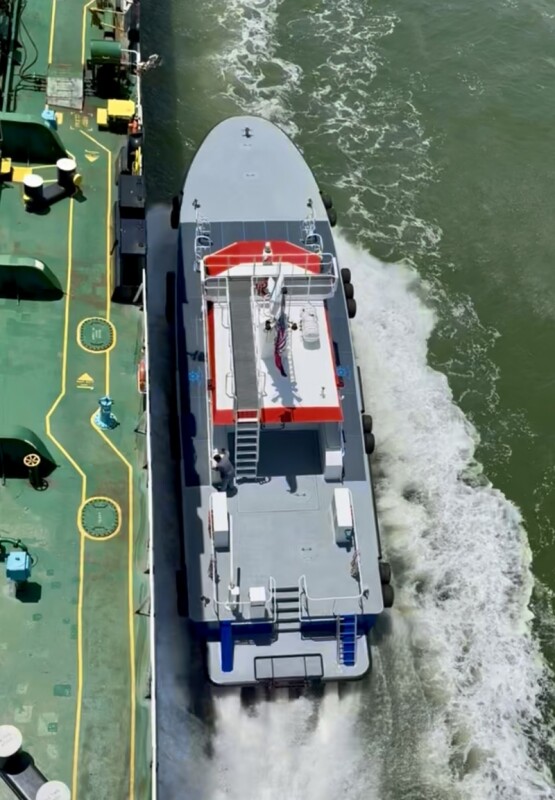
According to the builder, the stability of both overhead and forward bow boarding allows for safe transport of maritime pilots to and from ships that they are piloting, as well as a rescue SeaLift rescue system located on the stern of the boat.
The vessel features fritted laminated glass with integrated defrosters installed on the forward three windshields and the forward two side windows by B&G Glass. Custom SeaDeck flooring from Castaway Customs Texas adds traction underfoot and provides a clean aesthetic finish on the walk-around deck and boarding area. All logos, name, and home port were designed and installed on reflective material by Lipari Sporting.
The Houston Pilots hired a third-party company, Valkor, Houston, to oversee the builds and “be a second set of eyes,” said Kern. “They’ve given us a lot of positive feedback about what they witnessed and the product that we’ve received from Breaux.”
With the San Jacinto now in service and the Juan Seguin on the way, the Houston Pilots plan to decommission the 25-year-old Swath design pilot boat Lone Star, while the 15-year-old Yellow Rose will be overhauled and operated as a backup vessel or fifth boat in the pilots’ fleet, said Kern.