



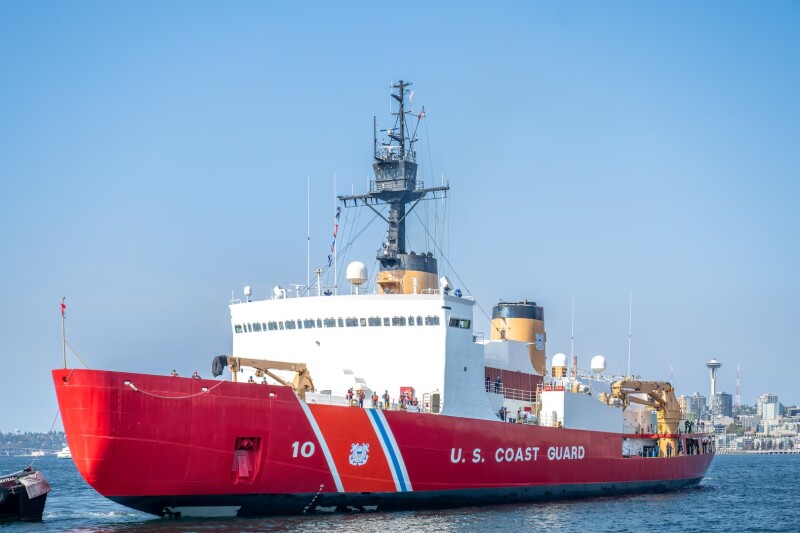
The Coast Guard’s 399’ heavy icebreaker Polar Star returned after 308 days and the annual Operation Deep Freeze (ODF) 2025 science support mission to put into the Mare Island Dry Dock in Vallejo, Calif., to complete the final year of a five-year Service Life Extension Program.
Finishing the 49-year-old Polar Star’s SLEP is a priority as the Coast Guard ramps up its polar capability amid competition from Russian and Chinese forces. Over the past five years the Coast Guard has recapitalized Polar Star’s integral systems, including propulsion, communication, and machinery control systems.
The effort to extend the cutter’s service life continues as the Coast Guard begins construction of its first Polar Security Cutter. Until PSCs becomes operational, Polar Star will remain the only U.S. icebreaker capable of completing the annual breakout of McMurdo Sound, Antarctica in support of the U.S. Antarctic science program.
“Much has been asked of this ship over the past five decades,” said Capt. Jeff Rasnake, Polar Star’s commanding officer. “The completion of this extensive five-year maintenance and recapitalization project is a major milestone in enabling Polar Star’s operations into the future.”
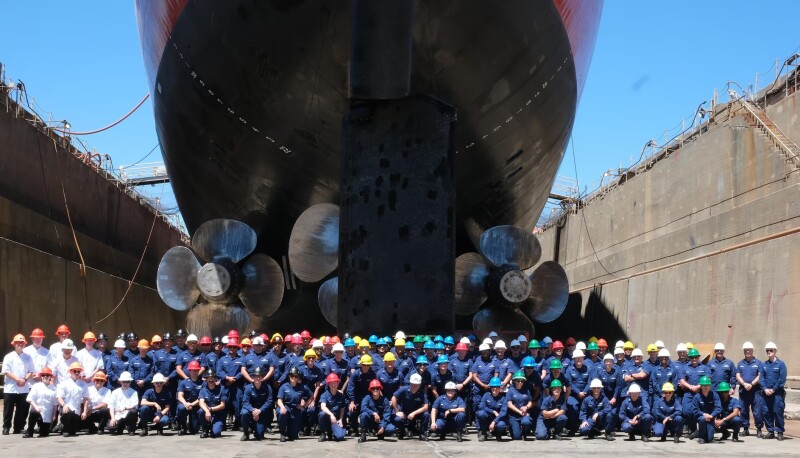
Polar Star’s SLEP has been completed in five phases to maintain its operational capability to complete annual polar deployments. Phase Five, the last phase in its SLEP, began March 30, 2024, focusing on these projects:
· Gyro repeater recapitalization to ensure that these critical pieces of navigation equipment are updated to modern standards, enabling safe navigation of the cutter.
· Ancillary pumps and motors recapitalization through the replacement of critical main propulsion and auxiliary systems with modern supportable units.
· Heating, ventilation, and air conditioning systems refurbishments; multiple zones were refurbished with ventilation trunks, fans, and heaters to improve air circulation and maintain a comfortable living environment for the ship’s crew during extended deployments.
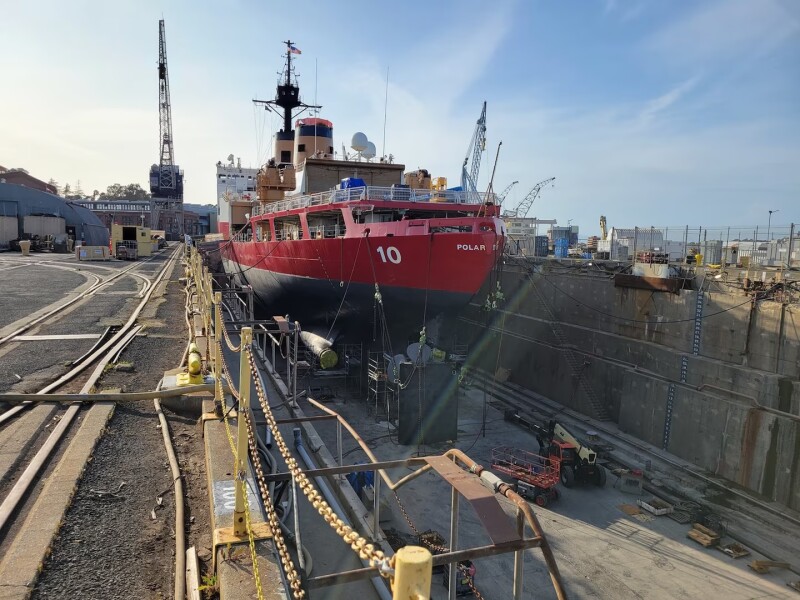
The fifth phase of Polar Star’s SLEP is taking 175 days and $12.7 million investment. The work at Mare Island received support from both Coast Guard Base Seattle and Base Charleston’s Naval Engineering Departments to perform a center section overhaul on one of Polar Star’s nine main diesel engines. In parallel with this work, members from the Coast Guard Yard in Baltimore completed vital work on the ship’s sanitary systems.
Additional major work completed includes removing the centerline shaft for servicing and inspection, exchanging all three propellers, and renewing both forward and aft main deck surfaces.
“This is a tremendous ship, and it is in better shape today than it was ten years ago,” said Rasnake. “That’s a testament to the unrelenting efforts of the crew, the enduring support of our mission partners, and the renewed enthusiasm and investment in our nation’s polar icebreaking capabilities.”
Commissioned in 1976, Polar Star is 13,500 tons with a 34-foot draft. Despite reaching nearly 50 years of age, Polar Star remains the world’s most powerful non-nuclear icebreaker, producing up to 75,000 shaft horsepower.
