



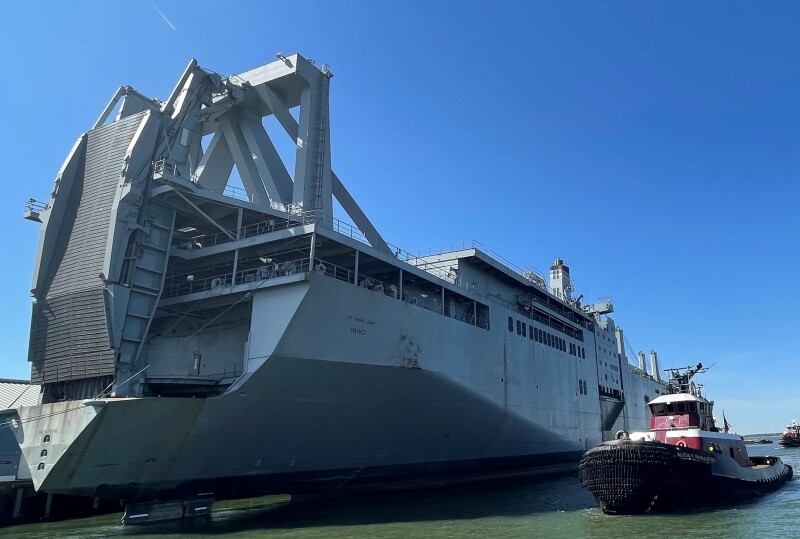
The U.S. Maritime Administration has signed 20 contracts totaling $6.2 million to manage its Ready Reserve Force that provides strategic sealift support for the rapid deployment of U.S. military forces and equipment during conflicts, crises, and emergencies.
“Our contracts with seven ship managers will ensure the fleet stays ready, reliable, and responsive,” said Sang Yi, Marad’s acting administrator, in an announcement July 30 with U.S. Transportation Secretary Sean P. Duffy. “Marad has a tremendous responsibility to maintain the RRF so that during critical military, humanitarian, and natural disaster operations, Americans can rely on these vessels for logistics support.”
“When our military is called to respond, the RRF delivers the tanks, the trucks, and the supplies,” said Duffy. “These ships don’t just support the mission – they are the linchpin that makes the mission possible. National security depends on strategic sealift, and strategic sealift depends on the RRF.”
The contracts cover 51 RRF vessels, including roll-on/roll-off (Ro/Ro) vessels, auxiliary crane ships, and aviation maintenance vessels.
Since its creation in 1976, the RRF has supported hundreds of U.S. missions, including annual military exercises and operations, as well as response efforts for emergency declarations. The Ready Reserve provides nearly 100% of government-owned surge sealift, according to Marad.
The new contracts run for 10 years and cover maintenance, repair, logistics support, activation, operation, deactivation, crewing, and management of the 51 vessels, to ensure they are ready to deploy as soon as needed.
Marad-owned and contractor-operated vessels can be activated within five days for worldwide deployments. Ships in priority readiness are staffed in Reduced Operating Status (ROS), with maintenance crews of about 10 merchant mariners. Once activated, these crews are supplemented by additional mariners as needed.
RRF ships are moored at various U.S. "outports"—a combination of government and commercial facilities strategically selected by military planners to minimize sailing time to key locations. The RRF readiness is periodically tested through Department of Defense-directed activations for military cargo operations and exercises.
Some RRF ships are anchored with the reserve fleet homeport in Beaumont, Texas, but most are anchored at various U.S. "outports" around the country, a combination of government and commercial facilities selected by military planners to minimize sailing time to strategic locations. Outported RRF ships are also used by the Army and Navy for cargo-handling exercises, and by various law enforcement agencies for homeland security training.
RRF ships are expected to be fully operational within their assigned 5 and 10-day readiness status and then sail to designated loading berths.
Ships in priority readiness have Reduced Operating Status (ROS) maintenance crews of about 10 commercial merchant mariners that are then supplemented by additional mariners as needed once activated.
