


Fireboats are a critical part of port and waterfront emergency response, providing firefighting capability where land-based equipment can’t reach. From vessel and waterfront facility fires to bridge and shoreline incidents, fireboats serve as both primary responders and mutual-aid platforms for municipal fire departments, port authorities, and industrial operators.
Recent incidents, like a barge fire on Delaware Bay and a towboat fire near Pittsburgh, continue to highlight the need for dedicated marine firefighting assets capable of delivering large volumes of water while maintaining maneuverability in confined waterways.
Modern fireboats are increasingly being designed as multimission platforms. In addition to firefighting, many are equipped for search and rescue, emergency medical services (EMS), towing, dive operations, and law enforcement support. Builders report steady demand driven by aging municipal fleets, expanding port infrastructure, and increasing safety requirements at energy terminals and cruise facilities. The following builds highlight recent fireboat activity and market trends from several U.S. builders.
METAL SHARK
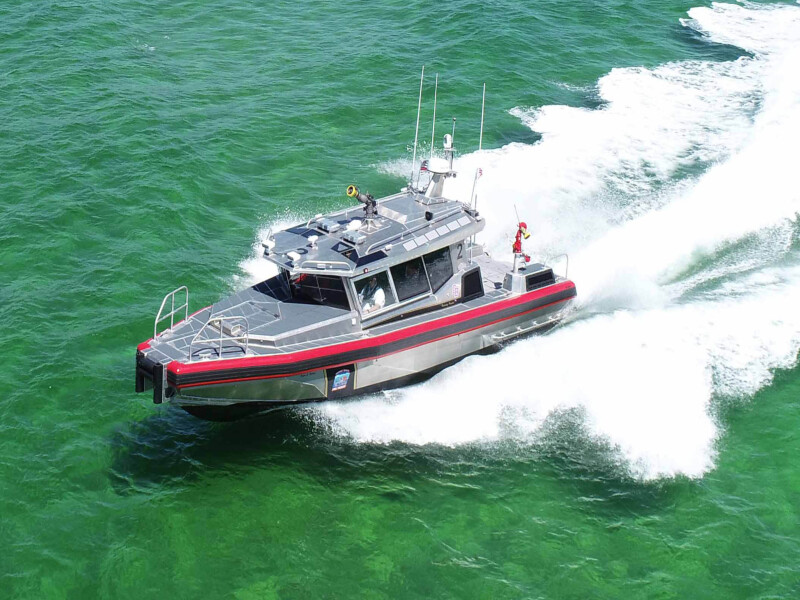
Metal Shark, Jeanerette, La., has built a substantial position in the fireboat market over the past decade, producing its Defiant hull series in sizes ranging from 21' to 100'. The builder’s fireboat business began gaining traction around 2012 and has been a consistent part of its portfolio since a more focused push into the market in 2015.
Dean Jones, vice president of sales, said the company typically has a couple dozen fireboats on order at any given time, spanning various stages of production. Of those, roughly 70% are replacement boats for aging fleets, about 20% are for departments upgrading or expanding existing programs, and around 10% are for entirely new programs.
“There’s not a lot of new startups,” Jones said. “A lot of times it’s departments that had a boat in the past, shut the program down for funding reasons, and are now reopening it.”
That pattern of lapsed and relaunched programs speaks to a broader tension in the fireboat market: demand is broadly understood to exceed supply, but municipal budgets often force departments to suspend marine operations until a crisis or an opportunity for grant funding brings programs back online.
At Metal Shark, the design process starts with mission definition, Jones said. The company works with prospective customers to identify primary, secondary, and tertiary missions before settling on hull size, propulsion, or pump configuration. Because many fireboats are deployed more often for rescue and EMS response than for firefighting, the builder is careful not to put oversize fire pumps on smaller hulls.
“Build the boat around what it’s going to do most, then include the other ancillary things that it might do as long as they don’t hinder or get in the way of the things it’s going to do most,” Jones said.
Even neighboring departments can end up with very different vessels depending on their operational areas. Jones noted Miami-Dade County and the City of Miami as an example — two departments operating in close proximity whose fireboats serve different missions, with differences playing out in layout, equipment storage, medical gear, and crew workflow. The goal, he said, is a vessel configured so clearly that crews can focus entirely on the incident rather than on managing the boat.
“If it’s set up the right way and the proper equipment is there, then they don’t have to think about how to do what they’re going to do. They can just do it,” he said.
Metal Shark’s most common platform is its 38' Defiant, available in inboard or outboard configurations. Inboard propulsion supports larger pumps and higher flow rates, while outboards offer speed, lower cost, and simpler maintenance — attributes that attract departments whose primary focus is rescue and EMS rather than large-scale firefighting. Jones noted that the price difference between the two configurations can prove decisive for smaller municipalities working within tight capital budgets.
Jones said funding remains the central constraint on how quickly the national fireboat fleet can modernize. Many departments rely on grants or special programs, and financing options for marine fire apparatus remain limited compared with land-based equipment. “The primary responder for safety on the water is a fireboat,” he said. “There’s a big disparity between how many we need and how many we have.”
MOOSE BOATS
Moose Boats, Vallejo, Calif., has delivered multiple fireboats over the past year and continues work on several specialized response vessels, according to Ken Royal, vice president of sales. The builder has carved out a distinct position in the market through its catamaran hull designs and adoption of fire pumps that are driven by power take-off (PTO) systems, he said.
Among recent deliveries is a fireboat for the Santa Barbara Harbor Patrol, completed in March 2025, followed by an M2-38 fireboat for the Boston Fire Department later in the year. The Boston vessel is powered by twin 425-hp Cummins QSB 6.7-liter engines equipped with two 1,500-gpm fire pumps producing a combined flow of roughly 3,800 gpm, driven through a PTO system connected to the propulsion engines rather than a dedicated pump engine.
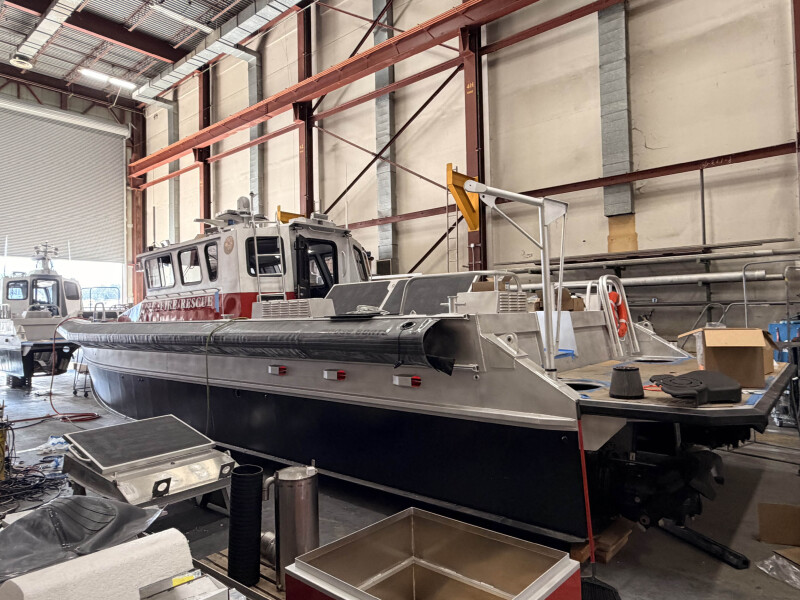
Royal said the PTO-driven approach reduces weight and maintenance by eliminating a separate engine for the fire pump. Under the arrangement, most engine power is directed to the pump while enough remains for propulsion to hold position during firefighting operations.
A 46' catamaran that Moose is constructing for the San Francisco Fire Department is one of the more mission-specific builds in the company’s portfolio. “The primary use of that vessel is specifically to act in the capacity of a rescue vessel in the event of an airliner down,” Royal said. To be stationed at San Francisco International Airport, the vessel will be equipped with a 1,200-gpm fire pump and will also carry approximately 50 ten-person life rafts for mass rescue operations.
SAFE BOATS
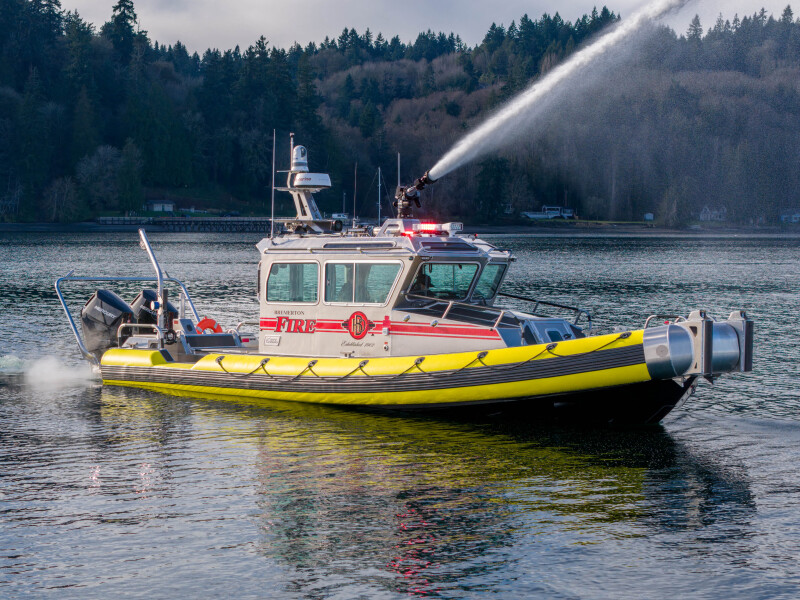
SAFE Boats International, Bremerton, Wash., continues to see steady demand for municipal fireboats and emergency response vessels. A recent delivery to the Bremerton Fire Department illustrates the company’s approach to the customization demands that make fireboats more complex than standard patrol boats.
The 33' full-cabin vessel features a 1,000-gpm fire pump positioned in an aft locker rather than the bow to preserve cabin space, a reinforced engine compartment deck for heavy gear, a dropdown bow for shore access along undeveloped coastline, and a davit for search-and-rescue operations.
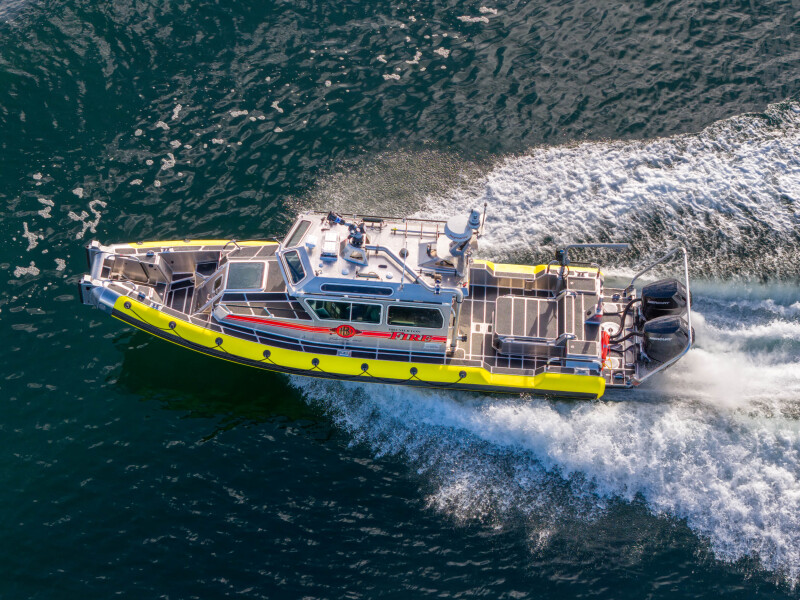
Fireboats require considerably more stakeholder involvement than police boats, which tend to carry similar equipment across agencies, according to Scott Clanton and Cole Christianson, who do business development for SAFE Boats. Fireboat designs are built around specific operational profiles, with equipment combinations ranging from bow, roof, and aft monitors to fire pumps between 500 and 1,500 gpm, a level of customization that demands extensive front-end engineering.
One notable trend is a continued shift toward outboard propulsion, Clanton said. Modern high-horsepower outboards offer maneuverability comparable to the inboard engines and waterjets, while simplifying maintenance, reducing downtime, and freeing up interior space, he said, noting this provides a practical advantage for agencies that cannot afford extended out-of-service periods.
SAFE Boats builds a range of fire pump configurations, including a commonly used 500-gpm Darley pump installed in a transom locker that integrates across multiple platforms without significantly affecting deck layout. The company also builds EMS and search-and-rescue vessels, which are becoming more common as departments shift toward rescue and medical response missions.
Current projects include a 38' fireboat for the Broward County Sheriff’s Office outfitted with multiple fire monitors and an articulating mast that lowers to pass under bridges.
“The fire department guys, they ask for everything and the kitchen sink,” Clanton joked, noting that firefighters are accustomed to having extensive equipment and amenities on a fully outfitted firetruck. “A lot of times you have to start pulling them back away from, it’s got to float first and operate, you know.”
METALCRAFT MARINE
MetalCraft Marine, whose fireboats and patrol boats earned WorkBoat’s Boat of the Year honors in 2020 and 2022, continues to see steady demand across its fireboat product lines, particularly in the municipal and port markets.
MetalCraft Contracts Manager Bob Clark said the company continues to see strong demand for its FireStorm series vessels, noting their “best big boat seller is the FireStorm 4344.”
The boatbuilder is running approximately 18 months out on new fireboat builds, reflecting steady demand from fire departments and port authorities.
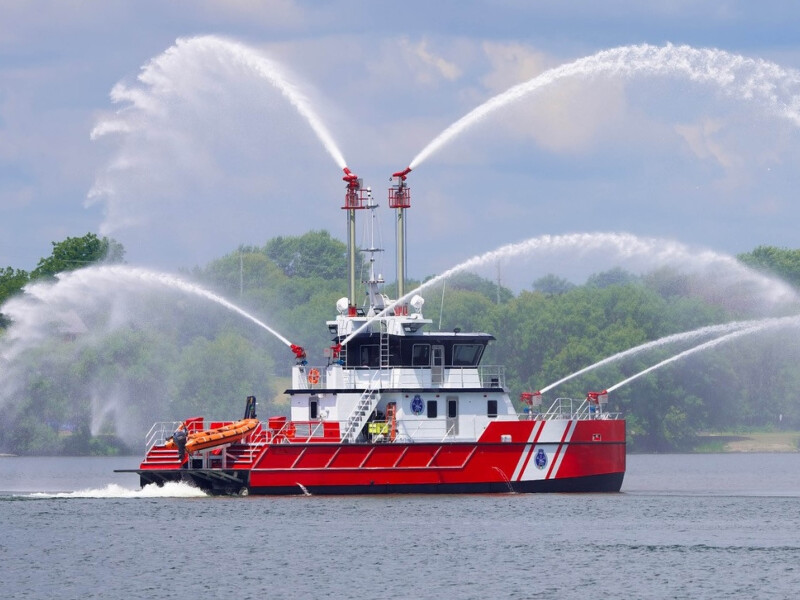
Clark said a recent trend has been the use of landing craft bow designs on fire-rescue boats, though the configuration is appropriate only in certain circumstances. “The landing craft thing is a very unique boat, and it really fits certain shorelines,” he said. “If you’ve got any kind of sea state, that’s not the best thing to go with. But in rivers, beachfronts, and urban waterfronts, it works very well.”
With larger builds, Clark pointed to major ports as the primary drivers of demand for high-capacity fireboats. Jacksonville, Fla., operates a mix that includes Firestorm 50' and 70' vessels alongside landing craft-style fire-rescue boats and smaller conventional fireboats. In Texas, the ports of Corpus Christi and Houston represent the kind of industrial fireboat customers who require vessels capable of delivering enormous volumes of water to support petrochemical facility operations.
Clark cited a refinery fire in the Houston area where multiple large fireboats pumped water continuously for several days through large-diameter hoses to supply land-based crews after the facility’s built-in firefighting systems were destroyed by explosions. “These big boats can move massive amounts of water,” he said. “You’re talking about 15,000 gallons per minute. That’s hard to conceive.”
MetalCraft’s most popular fireboat size remains its 43' to 44' platform. San Diego, for example, is replacing older 36' fireboats with new 44' vessels that offer greater firefighting capacity and expanded mission capability.
Speed is another factor reshaping procurement decisions. Historically, some ports operated large displacement fireboats capable of high pumping volumes but limited to speeds of around 10 to 12 knots. Clark said response time has become a major variable in purchasing decisions, and some departments that opted for slower vessels in the past are now reconsidering after observing how delayed response affects outcomes. “The thing about time and a fire is if you take too long and it gets fully engulfed, then you can’t put it out,” he said.
Across builders, the picture that emerges is a market driven by aging fleets, port infrastructure expansion, and rising operational expectations but constrained by the realities of municipal finance and procurement timelines. The vessels being built today are more capable, more versatile, and often faster than what they are replacing.
