



Michael Eaglen believes that real progress comes from taking on the hardest problems.
The founder and CEO of naval architecture firm and marine systems integrator EV Maritime, Auckland, New Zealand, aims to help harbor cities decarbonize through zero-emissions ferry operations. “The transition is not just electrification for the sake of slapping a green sticker on the side and virtue signaling,” he said. “It’s genuine from a pollution-control and emissions perspective, but it also stacks up economically.”

EV Maritime began as an R&D effort inside McMullen & Wing, the New Zealand shipyard Eaglen once ran. As the work expanded, it became clear the company needed to operate as its own entity, said Eaglen, who stepped away from the yard in 2019 to run EV Maritime full time. Eaglen initially owned EV Maritime jointly with the shipyard owners but took 100% ownership in 2025. Today, the company employs 11 people, including two engineering interns.
ELECTRIFYING SPEED
Traditional ferries, which typically operate on short, repeated, and predictable routes, can often be strong candidates for electrification. Fast ferries, however, are not always such an obvious choice. Weight is the enemy of speed, and batteries are heavy. High speeds require more power, and more power demands more batteries. It is easy to end up in a design spiral that never converges, Eaglen said.
Through its dual role as naval architect and systems integrator, EV Maritime can engineer hull design and energy systems together, avoiding the compounding small changes that degrade performance. “We’re choosing a hard problem to solve because it’s an area in which we can bring special skills,” he said.
EV Maritime draws on New Zealand’s marine heritage, particularly in high-performance racing yachts and superyacht innovation — areas in which Eaglen, a naval architect, has many years’ experience. Those industries demand ruthless efficiency, deep understanding of hydrodynamics, and above all, reliability, he said. “Being able to deliver innovation straight out of the box, first try, that works reliably for a long time, is something that the New Zealand industry has a strong reputation for,” Eaglen said, referencing a famous quote from the late round-the-world yachtsman Sir Peter Blake: “To finish first, first you must finish.”
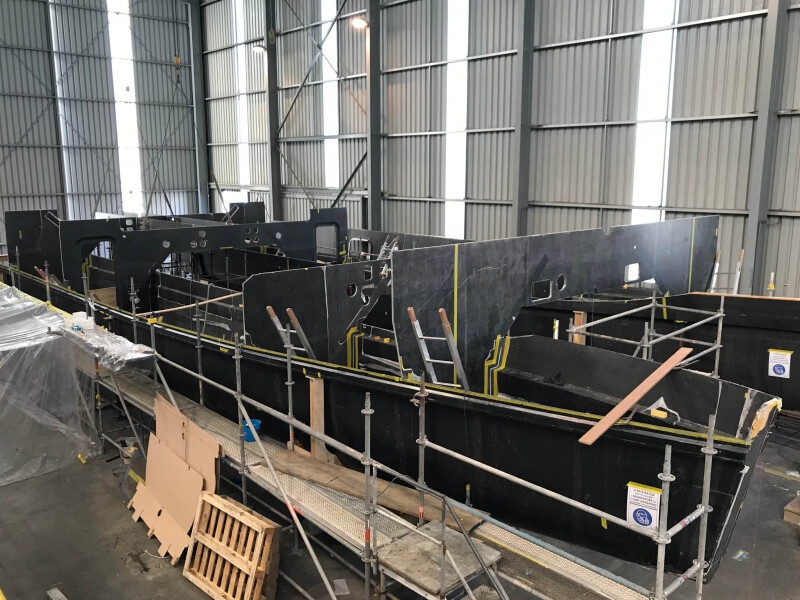
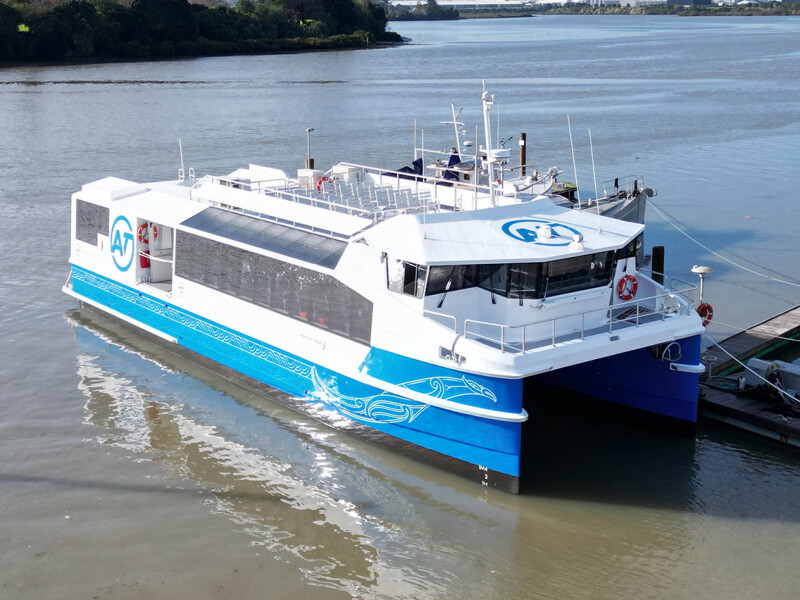
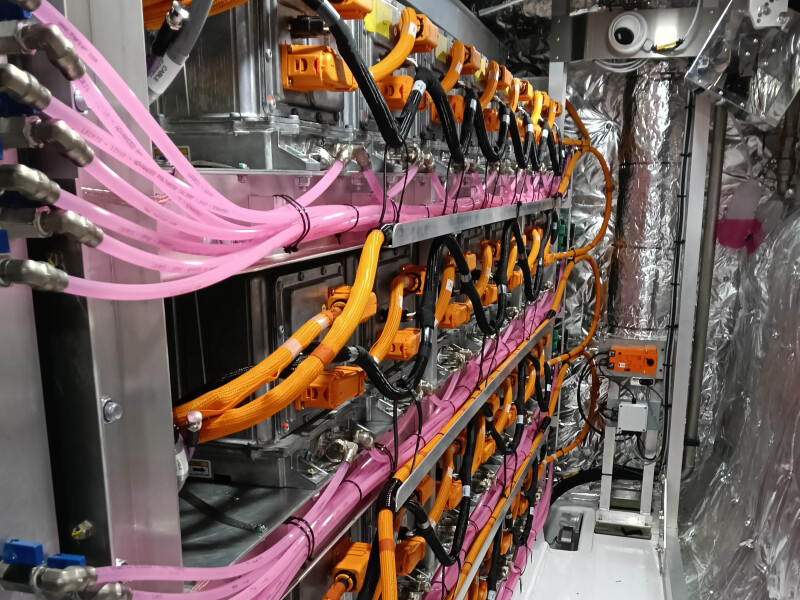
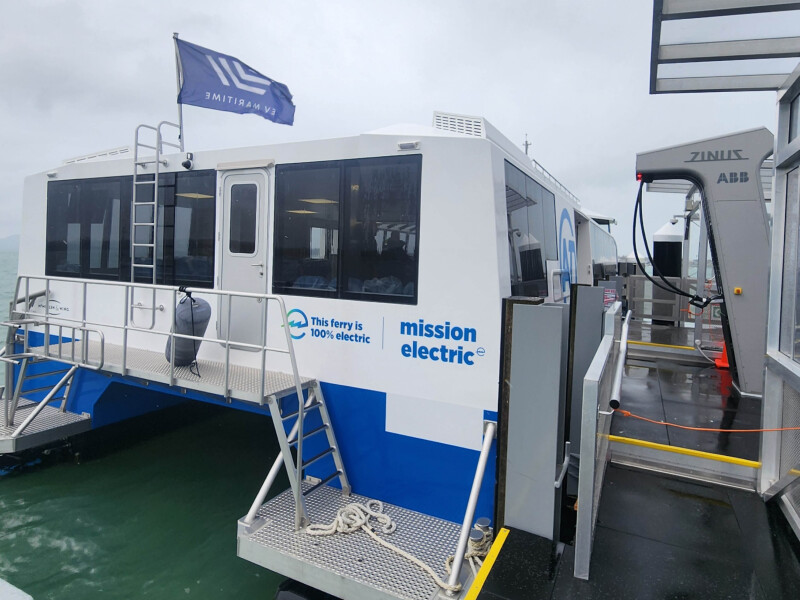
EV Maritime pitched its idea for cleaner-running vessels to Auckland Transport, which ultimately signed off on the construction of two EVM200-series battery-electric fast ferries built in lightweight carbon fiber. The first, AT1, was launched from McMullen & Wing in June 2025. The 78'9", 200-passenger vessel will operate the 10-mile route between downtown Auckland and Half Moon Bay, offering a top speed over 30 knots, service speeds up to 25 knots, and a range up to 20 miles. It features a 1,075-kWh Freudenberg liquid-cooled, lithium-ion battery pack that drives four Danfoss Editron 300-kW electric motors connected to four HamiltonJet LTX36 waterjets.
SUCCESS IN THE US
When Eaglen first began engaging with the United States’ fast-ferry market, he found that many American vessels were already being designed in New Zealand or Australia. While the accent may be unfamiliar, the expertise is not, said Eaglen, noting that the reputation helped EV Maritime gain traction in the U.S. market.
New Zealand marine companies, Eaglen explained, are known for “not taking anything for granted or doing things simply because they’ve always been done, but instead rigorously interrogating the process and questioning every decision. [This approach] is essential to making high-performance electric boats work, especially given the weight challenge.”
In the San Francisco Bay Area, EV Maritime is involved in another landmark electrification project, for Angel Island-Tiburon Ferry Co. The firm is designing a plug-in hybrid vessel to replace the 62', 102-passenger luxury charter vessel Tamalpais. Built from carbon-fiber and fiberglass composites, the 63' catamaran newbuild — currently in detailed design and scheduled for delivery in late 2027 — will operate primarily on grid power, with an onboard generator for longer trips or rougher conditions. The new vessel is part of a wider fleet electrification for the small, privately-held Tiburon operator. Largely funded by the California Air Resources Board, the demonstration project also includes retrofit electrification of two existing vessels: the 59', 400-passener ferry Angel Island and the 53', 98-passenger water taxi Bonita, as well as establishing shore charging infrastructure.
Eaglen said EV Maritime is also involved in a pair of design projects for another U.S. customer, including a 48-passenger electric fast ferry and an electric water taxi. In addition, EV Maritime performs consultancy work for public transit agencies and ferry operators.
DELIVERING DATA
Eaglen said he views ferries as civic infrastructure. Water-based public transport can relieve congestion, offer direct routes, and improve the quality of urban life, he said, yet ferries are also costly and operationally fragile.
“A ferry fleet of twenty boats is considered large,” he said. “A bus fleet of twenty would barely exist.” When one ferry breaks down, the impact is immediate. Operators compensate by holding spare vessels, which drives up costs.
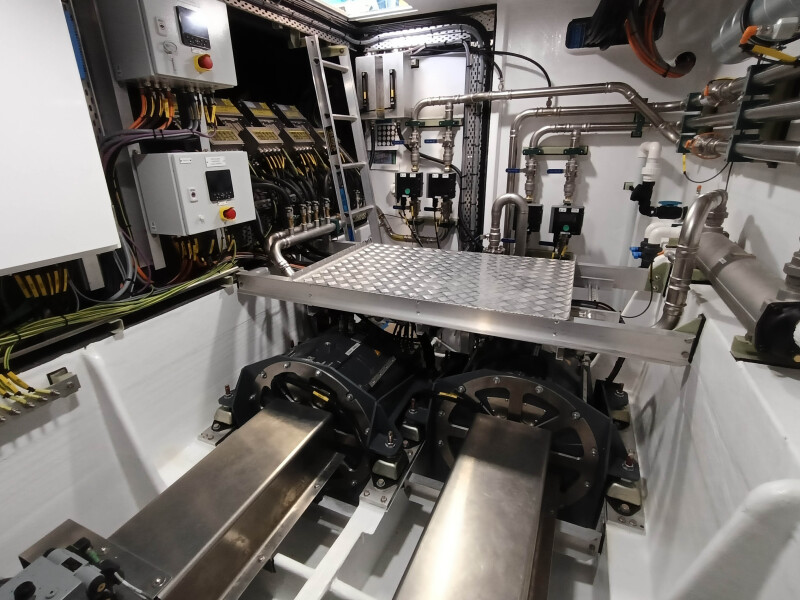
Electric drivetrains, which have far fewer moving parts than diesel engines, change the equation by reducing routine maintenance, said Eaglen, who was careful not to oversimplify. “Even if the electric motor was flawless,” he said, “it’s still a boat. Pumps, steering systems, seawater circuits, all the traditional failure points remain.”
Rather than focusing narrowly on propulsion, EV Maritime looks holistically at reliability through smarter system design and better monitoring so that problems can be addressed before they disrupt service.
Data became an unexpected contribution to EV Maritime’s business. Electric ferries generate enormous amounts of information — thousands of sensors tracking energy use, temperatures, pressures, and flows. The company has built systems to stream that data ashore, analyze it, and turn it into practical insight.
The opportunities extend beyond electric vessels. Diesel operators often struggle to explain why fuel consumption varies dramatically between similar days. Weather, tides, loading, hull condition, and driving style all play a role. Without data, it becomes guesswork.
EV Maritime’s tools help strip away external variables and reveal what crews and operators can actually control, Eaglen said. “If you can’t measure it, you can’t manage it,” he explained. “Fuel is one of the few operating costs operators can meaningfully influence, yet it remains poorly understood.”
STANDARDIZATION
Underlying EV Maritime’s thinking is a belief that electrification will not scale without standardization. Ferries are traditionally custom-built, and many operators tend to prefer starting from a blank page. But Eaglen said that this approach keeps costs high and progress slow.
“The key is recognizing what truly needs to be customized and what does not,” he said, noting that boarding arrangements and layouts can vary widely, but can be easily customized. “The complexity lives below decks. Standardize that, and fleets become cheaper, more reliable, and easier to support.”
Ferry routes around the world, he noted, are more similar than they appear. Harbors are finite. Commutes are bounded. Speeds and distances converge. The technical solutions can converge, too.
