



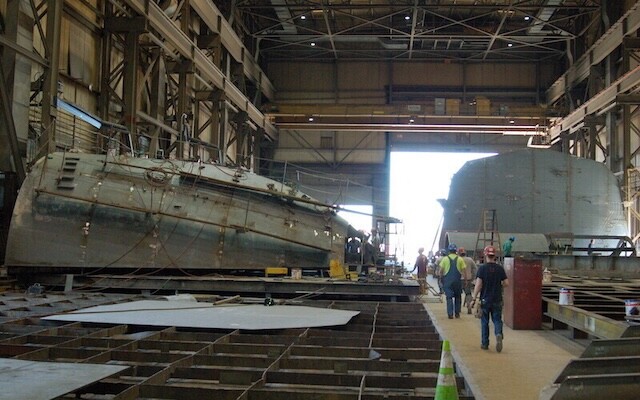
Support is building in Congress to tackle a long overdue revitalization of the nation’s declining shipbuilding industry, as lawmakers begin to take a closer look at what is needed to fashion a successful overhaul.
Despite a government shutdown, the Senate Commerce Committee began hearings on Oct. 28 examining best ways to modernize and expand commercial and naval shipbuilding while also bolstering other aspects of a maritime industry that has been in a steady free fall since World War II.
At the center of the discussion was a far-reaching proposal, The SHIPS for America Act, proposed by Sen. Mark Kelly, D-Ariz., a graduate of the U.S. Merchant Marine Academy, and Republican Sen. Todd Young, a Republican from Indiana, a Naval Academy graduate.
The bill would create a national maritime strategy by boosting shipbuilding through new tax credits, expanding the U.S.-flagged fleet by 250 over the next 10 years, creating more maritime jobs while investing in workforce training at the federal and state maritime schools, streamlining the mariner credentialing system, creating a maritime security trust fund to support shipbuilding programs, and centralizing federal decisions through a new Maritime Security Advisor within the White House.
The hearing also addressed the Trump Administration’s pending Maritime Action Plan, promised in an Executive Order signed in April, which is expected to be unveiled in early November.
“Today’s hearing made clear that there is growing, bipartisan momentum to rebuild American shipbuilding, which will be good for our economy and national security. This hearing is an important step in getting the (bill) passed to revitalize our maritime and shipbuilding industries,” Sens. Kelly and Young said in a joint statement. “We’ll keep working in Congress and with maritime leaders to pass our bill.”
Other steps forward have already been taken by Congress, such as making historic investments in building ships for the Navy and Coast Guard, including Arctic ice breakers, as part of the recent budget reconciliation bill, known as the One Big Beautiful Bill. The Trump administration has also imposed new port fees on Chinese-built and flagged vessels with receipts going toward reinvestment in U.S. shipbuilding. And Congress has directed use of an innovative Vessel Construction Manager strategy for of the next generation of training vessels used by the federal and state maritime academies. This allows a private entity other than the bureaucratic-heavy Maritime Administration to oversee vessel construction, which has made projects more efficient, with fewer delays and at lower costs.
But little more can happen at the moment, noted Sen. Dan Sullivan, R-Alaska, who chaired the subcommittee on Coast Guard, Maritime and Fisheries subcommittee hearing, because of the government shutdown. “Let’s reopen the government and get these workers who build our ships in public yards paid as well,” he said.
Subcommittee members generally had the same question for its witnesses — Matthew Paxton, president, Shipbuilders Council of America, Jeff Vogel, a vice president at TOTE Services, a vessel construction management company based in Jacksonville, Fla., Salvatore Mercogliano, a former mariner and current professor at Campbell University who studies the industry, and Tuuli Snow, Talent Acquisition manager at Snow and Company, a small family-run shipyard in Seattle: “What went wrong with American maritime?”
The common response was that after the Cold War, the United States moved away from commercial shipbuilding to concentrate on building ships primarily for the Navy, letting global free trade take over the commercial market. This created an opening for Asian shipbuilders, especially in China, Japan and Korea to build up their shipbuilding powers.
By far the biggest impediment for American shipbuilding is the focused effort over the past 25 years of China to dominate world shipping by distorting international shipbuilding markets. This has been achieved through state planning, direct investment and subsidies, and tax and trade policies. As a result, Chinese shipyards now account for nearly half of all global production, while the United States builds less than 1% of the world’s commercial ships.
China’s growth has been steady and deliberate, witnesses said.
“China’s dominance has been fascinating to watch. They have gone from small shipyards to consolidating into much larger entities. They have built up huge conglomerates,” said Professor Mercogliano, who also hosts a maritime-focused YouTube channel. “They have done vertical integration of shipbuilding unlike any other country has done.” He added that the Chinese provided $132 billion in shipbuilding subsidies between 2010-2018, while the U.S. Title XI ship building program provided $77 million.
This imbalance between Chinese and American investment puts American yards at a competitive disadvantage while also presenting serious economic and national security risks for the United States. As Paxton of the Shipbuilders Council put it: “Maritime dependency makes us a client state.”
Vogel of TOTE said there is already a good foundation for rebuilding, as the United States has 154 private shipyards located in 29 states and the U.S. Virgin Islands, and more than 300 yards engaged in repairs and capable of building ships but are not currently active in shipbuilding. “From this base, a strong shipbuilding industrial base can be reborn,” if a steady demand for U.S-made commercial and government vessels can be established.
Paxton underscored the importance of preserving the Jones Act, which requires that cargo moved between U.S. ports be done on U.S. ships operated by American mariners. “Weakening or waiving the Jones Act would erode this foundation, undercut investment and financing for U.S.-built fleets and directly harm the industrial base the nation depends on for naval readiness. Congress should continue to uphold and enforce the Jones Act without exception.”
It was also discussed that fishing vessels be included in the federal Title XI vessel financing program, that smarter procurement and regulatory processes are needed, that continuation of federal grants for small shipyards is essential, and that federal higher education Pell grants and 529 college investment programs can be used for vocational and technical education such as maritime training.
