



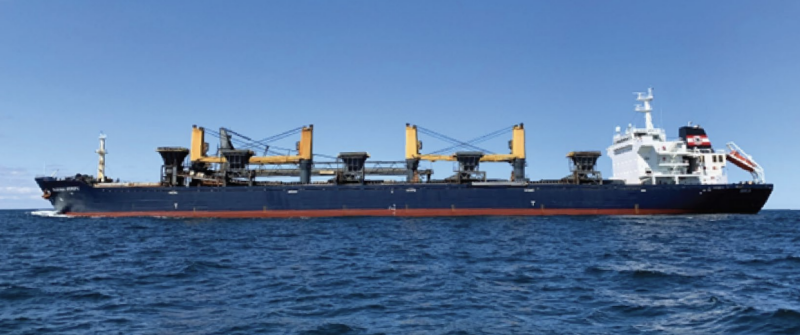
The Jan. 8, 2025 grounding of a bulk carrier in the Delaware River near Philadelphia happened when a pilot maneuvered the ship outside the channel into shallow water, the National Transportation Safety Board reported.
The incident was likely a result of “expectation bias” that the river current and ship’s handling characteristics would have had more effect on its movement, NTSB investigators wrote in their summary of the 623’ Algoma Verity’s stranding off Northeast Philadelphia and Petty Island.
The Algoma Verity was transiting upbound on the river when it first ran aground outside the channel less than a half mile north of the Ben Franklin Bridge. The vessel repositioned and continued its upbound transit, outside the channel, until around 6:28 p.m. when it grounded again, coming to a complete stop.
The Algoma Verity was refloated 3 days later, with no pollution or injuries were reported. Damage to the vessel was estimated at $6.6 million.
The Algoma Verity was owned and operated by Algoma Shipping Ltd., a subsidiary of the Algoma Central Corporation, based in St. Catharines, Ontario, Canada. The vessel had a single rudder and a single right-hand-turning propeller directly driven by a slow speed diesel main engine rated at 8,580 hp.
The ship was laden with a cargo of salt that originated at Great Inagua, The Bahamas. The vessel’s forward and aft drafts were 38.5’ at the Marcus Hook anchorage, located about 12 miles downriver from Philadelphia, where the vessel had anchored to await tidal conditions for a slack/high-tide arrival at a terminal located about 22 miles upriver of Philadelphia.
At 4:06 p.m, the Algoma Verity weighed anchor and got underway en route to the terminal with a the first of two pilots from the Pilots of the Bay and River Delaware at the conn. During the consultation between the master and the local pilot before getting underway, the master had reported no deficiencies with the engine or rudder.
The first pilot (referred to as “pilot 1” in the NTSB’s recounting of the incident) told investigators that the vessel was “handling like a deep [draft] ship.” He stated that, whenever he turned the ship, he had to use significant rudder orders – up to 20° or more at slower speeds – to get the ship turning, then use up to 20° opposite rudder to check, or stop, the swing.
“Around 5:42 p.m another DelPilots pilot (“pilot 2”) boarded the vessel in the vicinity of Eagle Point, New Jersey, to relieve pilot 1,” according to the report. “During the pilot turnover, pilot 1 told pilot 2, ‘[the Algoma Verity is] steering straight … I think you’ll have no problem getting up there [to the terminal].’ However, pilot 1 added that the vessel needed a lot of rudder to steer it.”
“As pilot 2 took the vessel through the first few turns after he had taken the conn, he found the Algoma Verity difficult to handle. He said that the vessel ‘wanted to dive to port,’ and he had to use hard (35°) starboard rudder several times to check the swing.”
Approaching the Walt Whitman Bridge, the vessel maneuvered just outside the starboard side of the channel. “The master stated that he noted the ship’s position, but because the water outside the channel was sufficiently deep, he did not say anything to the pilot.”
After passing the Walt Whitman Bridge the bulker met up with the tug Annabelle Dorothy Moran for escort as required for transiting to the upper reaches of the Delaware River.
NTSB investigators recounted in detail the difficulties the pilot had keeping the Algoma Verity in the channel, including the passage north of the Ben Franklin Bridge with docks and wharves extending into the river, some as close as 150’ to the channel.
During 18 minutes the Algoma Verity transited from the Benjamin Franklin Bridge to a first grounding and on to the second, final grounding location, while “the ship’s heading never appreciably moved to port, with the exception of when the tugboat was pushing on the bow,” according to the NTSB report.
“Pilot 2 expected the Algoma Verity would be pushed to port by the current, and he also expected the vessel to dive to port. Likely as a result of his expectation of these factors, pilot 2 overcompensated and maneuvered the vessel further outside the channel to starboard.”
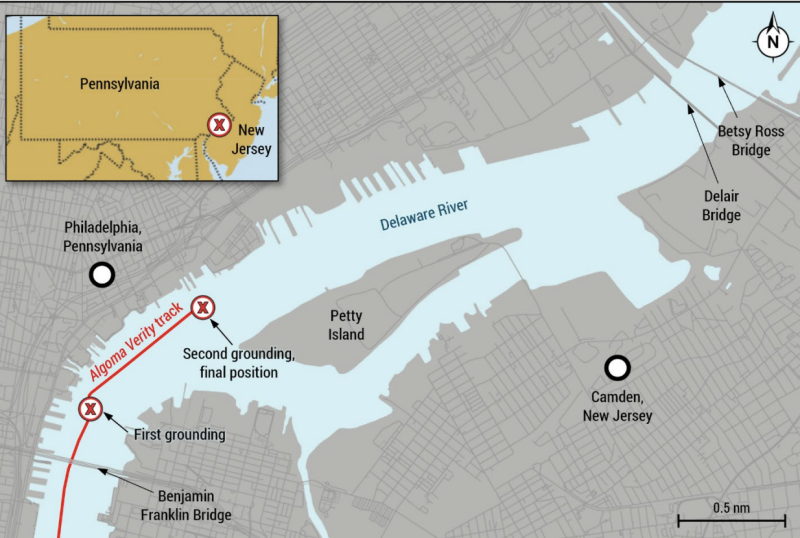
AIS (Automatic Information System) data showed the ship continued to transit further outside channel to starboard as it navigated the bend north of the bridge.
Bottom shell plating along the Algoma Verity’s starboard-side hull was inset and ruptured during the groundings, allowing water intrusion into four out of the five previously empty starboard ballast tanks and a previously empty fuel tank. Structural members along the affected hull area were also damaged. The cost of repairs was estimated at $6.6 million.
The NTSB determined that the probable cause of the grounding and subsequent re-grounding of the dry bulk carrier Algoma Verity “was the pilot maneuvering the vessel outside the channel into shallow water, likely due to expectation bias that the current and the vessel’s maneuvering characteristics would have more impact on the bulker’s movement.”
The NTSB’s investigation page has a detailed recounting of the incident and investigator’s analysis.
