



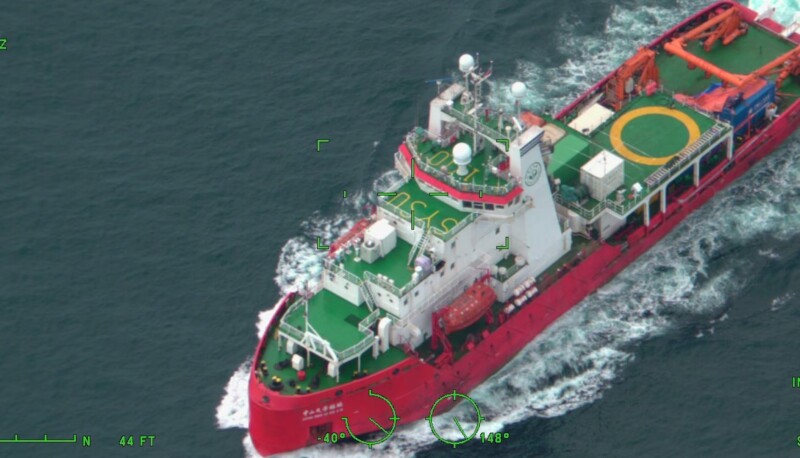
Coast Guard patrols again tracked Chinese research vessels in and near U.S. Arctic waters this week, continuing a three-year pattern of China increasing its operations in the high north.
A C-130J Hercules aircraft from Air Station Kodiak responded Aug. 5 to the Chinese vessels Ji Di and the Zhong Shan Da Xue Ji Di as they transited northeast in the Bering Sea, according to a Coast Guard statement Friday. One day later the crew of the Coast Guard cutter Waesche tracked with the Zhong Shan Da Xue Ji Di as it made its way north in the Chukchi Sea above the Arctic Circle, after passing through the Bering Strait.
The 259’x56.5’ Zhong Shan Da Xue Ji Di (translated as “the polar icebreaker of Sun Yat-Sen University”), a former OSV, was upgraded in 2022-2023 for ice operations and research, becoming China’s third polar icebreaker.
In July a Hercules aircrew from Air Station Kodiak surveilled the Chinese research vessel Xue Long 2 about 290 miles north of Utqiagvik, Alaska. Canadian authorities have likewise tracked Chinese ships in the region.
“The presence of these vessels is consistent with a three-year trend of increased activity from Chinese research vessels operating in the U.S. Arctic,” the Coast Guard noted. “Last year, three Chinese research vessels conducted research operations north of the Bering Strait.”
With climate shifting and increasing shipping activity in the high latitudes, U.S. policy makers have already shifted into high gear to make up for the nation’s long-neglected polar fleet. On Sunday, the Coast Guard will commission one stopgap measure: the Coast Guard cutter Storis, the newest icebreaker in the fleet, at a ceremony in Juneau.
A former anchor handling supply tug named Aiviq, the 360’8”x80’x34’ Storis was acquired from Edison Chouest Offshore, to become the first new polar icebreaker for the Coast Guard in more than 25 years.
Coast Guard plans call for a future fleet of eight to nine polar icebreakers to meet national objectives in the polar regions. The Storis is intended to help bridge a gap until the first new Polar Security Cutter is delivered in 2030.
